



Real-time marketing updates are defined as instant, data-triggered messages delivered to audiences based on live events, behavioral signals, or trending cultural moments. The role of real-time marketing updates has become central to campaign performance: brands using these strategies see 3–5x higher engagement and up to 40% improved conversion rates compared to static approaches. That gap is not marginal. It reflects a fundamental shift in how consumers respond to content that feels relevant right now versus content that was planned weeks ago. With average attention spans under 8 seconds on scrolling feeds, the window to capture interest is brutally short. Marketing teams that build real-time capabilities are not just moving faster. They are competing on a different playing field entirely.
How do real-time marketing updates integrate with data and analytics?
Real-time marketing runs on live data. Without it, you are guessing at relevance instead of responding to it. Real-time analytics engines increase personalization relevance by 28%, which means messages land with more precision when they are built from behavioral signals rather than static audience segments.
The practical mechanism is behavioral triggering. A customer abandons a cart, views a product page three times, or engages with a competitor’s post. Each action fires a signal that an integrated CRM and analytics stack can act on within seconds. Unified streaming data infrastructure eliminates the batch delays that make most marketing feel a step behind. Without that architecture, your personalization is always working from yesterday’s data.

Privacy regulations complicate this picture. GDPR and CCPA reduce accessible data pools by up to 34%, which directly limits how granular your real-time targeting can be. The practical response is a two-part approach: federated learning models that process data without centralizing it, and consent management platforms that capture first-party permissions at every touchpoint. Teams that treat consent as a data asset rather than a compliance checkbox end up with richer, more durable audience profiles.
Real-time analytics for campaigns also support mid-flight optimization. You can see which message variant is pulling engagement and shift budget toward it while the campaign is still live. That is a capability that post-hoc reporting simply cannot replicate.
- Behavioral triggers: Cart abandonment, repeat page views, and social engagement each signal purchase intent and warrant immediate follow-up.
- First-party data: Consent-based email and CRM data remain the most reliable inputs for real-time personalization under current privacy law.
- Federated learning: Processes user data locally on devices, preserving privacy while still training personalization models.
- Live dashboards: Replace weekly reports with minute-by-minute visibility into audience response rates and content performance.
Pro Tip: Build your consent capture into every campaign touchpoint, not just your website footer. First-party data collected with clear intent outperforms third-party data in both accuracy and legal durability.
What workflows enable effective real-time marketing updates?
Speed without structure creates brand risk. The operational reality of real-time marketing is that your team needs to move fast, but not recklessly. Effective reactive marketing requires action within 15–60 minutes before a moment’s cultural relevance fades. That window is tight enough to expose every bottleneck in your approval process.
The teams that execute well have solved this problem before the moment arrives. Here is the operational framework that works:
- Build a pre-approved asset library. Create a bank of templates, tones, and visual formats that legal and brand have already cleared. When a moment hits, your team adapts an approved template rather than starting from scratch.
- Implement single-approval workflows. Pre-approved creative assets and single-approval systems let teams post rapidly without multi-level sign-offs that kill timing. Designate one decision-maker per channel for real-time content.
- Station cross-functional teams during major events. Award shows, sports finals, and product launches are predictable. Have your creative, social, legal, and analytics leads in the same room or shared channel during these windows.
- Define guardrails in advance. Specify which topics, tones, and cultural moments are off-limits. A written “do not engage” list prevents impulsive posts that create backlash.
- Separate reactive from planned real-time content. Planned real-time content, prepared ahead of predictable events, consistently outperforms purely spontaneous improvisation in brand consistency and engagement.
The distinction between reactive and planned real-time marketing matters more than most teams realize:
| Type | Trigger | Preparation | Risk level |
|---|---|---|---|
| Planned real-time | Predictable events (Super Bowl, product launch) | Pre-built assets, approved messaging | Low |
| Reactive real-time | Unexpected trending moments | Rapid adaptation of approved templates | Medium |
| Spontaneous improvisation | Unplanned cultural moments | No prior preparation | High |
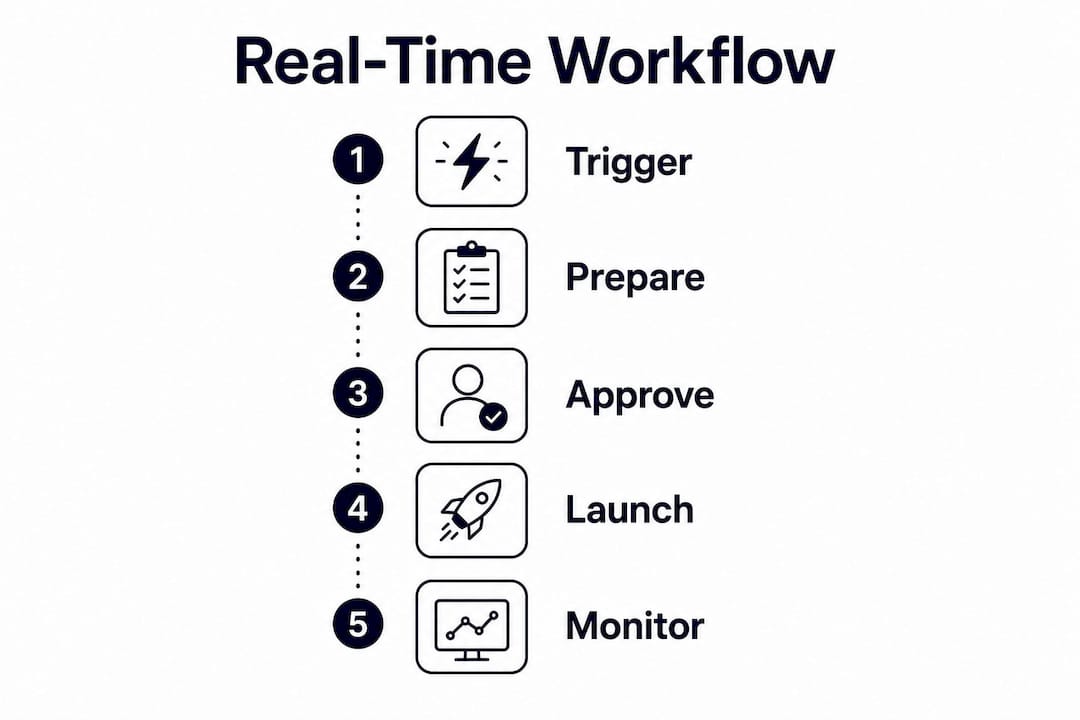
Pro Tip: Treat your real-time content calendar like a fire drill schedule. Run quarterly simulations where your team practices responding to a mock trending event within 30 minutes. The first drill will expose every bottleneck.
What are the measurable benefits of real-time marketing updates?
The performance data for real-time marketing is not ambiguous. Timing strategies deliver up to 209% more consumer attention compared to standard scheduled content. That figure reflects the compounding effect of relevance: content that connects to what an audience is already thinking about commands disproportionate attention.
Conversion improvement follows a similar pattern. Brands using real-time strategies see up to 40% better conversion rates. The mechanism is straightforward. A message that arrives when a consumer is already engaged with a related topic requires far less persuasion than one that interrupts an unrelated moment.
“Real-time marketing campaigns that integrate rapid analytics and AI tools enable continuous optimization by identifying campaign dips and spikes during execution rather than post-hoc. The shift from backward-looking reports to live dashboards enhances marketing agility and budget efficiency.”
Live dashboards allow marketers to intervene during execution, not after the fact. If a message variant is underperforming at hour two of a six-hour campaign, you can pull it and redirect spend. That is budget efficiency that static campaign management cannot achieve.
Brands responding to trending moments also generate higher earned media value. When a real-time post resonates, it gets shared, quoted, and covered. The organic amplification extends reach well beyond the paid distribution. Conversion attribution in these cases is complex because timing overlaps with other campaign activity, but brand lift and earned impressions are measurable through social listening tools and share-of-voice tracking.
Understanding marketing analytics metrics is the foundation for capturing these gains. Teams that cannot measure real-time performance cannot improve it.
How can marketers balance speed with brand fit and risk control?
Speed is not the only variable in real-time marketing. Brand fit is equally important, and teams that ignore it pay for it in public backlash. Brands must evaluate whether they can add unique value before entering a trending conversation. If your brand has no genuine connection to the moment, forcing engagement reads as opportunistic and often generates negative sentiment.
Planned real-time content yields higher consistent engagement than purely reactive improvisation. The brands that execute real-time marketing well are not the ones with the fastest fingers. They are the ones with the clearest understanding of where their brand voice belongs and where it does not.
A practical decision framework for real-time engagement:
- Relevance check: Does this moment connect to your product, audience, or brand values? If the answer requires a stretch, skip it.
- Tone check: Does your planned response match the emotional register of the moment? Humor during a tragedy is the most common and most damaging error.
- Uniqueness check: Can you say something that adds value, or are you repeating what every other brand is already saying?
- Sensitivity screen: Run the draft through an AI content filter before posting. Automated sensitivity checks catch blind spots that tired humans miss at 11 PM during a live event.
Brand safety in real-time marketing depends on risk control frameworks built before the pressure hits. The worst real-time marketing decisions happen when teams feel the urgency of a trending moment and skip the checks they would normally run. The role of AI in marketing includes exactly this kind of automated guardrail, flagging content that conflicts with brand guidelines or touches sensitive topics before it goes live.
Pro Tip: Create a one-page “engage or pass” decision card for your social team. It should take under two minutes to complete and give a clear go or no-go signal for any trending moment.
Key Takeaways
Real-time marketing updates deliver measurable performance gains only when speed is paired with structured workflows, live data infrastructure, and clear brand fit criteria.
| Point | Details |
|---|---|
| Engagement and conversion lift | Real-time strategies drive 3–5x higher engagement and up to 40% better conversion than static campaigns. |
| Data infrastructure is foundational | Unified streaming data eliminates batch delays and enables instant personalization based on live behavior. |
| Speed requires pre-built structure | Single-approval workflows and pre-approved asset libraries are what make 15–60 minute response windows achievable. |
| Brand fit prevents backlash | Teams must apply relevance, tone, and uniqueness checks before engaging any trending moment. |
| Live dashboards enable mid-flight optimization | Real-time analytics let marketers redirect budget and creative during execution, not after it ends. |
Why planned agility beats pure improvisation every time
I have watched marketing teams chase trending moments with nothing but enthusiasm and a social login. The results are almost always the same: a post that lands flat, a brand voice that feels off, or worse, a response that generates the wrong kind of attention. The teams I have seen execute real-time marketing well share one trait. They treat it as a discipline, not a reflex.
The shift that matters most is from reactive improvisation to what I call planned agility. You prepare for the moments you can predict, build the infrastructure to respond to the ones you cannot, and define the guardrails that keep your brand safe when the pressure is highest. That is not a creative limitation. It is what makes creative speed possible.
The data infrastructure investment is where most teams underinvest. They spend on creative tools and social listening platforms, but they leave their CRM, analytics, and ad platforms running on batch processes. The result is personalization that is always one cycle behind. Analytics-driven marketing consistently outperforms intuition-driven marketing, and real-time marketing is no exception.
My advice for teams building this capability incrementally: start with one channel and one event type. Master the workflow, measure the results, and then expand. Trying to go real-time across every channel simultaneously is how teams burn out and make mistakes.
AI will continue to expand its role here. Automated sensitivity checks, dynamic content generation, and predictive moment identification are already reducing the cognitive load on marketing teams. The human judgment call, whether this moment fits your brand, will remain essential. Everything else is becoming faster and more automated.
— Zachary
How Derail Logic’s MartechAI supports real-time campaign execution
Real-time marketing demands connected systems. Fragmented tools create the exact batch delays and approval bottlenecks that kill timing.
Derail Logic’s MartechAI platform unifies your CRM, analytics dashboards, campaign studio, and content management into a single workflow. That means your team can act on live behavioral signals, adapt creative from pre-approved templates, and track performance in real time without switching between five disconnected tools. The marketing automation features include AI-driven insights that flag campaign dips and surface optimization opportunities during execution. For teams building real-time capabilities, MartechAI removes the infrastructure friction that slows response times. Explore the full platform features to see how it fits your campaign workflow.
FAQ
What is the role of real-time marketing updates?
Real-time marketing updates deliver instant, relevant messages triggered by live events, consumer behavior, or trending topics. Their primary role is to increase engagement and conversion by reaching audiences at the moment of highest relevance.
How much do real-time strategies improve engagement?
Brands using real-time marketing strategies see 3–5x higher engagement and up to 40% improved conversion rates compared to static campaign approaches.
What is the critical response window for real-time marketing?
Effective reactive real-time marketing requires teams to act within 15–60 minutes. After that window, the cultural relevance of a trending moment typically fades and engagement drops sharply.
How do privacy laws affect real-time personalization?
GDPR and CCPA reduce accessible data pools by up to 34%, limiting targeting granularity. Privacy-preserving techniques like federated learning and first-party consent management help teams maintain personalization quality within legal boundaries.
What is the biggest operational risk in real-time marketing?
The biggest risk is engaging trending moments without brand fit or sensitivity checks. Brands that skip congruence and tone reviews in the rush to post are most likely to generate backlash or off-brand content that damages long-term trust.