



Marketing analytics metrics are quantitative indicators marketers use to evaluate campaign success and guide strategic decisions. The field organizes these indicators into four hierarchical types: descriptive, diagnostic, predictive, and prescriptive. Each type answers a different question, from “What happened?” to “What should we do next?” Understanding these analytics measurement types helps marketing professionals move beyond surface-level reporting and into decisions that actually improve performance. The right mix of key marketing indicators depends on your goals, your data maturity, and how your team acts on what it finds.
1. Types of marketing analytics metrics and the framework behind them
Marketing analytics metrics fall into four categories that build on each other. Descriptive metrics tell you what happened. Diagnostic metrics explain why. Predictive metrics estimate what will happen next. Prescriptive metrics recommend what to do about it. This hierarchy, recognized across data science and marketing practice, gives teams a clear path from raw data to real decisions.
Most marketing teams start at the descriptive level and never move further. That is a missed opportunity. The real value of marketing data analysis metrics comes from connecting each layer. A drop in CTR (descriptive) leads you to investigate which audience segment caused it (diagnostic), which feeds a model predicting future drop-off (predictive), which triggers an automated bid adjustment (prescriptive). Each type depends on the one before it.

2. Descriptive marketing analytics metrics
Descriptive analytics answers “What happened?” by summarizing past marketing activity. It requires clean event capture and accurate timestamps. These metrics form the baseline for every other type of analysis.
Core descriptive metrics include:
- Reach and impressions: How many people saw your content and how often.
- Click-through rate (CTR): The percentage of viewers who clicked on an ad or link.
- Pageviews and sessions: Total traffic volume and how users moved through your site.
- Social engagement rate: Likes, shares, comments, and saves relative to reach.
- Email open rate and click rate: How many recipients opened and acted on your emails.
These metrics provide foundational visibility into campaign performance. They tell you whether your content reached people and whether those people took an initial action. Without clean descriptive data, every downstream analysis becomes unreliable.
Pro Tip: Prioritize event-based tracking over session-based tracking. Capturing specific user actions, such as button clicks, form submissions, and video plays, gives you far more accurate descriptive data than page-level session counts alone.
3. Diagnostic marketing analytics metrics
Diagnostic analytics focuses on “Why did it happen?” It goes deeper than summary numbers by applying segmentation and root cause analysis. Diagnostic metrics need extra dimensions such as device type, creative variant, and deployment history to explain performance shifts.
| Diagnostic metric | What it measures | Typical use case |
|---|---|---|
| Bounce rate by source | Percentage of single-page sessions from a specific channel | Identify low-quality traffic sources |
| Conversion funnel drop-off | Where users exit before completing a goal | Pinpoint friction in checkout or signup flows |
| Source/medium segmentation | Performance broken down by traffic origin | Compare organic vs. paid vs. email performance |
| Device type performance | Conversion rates split by desktop, mobile, tablet | Detect mobile UX problems |
| Creative performance variance | Results across different ad versions | Identify which message or visual drives action |
Temporal change logs matter here. If your conversion rate dropped on a specific date, the first question is: what changed that day? A campaign modification, a landing page update, or a budget shift can all explain a sudden performance change. Without that metadata, you are guessing.
Attribution by channel is one of the most powerful diagnostic tools available. It reveals which touchpoints actually drive results versus those that only appear active. Accurate attribution requires stitching touchpoint data to individual customer profiles, which is why unified customer data platforms have become central to diagnostic work.
4. Predictive marketing analytics metrics
Predictive analytics estimates “What is likely to happen?” using statistical models and machine learning to forecast future outcomes like lead conversions, churn, and revenue. These metrics shift your team from reacting to anticipating.
Key predictive metrics include:
- Lead scoring: A numeric value assigned to each prospect based on behavior and fit, indicating conversion likelihood.
- Churn probability: The estimated chance a customer will stop engaging or cancel within a given period.
- Revenue forecasting: Projected income based on pipeline data, historical close rates, and seasonal patterns.
- Propensity models: Scores predicting which customers are most likely to respond to a specific offer or campaign.
- Lifetime value prediction: An estimate of total revenue a customer will generate over their relationship with your brand.
The quality of predictive outputs depends entirely on input data quality. Typical inputs include recency of engagement, frequency of interaction, engagement depth, and prior outcomes. Garbage in, garbage out is not a cliché here. It is a technical reality. A lead scoring model trained on inconsistent data will misrank prospects and send your sales team after the wrong people.
Pro Tip: Establish a consistent event taxonomy before building any predictive model. Every event name, parameter, and value must follow the same naming convention across all platforms. Inconsistent taxonomy is the single most common reason predictive models underperform.
5. Prescriptive marketing analytics metrics
Prescriptive analytics answers “What should we do next?” It takes predictions and constraints and produces specific recommendations. Prescriptive analytics applies optimization models and business rules to recommend actions such as bid adjustments and budget reallocations in real time.
This is the most advanced analytics measurement type, and the one most directly tied to marketing ROI. Metrics at this level include budget allocation scores, channel mix recommendations, personalization triggers, and automated bid adjustment signals. Each one connects a data insight to a specific action.
| Analytics type | Question answered | Key metrics | Output |
|---|---|---|---|
| Descriptive | What happened? | CTR, impressions, pageviews | Reports and dashboards |
| Diagnostic | Why did it happen? | Bounce rate, funnel drop-off, attribution | Root cause analysis |
| Predictive | What will happen? | Lead score, churn probability, revenue forecast | Forecasts and propensity scores |
| Prescriptive | What should we do? | Budget allocation score, bid signal, personalization trigger | Automated recommendations |
Prescriptive metrics work best when your descriptive and diagnostic data are clean and your predictive models are validated. Teams that skip the earlier layers and jump straight to automation often find their recommendations are built on flawed assumptions. The hierarchy is not just conceptual. It is operational.
6. How privacy regulations are reshaping marketing metrics
Measurement must now be privacy-first, requiring marketers to prioritize first-party data capture and server-side tagging over legacy third-party cookie strategies. This shift changes which metrics you can collect, how you collect them, and how reliable they are.
Relying on session-based tracking is now a critical pitfall. Privacy regulations and the decline of third-party cookies have made session data increasingly incomplete. Event-based tracking of meaningful actions, such as signups, add-to-cart events, and form completions, provides richer and more privacy-compliant insights.
Practical steps for marketing professionals adapting to this environment:
- Audit your current tracking setup. Identify which metrics depend on third-party cookies and replace them with first-party equivalents.
- Implement server-side tagging. This keeps data collection under your control and reduces browser-level blocking.
- Build a first-party data strategy. Collect email addresses, preferences, and behavioral data directly through owned channels.
- Revisit your attribution model. Cross-device and cross-channel attribution becomes harder without cookies. Data-driven attribution using first-party signals is now the standard.
Analytics in marketing drives measurably better ROI when the underlying data is accurate and privacy-compliant. Teams that adapt their measurement frameworks now will have a significant advantage as cookie deprecation continues.
7. Integrating cross-platform data for reliable marketing metrics
Marketing analytics metrics require data from multiple systems, including CRM platforms, ad platforms, and behavioral data sources. Integration and clean data are critical for calculating metrics such as customer acquisition cost (CAC) and customer lifetime value (CLV) reliably.
The challenge is that most marketing teams operate with fragmented data. Your ad platform reports one conversion count. Your CRM reports another. Your analytics tool reports a third. Without a unified data layer, you cannot trust any of them fully. This fragmentation is not just inconvenient. It leads to budget decisions based on incomplete information.
Derail Logic’s MartechAI platform addresses this directly by connecting CRM data, campaign data, and analytics dashboards into a single workflow. When your data lives in one place, calculating CAC, CLV, and attribution becomes a reporting task rather than a data engineering project. You can read more about managing tool sprawl and how connected systems change what your metrics can tell you.
Pro Tip: Use data-driven growth strategies to connect your analytics outputs to specific business decisions. Metrics without a decision attached to them are just numbers.
Key takeaways
The most effective marketing analytics practice moves through all four analytics types in sequence, from descriptive reporting to prescriptive action, using clean first-party data as the foundation.
| Point | Details |
|---|---|
| Four analytics types form a hierarchy | Descriptive, diagnostic, predictive, and prescriptive each build on the layer before. |
| Event-based tracking is now the standard | Session-based tracking is unreliable; capture specific user actions for accurate data. |
| Privacy compliance changes metric availability | First-party data and server-side tagging replace third-party cookie-dependent metrics. |
| Cross-platform integration is non-negotiable | CAC, CLV, and attribution require unified data from CRM, ad, and behavioral sources. |
| Prescriptive metrics require validated foundations | Automated recommendations only work when descriptive and diagnostic data are clean. |
My take on where most marketing teams actually go wrong
Most marketing teams I have seen collect far more data than they act on. The dashboards are full. The reports go out every Monday. And yet the same campaigns run with the same budgets, targeting the same audiences, producing the same mediocre results. The problem is not a lack of metrics. It is a lack of connection between metrics and decisions.
The four-tier analytics framework is genuinely useful, but only if you treat it as a decision-making system rather than a reporting checklist. Descriptive metrics should trigger diagnostic questions. Diagnostic findings should feed predictive models. Predictive outputs should drive prescriptive actions. When those connections break, you get a lot of data and very little insight.
The privacy shift has actually forced a useful discipline on teams that were coasting on third-party cookie data. First-party data collection requires intentional design. You have to give people a reason to share their information with you. That forces clarity about your value proposition in a way that passive tracking never did.
My honest recommendation: pick two or three metrics at each analytics level that directly connect to a business decision your team makes regularly. Ignore everything else until those are working. Data overload is real, and it is just as dangerous as data scarcity.
— Zachary
How Derail Logic’s MartechAI supports your analytics practice
Tracking the right metrics across four analytics types is hard when your data lives in separate tools. Derail Logic’s MartechAI platform brings your marketing automation and analytics into one connected workspace, so your team can move from descriptive reporting to prescriptive action without switching between systems.
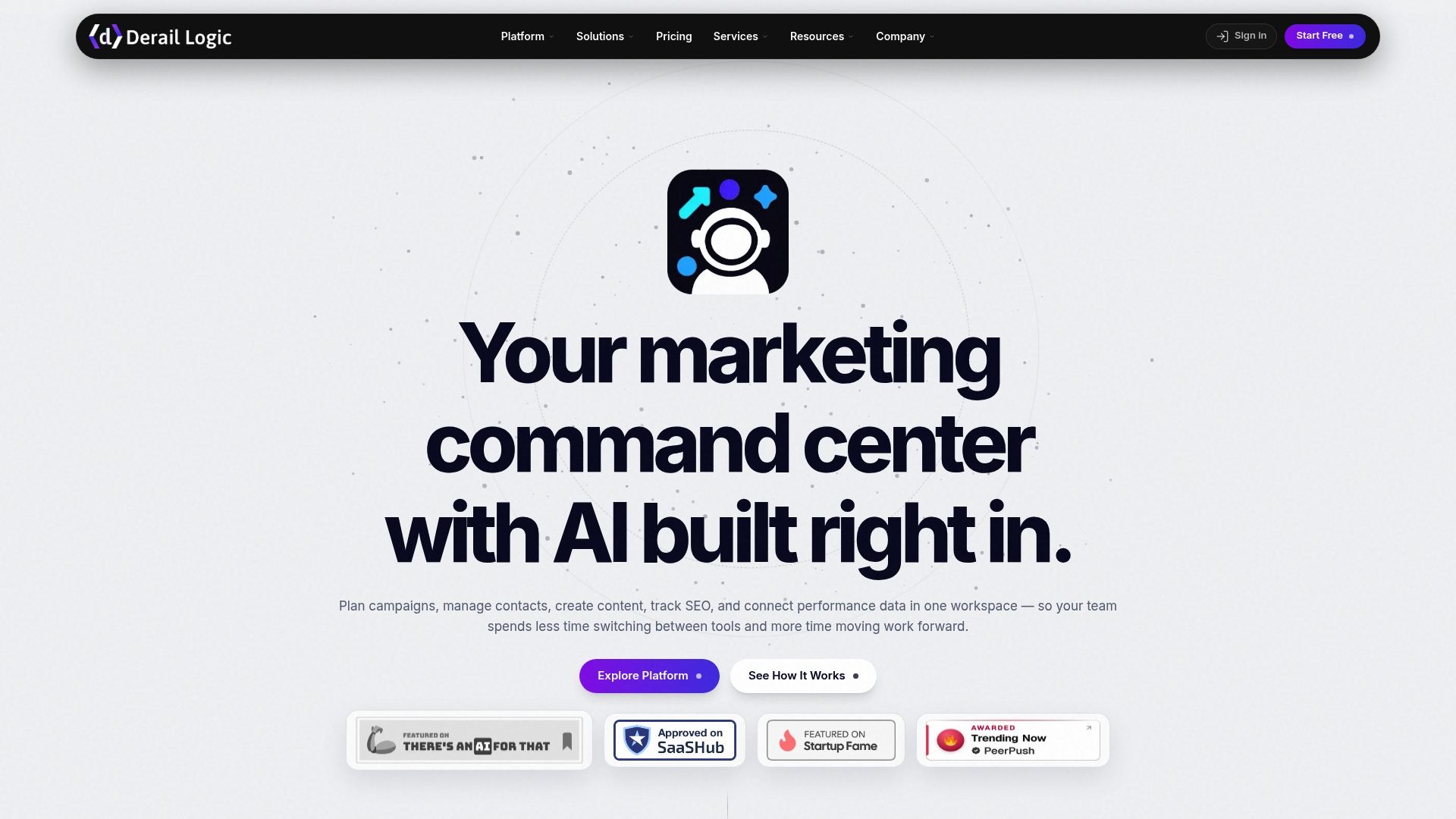
MartechAI connects your CRM, campaign studio, analytics dashboards, and content tools in a single workflow. You get unified event tracking, cross-channel attribution, and AI-driven insights built around your specific business goals. Marketing teams using MartechAI spend less time reconciling data from disconnected platforms and more time acting on what the data actually says. Explore the full platform features to see how each analytics layer is supported.
FAQ
What are the four types of marketing analytics metrics?
The four types are descriptive (what happened), diagnostic (why it happened), predictive (what will happen), and prescriptive (what should we do). Each type builds on the previous one to move from reporting to decision-making.
What is the difference between a KPI and a marketing metric?
A marketing metric is any measurable data point from a campaign or channel. A KPI (key performance indicator) is a metric tied directly to a specific business goal, making it a subset of the broader category of marketing performance metrics.
Why are third-party cookies no longer reliable for marketing measurement?
Privacy regulations and browser-level restrictions have made third-party cookie data incomplete and unreliable. Event-based tracking and first-party data collection now provide more accurate and privacy-compliant measurement.
What data do predictive marketing models require?
Predictive models use recency of engagement, frequency of interaction, engagement depth, and prior outcomes as core inputs. Data quality and consistent event taxonomy are critical for reliable forecasts and propensity scores.
How do marketing teams use prescriptive analytics in practice?
Prescriptive analytics produces specific recommendations such as bid adjustments, budget reallocations, and personalization triggers. These outputs integrate predictions and business rules to guide real-time marketing decisions.