



Real-time analytics for campaigns is defined as the continuous collection, processing, and visualization of marketing data within seconds or minutes of generation, enabling live campaign optimization. Unlike traditional batch reporting, which processes data on fixed schedules, real-time systems ingest event streams continuously and deliver results through dashboards or automated actions. The industry term for this practice is live campaign analytics or streaming analytics, though “real-time analytics” has become the standard label across martech. The core benefit is speed: you see what is working and what is failing while the campaign is still running, not after the budget is spent.
What is real-time analytics for campaigns?
Real-time analytics continuously collects event data from ad platforms, CRMs, and web behavior, then processes it through low-latency pipelines to surface live metrics. The result is a dashboard that reflects current campaign performance rather than yesterday’s summary. This is the fundamental difference from batch analytics, which aggregates data on hourly or daily schedules.
Two distinct tiers exist within real-time processing. True real-time operates at sub-second to few-second intervals, which suits high-frequency trading or fraud detection. Near-real-time, the tier most marketing teams actually need, involves delays of one to several minutes. That distinction matters because infrastructure investment should match the decision latency your team actually requires. Paying for sub-second processing when your team reviews dashboards every 15 minutes is invisible waste.

The technical stack behind live campaign analytics typically includes an event ingestion layer (capturing clicks, impressions, and conversions as they happen), a stream processing engine, and a visualization layer. Common stream processing frameworks include Apache Kafka and Apache Flink, though many marketing teams access this capability through platform-level analytics rather than building custom infrastructure. The key requirement is that data flows continuously rather than sitting in a queue until a scheduled job runs.
Pro Tip: Before choosing a real-time analytics tool, map your team’s actual decision latency window. If your fastest campaign adjustment takes 20 minutes, near-real-time data is sufficient and far less expensive to maintain.
- Event ingestion: Captures user actions across ad platforms, landing pages, and CRM touchpoints as they occur
- Stream processing: Applies filters, aggregations, and anomaly detection rules to the incoming data flow
- Live dashboards: Surface processed metrics with minimal delay for human review
- Automated triggers: Execute bid adjustments, budget pauses, or alerts without waiting for manual review
What are the key benefits of real-time campaign analytics?
The most direct benefit of real-time campaign analysis is anomaly detection during the campaign window, not after it closes. When a paid search ad develops a cost-per-acquisition (CPA) above three times the target, flagging that outlier in minutes rather than hours prevents significant budget waste. The same logic applies to click-through rate (CTR) drops: an ad performing below 50% of the campaign average signals a creative or audience mismatch that needs correction now.
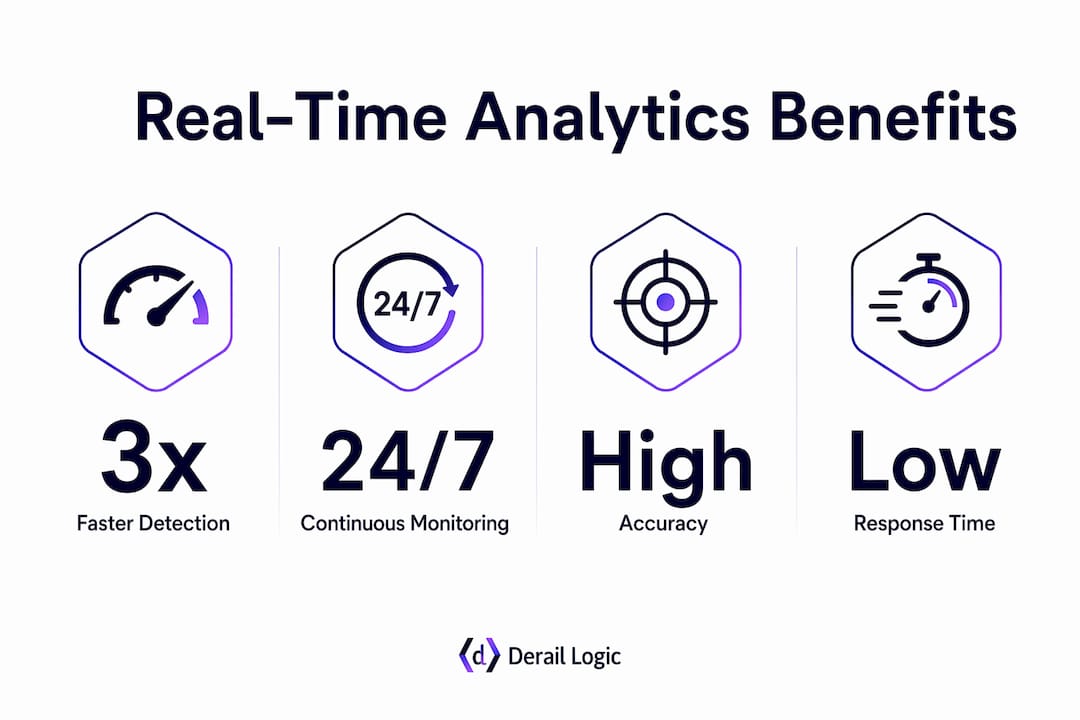
Revenue protection is the second major advantage. Adjusting media spend based on current conversion clustering, such as shifting budget toward the hours when your audience converts, prevents revenue loss from abandoned carts or missed leads. Traditional BI tools cannot do this because their data is already stale by the time a marketer opens the report.
The third benefit is targeting precision. Granular conversion tracking by audience segment, channel, and touchpoint separates genuine performance trends from statistical noise. Knowing that a specific audience segment on a specific channel converted at twice the average rate, right now, lets you reallocate budget with confidence rather than guesswork. Research shows that analytics-driven marketing consistently produces stronger ROI outcomes when teams act on granular, timely data.
- Anomaly detection: Identify high-CPA outliers and zero-conversion ads during the campaign, not after budget is exhausted
- Dynamic budget allocation: Shift spend toward converting channels and dayparts based on live conversion data
- Audience refinement: Adjust targeting parameters in response to real-time conversion patterns by segment
- Funnel protection: Detect drop-off points in the conversion funnel as they develop and intervene before leads are lost
- Automated response: Trigger bid adjustments or creative swaps without waiting for a manual review cycle
Pro Tip: Connect your real-time dashboard to automated alert rules for CPA and CTR thresholds. A human reviewing a dashboard every hour will always lag behind an automated alert that fires within two minutes of a threshold breach.
The shift from retrospective BI to live operational systems represents a genuine change in how marketing teams operate. Teams that previously spent Monday morning analyzing last week’s campaign performance now intervene on Friday afternoon while the campaign is still running. That time compression is where the ROI gains actually live.
What are the challenges of using real-time analytics in campaigns?
The most common mistake marketing teams make is over-investing in infrastructure that exceeds their actual needs. Sub-second processing is expensive to build and maintain. Most campaign decisions, including bid adjustments and creative swaps, happen on a timescale of minutes or hours. Matching infrastructure to real decision latency keeps costs proportional to value.
Integration is the second major challenge. Siloed dashboards across ad platforms, CRM systems, and web analytics tools create incomplete funnel visibility. When your Google Ads dashboard shows strong CTR but your CRM shows no lead creation, the disconnect is invisible if those systems do not share a unified data layer. Misdiagnosing funnel issues because of siloed data is a direct path to wasted spend and wrong decisions.
False positives represent a subtler problem. A CPA spike at 9:00 AM on a Monday may reflect normal weekly variance rather than a genuine campaign failure. Algorithms that compare spikes against week-on-week trends reduce false alerts and the manual effort required to investigate them. Reacting to every anomaly without that context creates alert fatigue and erodes trust in the monitoring system.
- Over-engineering: Match infrastructure investment to your team’s actual decision speed, not theoretical minimums
- Data silos: Build or adopt a unified data layer connecting CRM, ad platforms, and web behavior before deploying real-time dashboards
- False positives: Correlate anomaly alerts with historical trend data to distinguish genuine issues from normal variance
- Alert fatigue: Limit automated alerts to thresholds that require immediate action, not every minor fluctuation
How can marketers apply real-time data to improve campaign outcomes?
The most direct application is live CPA and CTR monitoring with automated alerts. Set threshold rules so that any ad group exceeding three times the target CPA triggers an immediate notification. That alert gives your team a defined window to pause the ad, adjust the bid, or swap the creative before additional budget is consumed.
Budget reallocation based on dayparting is a second high-value application. If live conversion data shows that your audience converts at twice the average rate between 6:00 PM and 9:00 PM, shifting budget toward that window during the campaign produces better outcomes than a static schedule set before launch. Automated bid adjustments triggered by conversion clustering are the most effective version of this, because they act faster than any manual review cycle.
The table below shows how real-time monitoring changes the response sequence compared to batch reporting.
| Scenario | Batch reporting response | Real-time analytics response |
|---|---|---|
| CPA spikes 3x above target | Discovered next morning; budget already spent | Alert fires within minutes; ad paused immediately |
| CTR drops below 50% of average | Identified in weekly review; creative already stale | Flagged same day; creative swapped during campaign |
| Conversion rate drops in key segment | Visible in post-campaign analysis | Detected live; targeting adjusted before opportunity closes |
| Budget depletes ahead of schedule | Noticed after the fact | Pacing alert triggers mid-campaign budget rebalance |
Derail Logic’s campaign analytics features cover the full range of metrics needed for this kind of live monitoring, from CPA and CTR to multi-touchpoint conversion attribution. The platform connects these metrics to a unified view rather than leaving teams to reconcile separate platform dashboards. That unified layer is what makes real-time monitoring operationally useful rather than just technically impressive.
Anomaly detection in campaigns becomes significantly more reliable when the system correlates alerts with historical trend data. A CPA spike that appears alarming in isolation may be normal for a Monday morning. A system that flags the spike and shows it is 40% above the same Monday last month gives your team the context to act with confidence rather than panic.
Real-time analytics changed how I think about campaign management
The most significant shift I have observed is not technical. It is psychological. When marketing teams had only batch reports, they accepted that campaigns would run for days before anyone knew if something was broken. That acceptance became cultural. Teams planned around the lag rather than eliminating it.
Live campaign analytics removes the excuse for that lag. When you can see a zero-conversion ad within 20 minutes of launch, the question is no longer “when will we know?” It becomes “what will we do right now?” That is a harder question, and it requires clearer decision protocols than most teams have built.
The teams I have seen get the most value from real-time data are not the ones with the most sophisticated infrastructure. They are the ones that defined their response playbook before the campaign launched. They knew exactly which thresholds would trigger a pause, which would trigger a bid adjustment, and which would trigger a creative swap. The data was only as useful as the decision framework waiting to receive it.
The other thing worth saying plainly: capturing which audience and touchpoint triggered conversions is the real prize. Surface-level metrics like total impressions or overall CTR tell you very little. Knowing that a specific retargeting segment on a specific channel converted at 4x the average rate, in the last two hours, is the kind of insight that changes where next week’s budget goes.
— Zachary
How Derail Logic supports live campaign monitoring
Derail Logic’s MartechAI platform connects campaign analytics, CRM data, and ad performance into a single workflow, removing the siloed dashboards that cause incomplete funnel visibility.
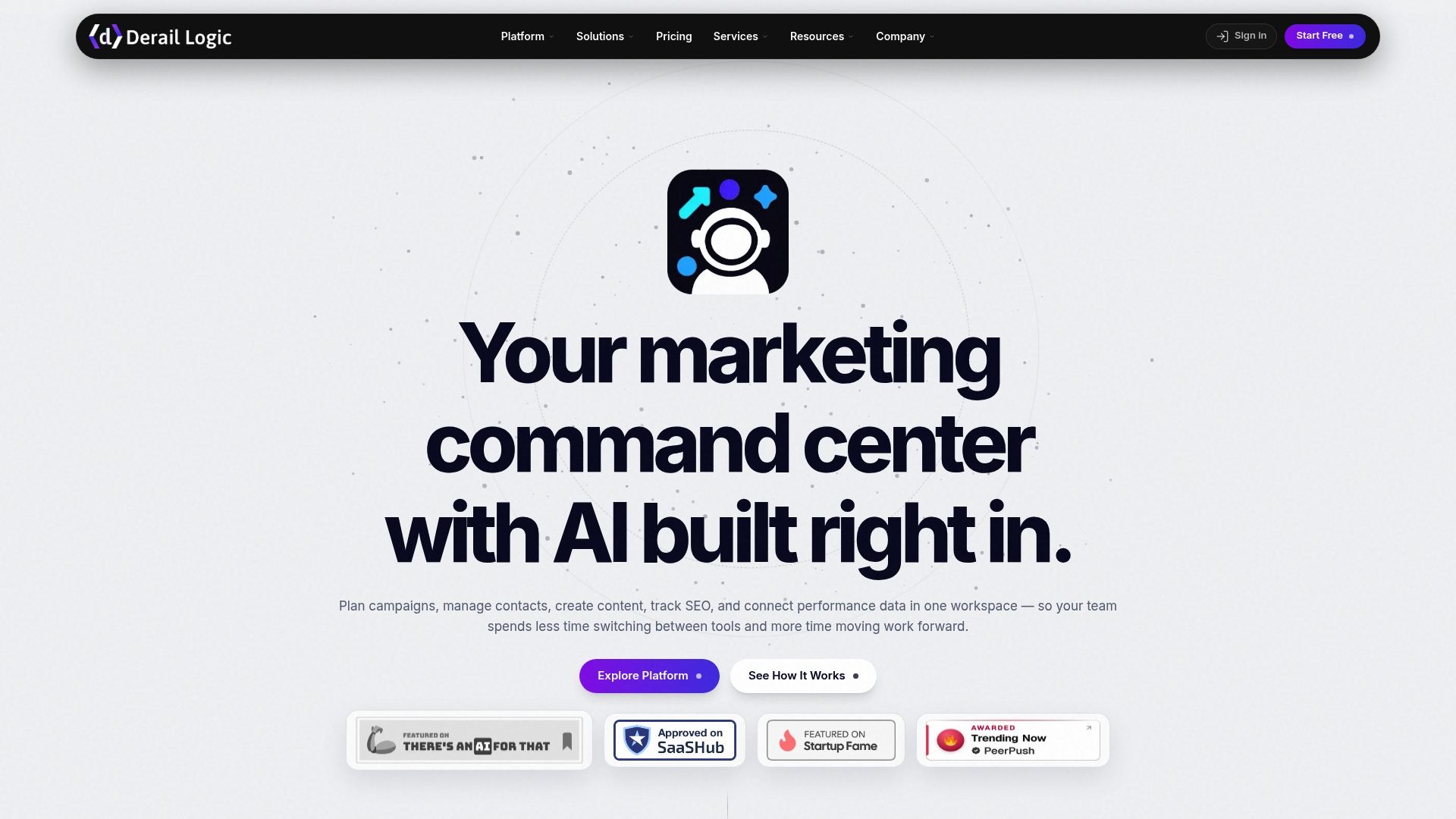
The platform’s marketing automation services include live campaign monitoring with automated alerts, so your team gets notified when CPA or CTR thresholds breach, without waiting for a scheduled report. The Campaign Studio provides a visual orchestration layer that connects live performance data to budget and creative decisions in one place. For marketing teams that want to move from retrospective reporting to live operational responsiveness, MartechAI provides the unified infrastructure to make that shift practical rather than theoretical.
Key Takeaways
Real-time campaign analytics delivers its full value only when unified data, clear decision thresholds, and automated response rules are in place before the campaign launches.
| Point | Details |
|---|---|
| Definition and scope | Real-time analytics processes campaign data within seconds to minutes, enabling live optimization rather than post-campaign review. |
| Near-real-time is sufficient | Most marketing decisions happen on a minutes-to-hours timescale, making near-real-time data the right investment for most teams. |
| Unified data layer is critical | Siloed dashboards across CRM, ad platforms, and web analytics create incomplete funnel views and false diagnoses. |
| Anomaly detection needs context | Correlating CPA spikes with week-on-week trends reduces false alerts and prevents reactive decisions based on normal variance. |
| Automated triggers multiply value | Systems that act on live data, by pausing ads or adjusting bids, outperform systems that only report faster. |
FAQ
What is real-time analytics for campaigns?
Real-time analytics for campaigns is the continuous collection, processing, and visualization of marketing performance data within seconds or minutes of generation. It enables marketers to detect anomalies, reallocate budget, and adjust targeting while a campaign is still running.
How does real-time campaign analysis differ from batch reporting?
Batch reporting processes data on fixed schedules, often daily or hourly, meaning insights arrive after the opportunity to act has passed. Real-time campaign analysis processes data continuously, so teams can respond to CPA spikes or CTR drops within minutes.
What metrics matter most for real-time reporting?
CPA, CTR, conversion rate by segment, and budget pacing are the core metrics for real-time reporting. Tracking these by audience, channel, and touchpoint gives marketers the granular view needed to make confident mid-campaign adjustments.
Do marketing teams need sub-second processing for real-time analytics?
Most marketing teams do not need sub-second processing. Near-real-time data with delays of one to several minutes is sufficient for campaign decisions like bid adjustments, creative swaps, and budget reallocation, and costs significantly less to maintain.
What is the biggest risk of real-time analytics in campaigns?
The biggest risk is acting on false positives caused by siloed data or normal statistical variance. Correlating anomaly alerts with historical trend data, and building a unified data layer across all platforms, reduces this risk significantly.