



Segmentation in marketing data analysis is defined as the practice of dividing a broad customer base into distinct groups that share common characteristics, so marketers can target each group with messages that actually fit. Without it, you are running campaigns against an undifferentiated mass of data that tells you very little about who is buying, why they buy, or what they will buy next. Companies using advanced segmentation report 10% higher revenue over five years and up to 50% lower customer acquisition costs. That gap between segmented and unsegmented marketing is not a rounding error. It is the difference between a campaign that pays for itself and one that quietly drains budget. Segmentation sits upstream of every major marketing decision, from product development to channel investment to pricing, making it the foundation of any serious data analysis practice.
What is the role of segmentation in marketing data analysis?
Segmentation converts raw customer data into groups that behave differently from each other. That behavioral difference is the whole point. When every customer looks the same in your dataset, you cannot make a decision that is better than a coin flip. When you split them into meaningful clusters, every downstream decision gets sharper.
The STP framework, which stands for Segmentation, Targeting, and Positioning, formalizes this logic. Segmentation comes first because it defines who exists in your market. Targeting picks which segments are worth pursuing. Positioning shapes how you speak to each one. Skip or rush the segmentation step and the targeting and positioning work collapses.

72% of consumers only engage with marketing messages tailored to their individual interests. That figure means a generic campaign is invisible to nearly three out of four people on your list. Segmentation is the mechanism that makes personalization possible at scale, and personalization is what drives engagement.
What are the main types of segmentation used in marketing analysis?
Four primary segmentation types anchor most marketing data analysis work: demographic, psychographic, behavioral, and firmographic. Each one answers a different question about your customer, and each one feeds different marketing decisions.
| Segmentation type | What it measures | Primary use case |
|---|---|---|
| Demographic | Age, income, gender, education | Broad audience sizing and media planning |
| Psychographic | Values, lifestyle, attitudes | Messaging tone and brand positioning |
| Behavioral | Purchase history, usage, loyalty | Retention campaigns and upsell targeting |
| Firmographic | Company size, industry, revenue | B2B account prioritization and pricing tiers |
Demographic segmentation is the easiest to collect and the most commonly misused. Knowing that your best customers are 35–44 years old tells you where to find them, but it says nothing about why they buy. Psychographic data fills that gap. A mid-career professional who values sustainability responds to entirely different messaging than one who prioritizes speed and convenience, even if they share the same age bracket.
Behavioral segmentation is the most directly tied to revenue. Customers who have purchased twice in the last 90 days respond differently to a loyalty offer than customers who bought once 18 months ago. Separating those two groups before you build a campaign prevents you from wasting budget on the wrong message.
Firmographic segmentation applies the same logic to B2B contexts. A 10-person startup and a 5,000-person enterprise both need your software, but they have different budgets, different buying committees, and different risk tolerances. Treating them identically in your data analysis produces recommendations that fit neither.
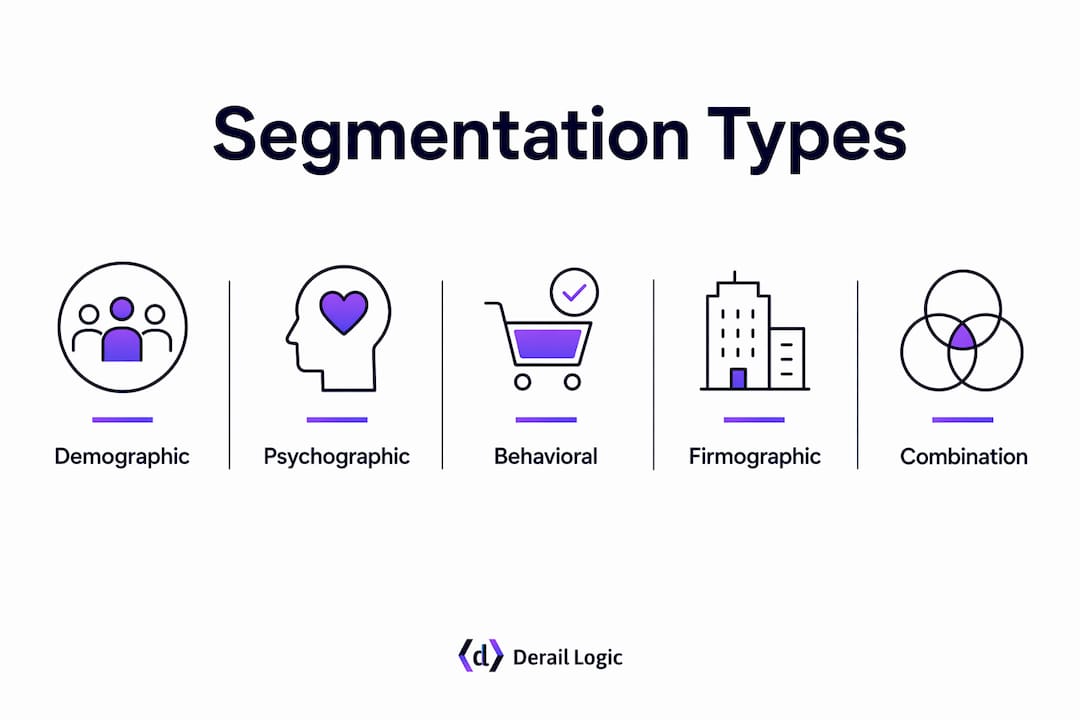
Pro Tip: Combine at least two segmentation types before building a campaign. Demographic data tells you who someone is. Behavioral data tells you what they do. Together, they tell you what to say and when to say it.
What criteria make segmentation effective and actionable?
A segment that looks good in a spreadsheet can still produce zero ROI in the field. The difference between a useful segment and a decorative one comes down to four tests.
- Measurable. You must be able to quantify the segment’s size and purchasing power. If you cannot measure it, you cannot budget for it.
- Accessible. You must be able to reach the segment through available channels. A perfectly defined group that you have no way to contact is analytically interesting and commercially useless.
- Substantial. The segment must be large enough to justify dedicated spend. Micro-segments can be valuable, but only when the economics support the investment.
- Differentiable. Segment distinctiveness should be verified by measuring different responses to marketing stimuli. If two segments respond identically to the same offer, they are one segment, not two.
The MECE principle, which stands for Mutually Exclusive and Collectively Exhaustive, adds a structural check on top of those four tests. Applying the MECE rule ensures that every customer belongs to exactly one segment and that no customer falls outside your segmentation scheme. Overlap between segments wastes ad spend because you end up targeting the same person with competing messages. Gaps in coverage mean you are leaving potential customers unaddressed entirely.
The most common mistake analysts make is building segments that pass the measurability test but fail the differentiability test. Two segments with different demographic profiles but identical purchase behavior will not respond differently to your campaigns. The data looks clean. The results are flat.
Pro Tip: Run a simple A/B test before committing budget to a new segment. Send two different offers to the same segment. If response rates are statistically identical, your segmentation variable is not driving behavior and needs to be replaced.
How does segmentation integrate with marketing strategies to improve outcomes?
Segmentation informs product priorities, channel investments, and messaging to improve marketing outcomes. That is not a soft benefit. It is a direct line from analytical work to budget allocation decisions.
Here is what that looks like in practice. Once your segments are defined and validated, they feed directly into:
- Product development. Segment data reveals which features matter most to your highest-value customers, so product teams build what buyers actually want.
- Pricing tiers. Willingness-to-pay varies sharply across segments. Behavioral and firmographic data lets you set prices that capture more value without losing price-sensitive buyers.
- Channel investment. Different segments live on different platforms and respond to different formats. Segment analysis tells you where to concentrate spend and where to cut it.
- Message framing. Psychographic segmentation drives copy decisions. The same product needs a different headline for a risk-averse buyer than for an early adopter.
- Retention campaigns. Behavioral segments identify customers approaching churn before they leave, giving your team time to intervene with the right offer.
“Personalization driven by segmentation delivers a 5–15% revenue lift and reduces customer acquisition costs by up to 50% for companies that apply it consistently across their marketing programs.”
That revenue lift compounds over time. Companies using advanced segmentation see 10% higher revenue over five years compared to those that do not. The compounding effect happens because each campaign cycle generates better data, which refines the segments, which improves the next campaign.
In what ways is AI transforming segmentation in marketing data analysis?
AI changes segmentation in two fundamental ways. First, it processes far more variables than a human analyst can handle manually, finding patterns in behavioral data that traditional demographic or psychographic models miss. Second, it updates segments continuously rather than on a quarterly or annual review cycle.
AI-powered behavioral segmentation enhances marketing effectiveness when integrated into broader marketing actions. The key phrase is “integrated into broader marketing actions.” An AI model that produces a beautiful cluster analysis but never connects to your CRM or campaign tools produces no business value. The output must flow directly into execution.
The methods AI uses for segmentation include:
- Clustering algorithms (such as k-means) that group customers by behavioral similarity without predefined categories
- Decision trees that identify the variables most predictive of purchase or churn
- Deep learning models that process unstructured data like browsing behavior, email engagement, and support interactions
Explainable AI (XAI) is increasingly necessary for analyst credibility and executive buy-in. A black-box model that says “trust the output” does not survive a budget review. XAI tools show which variables drove each segment assignment, making the logic visible to non-technical stakeholders. That transparency is what gets AI-driven segmentation approved and funded. You can read more about AI’s role in marketing strategies and how it connects to executive-level adoption.
The practical challenge is data fragmentation. Most marketing teams hold customer data across a CRM, an email platform, an ad platform, and a web analytics tool, with no unified identity layer connecting them. AI segmentation models are only as good as the data they receive. Fragmented inputs produce fragmented segments. Solving the identity resolution problem, meaning connecting the same customer across multiple data sources, is a prerequisite for AI segmentation to work at scale.
Pro Tip: Before deploying an AI segmentation model, audit your data sources for identity resolution gaps. If your CRM and your email platform cannot agree on who a customer is, your AI model will create phantom segments built on duplicate records.
Key Takeaways
Segmentation is the analytical foundation that makes every downstream marketing decision more accurate, more cost-efficient, and more directly tied to revenue outcomes.
| Point | Details |
|---|---|
| Segmentation drives revenue | Companies using advanced segmentation report 10% higher revenue over five years and up to 50% lower acquisition costs. |
| Four segment types cover most needs | Demographic, psychographic, behavioral, and firmographic segmentation each answer different questions about your customer. |
| MECE prevents wasted spend | Mutually exclusive and collectively exhaustive segments stop you from targeting the same customer with competing messages. |
| AI requires connected data | AI segmentation models only work when your CRM, email, and ad data share a unified customer identity layer. |
| Explainability drives adoption | Explainable AI outputs give executives the transparency they need to approve and fund segmentation programs. |
Why most segmentation projects stall before they deliver results
Most segmentation work I have seen fails at the same point: the handoff from analysis to execution. The analyst team builds a clean, well-validated set of segments. The segments sit in a deck. Six months later, the campaign team is still running the same broad-audience ads they ran before the project started.
The problem is not the segmentation. The problem is that segmentation without an operational path is just a research exercise. The segments need to live inside your CRM. They need to trigger automated workflows. They need to update when customer behavior changes, not when someone remembers to refresh the model.
The other failure mode I see constantly is over-engineering. Teams build 15 or 20 micro-segments because the data supports it. Then no one can maintain them, the messaging matrix becomes unmanageable, and the whole system collapses under its own complexity. Start with four to six segments. Validate them against real campaign results. Add complexity only when the simpler model stops explaining behavior.
Executive buy-in is the third lever that most analysts underestimate. A segmentation model that no one outside the analytics team understands will never get budget. Explainable outputs, meaning clear descriptions of who each segment is and why they behave differently, are not a nice-to-have. They are the price of admission for getting segmentation embedded in actual marketing decisions. Connecting your marketing automation tools to your segmentation outputs is what closes the loop between analysis and results.
— Zachary
How Derail Logic helps you act on segmentation data
Knowing your segments is only half the work. The other half is activating them across every channel without losing consistency or speed.
Derail Logic’s MartechAI platform connects your segmentation outputs directly to campaign execution. The visual campaign studio lets you build targeted workflows for each segment without switching between tools. The intelligent CRM updates segment assignments automatically as customer behavior changes, so your campaigns always reflect current data rather than a snapshot from last quarter. The marketing automation features handle personalized outreach, follow-up sequencing, and performance tracking in one place, so your team spends less time managing tools and more time reading results. If you want to see the full feature set, the MartechAI features page covers the campaign studio, analytics, CRM, and AI integrations in detail.
FAQ
What is the role of segmentation in marketing data analysis?
Segmentation divides a broad customer dataset into distinct groups that share common characteristics, so marketers can target each group with relevant messages. It sits upstream of every major marketing decision, including product development, pricing, channel selection, and campaign messaging.
Why is market segmentation important for campaign performance?
72% of consumers only engage with marketing messages tailored to their interests, which means unsegmented campaigns are ignored by the majority of recipients. Segmentation makes personalization possible at scale, which directly improves engagement rates and return on ad spend.
What are the four tests for an effective segment?
A valid segment must be measurable, accessible, substantial, and differentiable. If a segment cannot be reached through available channels or does not respond differently to marketing stimuli than other segments, it will not produce ROI.
How does AI improve segmentation in digital marketing?
AI processes more behavioral variables than manual analysis allows and updates segments continuously rather than on a fixed review cycle. Explainable AI tools make the logic behind each segment visible to non-technical stakeholders, which is critical for organizational adoption.
What is the MECE principle in segmentation?
MECE stands for Mutually Exclusive and Collectively Exhaustive. It means every customer belongs to exactly one segment and no customer falls outside the segmentation scheme, preventing overlap that wastes ad spend and gaps that leave customers unaddressed.