



Marketing analytics is defined as the practice of collecting, measuring, and analyzing data from all marketing channels to measure performance and drive decisions that go well beyond reporting past behavior. The discipline has evolved from simple click counts and impression reports into integrated systems that combine predictive modeling, customer demographic analysis, and financial outcome measurement. For marketing professionals and business owners, understanding marketing analytics means understanding how every campaign dollar connects to revenue, profit, and growth. This article covers what is marketing analytics explained in practical terms, the four types of analysis, how it connects to business outcomes, and how to apply it to real budget decisions.
What is marketing analytics, and why does it matter?
Marketing analytics is the discipline of using data from marketing activities to measure performance and optimize decision-making. It pulls data from online ads, content marketing, email campaigns, offline events, and more. The goal is not just to describe what happened but to explain why it happened and predict what will happen next.
The definition of marketing analytics has expanded significantly over the past decade. Early marketing measurement meant counting website visits or ad clicks. Modern marketing analytics integrates CRM data, revenue data, and customer lifetime value calculations into a single view of marketing’s contribution to the business. That shift matters because executives and CFOs no longer accept activity metrics as proof of marketing value.

Marketing professionals who understand analytics at this level hold a clear advantage. They can defend budgets, justify channel investments, and redirect spend toward what actually drives profit. That is the real benefit of marketing analytics: it replaces opinion with evidence.
What are the four types of marketing analytics?
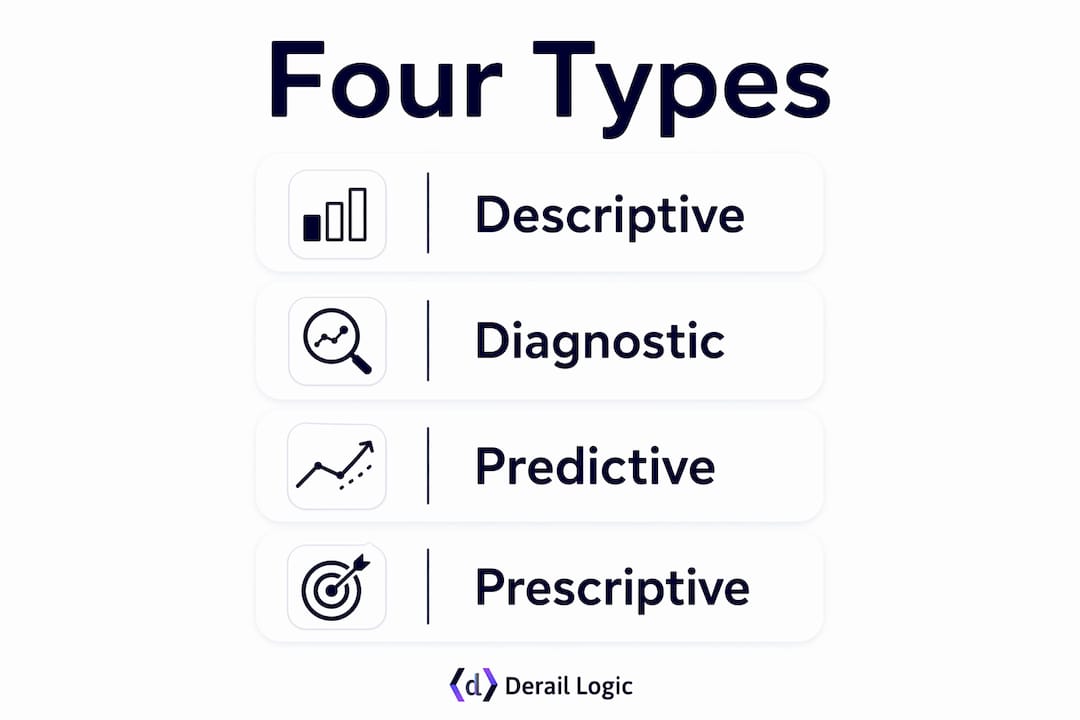
Marketing analytics uses four types of analysis, each answering a different business question. Organizations that apply all four types improve ROI and predict outcomes like churn and conversions more accurately.
| Type | Question answered | Example | Business value |
|---|---|---|---|
| Descriptive | What happened? | Email open rates last quarter | Baseline performance tracking |
| Diagnostic | Why did it happen? | Drop in conversions after creative change | Root cause identification |
| Predictive | What will happen? | Churn probability for a customer segment | Proactive resource allocation |
| Prescriptive | What should we do? | Recommended budget shift to paid search | Decision support for planning |
Most marketing teams live in descriptive analytics. They pull reports, review dashboards, and call it analysis. That is a mistake. Descriptive data tells you what happened; it does not tell you what to do next.
Diagnostic analytics closes that gap by identifying the cause behind a metric change. If your conversion rate dropped 20% in march, diagnostic analysis points to the specific campaign, audience segment, or creative element responsible. Predictive analytics goes further, using historical patterns to forecast future behavior. Prescriptive analytics is the most advanced layer, recommending specific actions based on predicted outcomes.
Pro Tip: Build your reporting cadence around all four types. Start with descriptive for weekly reviews, add diagnostic for monthly deep dives, and use predictive and prescriptive outputs for quarterly planning.
How marketing analytics connects to business outcomes
Marketing analytics differs from web analytics or campaign analytics in one critical way: it focuses on business outcome metrics like incremental revenue, customer lifetime value, and contribution margin rather than channel-specific indicators like ROAS or CTR. That distinction matters enormously when you present marketing results to a CFO or board.
Channel metrics like ROAS measure how efficiently an ad platform spends money. They do not measure whether that spending grew the business. A campaign can show a strong ROAS while generating zero incremental revenue if it is reaching customers who would have bought anyway. That is invisible waste, and it is common.
A measurement framework built around business outcomes solves this problem. The framework includes four layers:
- Business outcomes: Incremental revenue, payback period, contribution margin
- Pipeline metrics: Leads generated, pipeline value, conversion rates by stage
- Channel efficiency: Cost per acquisition, ROAS, click-through rate
- Operational signals: Campaign delivery, creative performance, audience reach
CFOs evaluate marketing primarily at the business outcomes layer. Most marketing teams report at the channel efficiency layer. That mismatch is why marketing budgets get cut: the data presented does not speak the language executives use to make investment decisions.
Pro Tip: When presenting to leadership, lead with incremental revenue and payback period. Follow with channel efficiency metrics as supporting evidence, not the headline.
Key components of a working marketing analytics architecture
A working marketing analytics setup requires more than a dashboard. Manual data stitching from multiple sources is inefficient and produces unreliable results. Automated, normalized data flowing into a single source of truth is the foundation every other analysis depends on.
The three structural components that matter most are:
-
Single source of truth data architecture. All marketing data, from paid media, CRM, email, and offline sources, flows into one normalized environment before analysis begins. Without this, teams spend more time reconciling spreadsheets than drawing conclusions.
-
Marketing mix modeling (MMM) and multi-touch attribution (MTA). MMM and MTA combined improve resource allocation and market resilience significantly more than either model alone. MMM measures the long-term effect of channels at an aggregate level. MTA tracks individual customer touchpoints across the path to purchase.
-
AI-driven predictive analytics. AI models trained on historical campaign data can forecast conversion rates, predict customer churn, and recommend budget shifts before results deteriorate. Integrated architectures combining MMM, MTA, and AI predictive insights contribute to smarter budgeting and planning.
Dashboards are not a substitute for this architecture. Most marketing teams have dashboards but lack a formal framework that defines how metrics are calculated, what assumptions underlie them, and how they connect to business outcomes. A dashboard shows numbers. A framework explains what those numbers mean and what to do about them.
For teams dealing with disconnected tools and data silos, the article on AI and marketing tool sprawl covers why adding more tools without integration makes the problem worse, not better.
How to use marketing analytics for campaign decisions
Practical marketing analytics produces decisions, not just reports. The most common application is budget justification and reallocation, and the metrics you use determine whether that conversation goes well or poorly.
ROAS overstates marketing’s impact by ignoring costs. Profit on ad spend (POAS) and overall ROI are the metrics CFOs prefer because they reflect true profitability. Calculating incremental revenue minus campaign costs and product costs gives you a number that withstands board-level scrutiny.
Practical applications include:
- Holdout tests and geo-lift tests. Causal measurement techniques like holdout groups establish incremental impact with far greater validity than correlation-based attribution. Run a holdout test by withholding ads from a control group and comparing their behavior to the exposed group.
- Audience prioritization. Use predictive models to identify high-value customer segments before spending on acquisition. Allocate budget toward segments with the highest predicted lifetime value, not just the lowest cost per click.
- Channel reallocation. When MMM shows that a channel’s marginal return is declining, shift budget to channels with higher incremental return. This decision requires data, not intuition.
Research on analytics-driven ROI shows that teams applying these methods consistently outperform those relying on last-click attribution or platform-reported ROAS. The gap between data-driven teams and intuition-driven teams widens every year as the tools and techniques become more accessible.
For a deeper look at the specific metrics that support these decisions, the guide on marketing analytics metrics covers which KPIs to track at each stage of the funnel.
Pro Tip: Before running any new campaign, define the holdout group and success metric in advance. Post-hoc analysis is far less credible with executives than pre-registered measurement plans.
Key Takeaways
Marketing analytics is the practice of connecting campaign data to business outcomes through structured measurement, not just dashboard reporting.
| Point | Details |
|---|---|
| Four types of analysis | Descriptive, diagnostic, predictive, and prescriptive analytics each answer a different business question. |
| Business outcomes over channel metrics | CFOs evaluate incremental revenue and contribution margin, not ROAS or CTR alone. |
| Single source of truth | Automated, normalized data architecture is the foundation of reliable marketing analytics. |
| POAS over ROAS | Profit on ad spend reflects true profitability and withstands board-level scrutiny better than ROAS. |
| Frameworks beat dashboards | A documented measurement framework defines how metrics are calculated and connects them to business decisions. |
Analytics is a decision system, not a reporting habit
The biggest misconception I see in marketing teams is treating analytics as a reporting function. Teams build dashboards, schedule weekly exports, and call it measurement. That is not analytics. True analytics is forward-looking and decision-focused, enabling marketers to anticipate results and decide future investments.
I have watched capable marketing teams lose budget battles not because their campaigns underperformed, but because they could not translate performance into financial language. They showed click-through rates to a CFO who was thinking about payback periods. The data was real. The framing was wrong.
The teams that win those conversations build measurement frameworks before campaigns launch. They define what incremental success looks like, set up holdout groups, and arrive at the budget review with POAS and contribution margin data. That is not a technical skill. It is a discipline.
Marketing analytics also protects the CMO from CFO scrutiny by demonstrating incremental business impact. Done well, it does not just justify the current budget. It builds the case for a larger one. The mindset shift from “reporting what happened” to “deciding what to do next” is what separates best-in-class practitioners from teams stuck in descriptive reporting.
— Zachary
Derail Logic brings analytics and execution together
Measuring marketing performance is only half the work. Acting on those insights quickly is where most teams fall short.
Derail Logic’s MartechAI platform connects your analytics data directly to campaign execution. The visual campaign studio, intelligent CRM, and deep analytics features give your team a single place to measure, plan, and act. AI-driven insights surface what is working and where budget is being wasted, without requiring a data science team to interpret the output. For teams ready to connect measurement to marketing automation, Derail Logic provides the infrastructure to do it at scale.
FAQ
What is the definition of marketing analytics?
Marketing analytics is the practice of collecting, measuring, and analyzing data from all marketing channels to measure performance and drive strategic decisions. It goes beyond reporting past behavior to include predictive modeling and business outcome measurement.
How does marketing analytics differ from web analytics?
Web analytics tracks on-site behavior like page views and sessions. Marketing analytics connects those signals to business outcomes like incremental revenue, customer lifetime value, and contribution margin across all channels.
What are the four types of marketing analytics?
The four types are descriptive (what happened), diagnostic (why it happened), predictive (what will happen), and prescriptive (what should be done). Organizations that apply all four improve ROI and forecast outcomes more accurately.
Why is ROAS a misleading metric for executives?
ROAS ignores costs and inflates marketing’s contribution to revenue. CFOs prefer metrics like POAS and ROI because they reflect true profitability and account for campaign and product costs.
What is a marketing measurement framework?
A measurement framework is a documented system that specifies how metrics are calculated, their underlying assumptions, and how they connect to business outcomes. It is distinct from a dashboard, which only displays data without defining what it means.