



Behavioral analytics in marketing is the practice of collecting and analyzing data generated by customer actions across digital environments, then using those patterns to predict what customers will do next and why. Unlike standard web analytics, which tells you what happened (page views, bounce rates, session counts), behavioral analytics digs into the “why” behind those actions, revealing the motivations and friction points that drive or derail conversion. The result is a sharper, more human picture of the customer journey than any demographic report can provide.
Here is what a complete behavioral analytics solution typically covers:
- Event-level tracking: Every click, scroll, form interaction, and purchase captured as a discrete data point
- Cohort analysis: Grouping users by shared behaviors to spot patterns across the customer lifecycle
- Funnel visualization: Mapping the steps from first touch to conversion and identifying where customers drop off
- Path and flow analysis: Tracing the actual routes customers take through your site or app
- Predictive modeling: Using historical behavior data to forecast future actions and prioritize outreach
- Real-time triggers: Firing automated marketing responses the moment a behavior threshold is crossed
What kinds of behavioral data do marketers actually analyze?
The raw material of behavioral analytics is event data: the discrete actions customers take across every digital touchpoint your brand owns. Aggregated across channels, these data points build a continuous record of how each customer moves through your ecosystem.
Common behavioral data types include:
- Clicks and navigation paths: Which links customers follow and in what sequence
- Scroll depth: How far down a page a visitor reads before leaving
- Session duration: Total time spent per visit and per session across return visits
- Form interactions: Fields filled, fields abandoned, and submission rates
- Purchase history: Products bought, order values, and repurchase frequency
- Cart abandonment: Items added but not purchased, and the point at which customers exit
- Content engagement: Video watch time, article completion rates, and social shares
- Feature usage: Which product features active users engage with most, and which they ignore
- Multi-channel behavior: How the same customer behaves differently on web, mobile, and social media
Pulling these streams together into a unified profile is where the real insight lives. A customer who reads three blog posts, downloads a white paper, and then abandons a pricing page tells a very different story than one who lands directly on the pricing page and converts in four minutes.
Pro Tip: Set up cross-device identity resolution before you start building behavioral cohorts. Without it, the same customer appears as three separate users across desktop, mobile, and tablet, and your funnel data will be structurally wrong from day one.
How behavioral analytics benefits your marketing team and bottom line
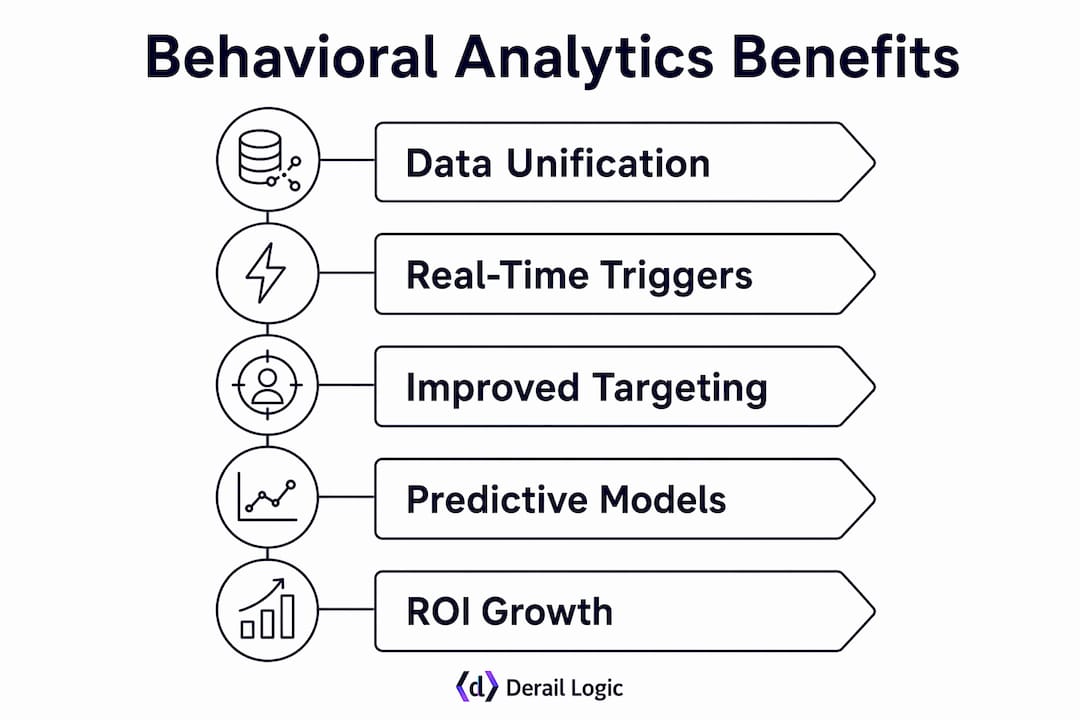
The business case for behavioral analytics is not abstract. According to McKinsey, organizations that use customer behavioral insights outperform peers by 85% in sales growth and more than 25% in gross margin. Those numbers reflect what happens when marketing decisions are grounded in actual customer behavior rather than assumptions.
The core benefits break down across four areas:
- Higher conversion rates: Personalized offers triggered by specific behaviors convert at a much higher rate than generic campaigns
- Better customer retention: Identifying behavioral signals that precede churn lets teams intervene before customers leave
- Improved campaign efficiency: Real-time behavioral data lets you reallocate budget toward what is actually working, mid-campaign
- Stronger lead prioritization: Behavioral scoring surfaces the leads most likely to convert, so sales teams focus their time where it counts
Behavioral analytics turns raw event data into strategic “why” insights. Those insights are what separate marketing teams that react to results from teams that shape them.
The efficiency gains compound over time. As your behavioral data set grows, your predictive models get sharper, your cohort segments get tighter, and your personalization gets more accurate. Teams that invest early in marketing analytics metrics build a compounding advantage over those still relying on last-click attribution.
What are the main types of behavioral analytics?
Behavioral analytics is not a single technique. It spans four analytical modes, each suited to different marketing questions.
- Descriptive analytics: Summarizes what happened. Page views, click-through rates, and session counts fall here. Useful for reporting, but it stops short of explaining causes.
- Diagnostic analytics: Explains why something happened. If conversion dropped 18% last week, diagnostic analysis traces the behavioral pattern that caused it, such as a new checkout step that created friction.
- Predictive analytics: Uses historical behavior patterns to forecast future actions. Which customers are likely to churn? Which leads are close to converting? Predictive models answer both.
- Prescriptive analytics: Recommends the next best action based on predicted behavior. This is where behavioral analytics connects directly to marketing automation, triggering personalized outreach at exactly the right moment.
Beyond these four modes, the analytical techniques that power them include:
- Cohort analysis: Comparing groups of users who share a common starting behavior, such as signing up during a specific campaign, to track how their engagement evolves over time
- Funnel analysis: Measuring conversion at each step of a defined sequence to locate the biggest drop-off points
- Path analysis: Mapping the actual navigation flows customers take, which often differ significantly from the flows designers intended
- A/B testing: Running controlled experiments on behavioral data to validate which version of a page, email, or feature drives better outcomes
- Segmentation: Dividing your audience by behavior patterns rather than demographics alone, which produces segments that are far more predictive of purchase intent
Which platform features matter most for behavioral analytics?
The technology stack underneath behavioral analytics determines how much of its potential you can actually use. A platform that only captures page views will not support cohort analysis or predictive triggers. Leading implementations aggregate data from web, mobile, and CRM systems into a unified customer journey profile, then layer analytical functions on top.
Features that separate capable platforms from basic ones:
- Event-level tracking: Capturing every discrete user action, not just aggregated session summaries
- Cohort building: Creating and comparing user groups based on any combination of behavioral criteria
- Funnel visualization: Seeing conversion rates at each step of a defined flow, with the ability to filter by segment
- AI-driven anomaly detection: Flagging sudden shifts in user behavior that traditional reporting would miss until the next weekly review
- Session replay: Watching recorded user sessions to understand exactly where and why friction occurs
- CRM integration: Connecting behavioral data to known customer records so personalization can operate at the individual level
- Real-time alerts: Notifying teams the moment a behavioral threshold is crossed, enabling fast response to conversion drops or engagement spikes
Integration depth matters as much as feature breadth. A platform that cannot push behavioral triggers into your email system or CRM creates a gap between insight and action. The real-time analytics layer is what closes that gap.
Real-world marketing applications: where behavioral analytics delivers results

The clearest illustration of behavioral analytics in practice is cart abandonment recovery. A customer adds items to a cart, reaches the payment page, and leaves. Behavioral analytics captures exactly where the exit happened, what the customer viewed before that point, and how many times they have visited previously. That context powers a retargeting sequence that is specific to their behavior, not a generic “you left something behind” email.
Marketing applications extend well beyond ecommerce recovery:
- Product recommendations: Amazon built its recommendation engine on behavioral data, surfacing products based on purchase history and browsing patterns rather than broad category affinity
- Content personalization: Media and SaaS companies use behavioral cohorts to serve different content to first-time visitors versus returning users who have already consumed introductory material
- Targeted retargeting: Users who viewed a pricing page but did not convert get different ad creative than users who only visited the homepage
- Lifecycle campaign triggers: A user who completes onboarding but has not used a key feature within seven days triggers an automated nudge campaign, timed to the behavior rather than a fixed calendar schedule
Behavioral cohorts defined by user actions, such as accepting a free trial or skipping a feature, let marketers tailor experiences that improve engagement and retention across the customer lifecycle.
The ROI impact of these applications is measurable at the campaign level. Personalized behavioral triggers consistently outperform batch-and-blast campaigns because they reach customers at the moment their behavior signals readiness.
Implementing behavioral analytics: what good looks like in practice
Successful implementation starts with a unified data foundation. Fragmented data sources, where web behavior lives in one tool, CRM data in another, and mobile events in a third, produce incomplete customer profiles and unreliable analysis. Unifying those sources into a single customer view is the prerequisite for everything else.
Core platform capabilities to prioritize during selection:
- AI-powered root-cause analysis that surfaces the behavioral driver behind a metric change, not just the metric itself
- End-to-end journey monitoring across all channels and devices, not just within a single property
- Channel behavior comparison to understand how the same customer behaves differently on web versus mobile
- Tight CRM integration so behavioral triggers can fire personalized outreach without manual intervention
Data governance is not optional. Privacy-by-design means removing personally identifiable information before data ingestion while still enabling mapping to known users when they authenticate. Consent management must be built into the data collection layer, not added as an afterthought.
Cross-team alignment is the operational factor most teams underestimate. Behavioral analytics produces insights that are relevant to product, marketing, customer success, and engineering simultaneously. Without a shared data dictionary and agreed-upon KPIs, each team will interpret the same behavioral data differently and act on conflicting conclusions.
Pro Tip: Before selecting a platform, map every behavioral trigger you want to fire and trace it back to the data source it requires. If the platform cannot ingest that source natively, the trigger will not work in production, regardless of what the demo showed.
Challenges and limitations you should plan for
Behavioral analytics is powerful, but it comes with real operational constraints that teams often discover after deployment rather than before.

Data volume and quality. Behavioral data accumulates fast. Without a clear taxonomy for event naming and a governance process for maintaining it, your data lake fills with inconsistent, duplicate, or misnamed events that make analysis unreliable. A click labeled “button_click” in one part of the app and “cta_tap” in another is effectively two different events in your analysis, even if they represent the same customer action.
Attribution complexity. Behavioral analytics captures what customers do, but attributing why they did it to a specific marketing input remains difficult. A customer who converts after seeing a retargeting ad, reading an email, and visiting the pricing page three times presents an attribution problem that behavioral data alone cannot fully resolve.
Skill gaps. Extracting strategic insight from behavioral data requires analysts who understand both the technical data layer and the marketing context. Teams that implement a platform without investing in the analytical capability to use it end up with expensive dashboards and no change in decision-making.
Signal lag in predictive models. Predictive models trained on historical behavior can lag when customer behavior shifts rapidly, as it does during economic disruptions or major product changes. Models need regular retraining to stay accurate, which requires dedicated engineering time most marketing teams do not budget for.
Privacy and ethical considerations in behavioral analytics
Behavioral tracking operates in a tightening regulatory environment. GDPR in Europe and CCPA in California both impose consent and data minimization requirements that directly affect how behavioral data can be collected, stored, and used. Collecting behavioral data without explicit consent, or retaining it longer than necessary, creates legal exposure that no personalization gain justifies.
The ethical dimension goes beyond compliance. Customers increasingly recognize when they are being tracked, and the line between helpful personalization and intrusive surveillance is thinner than most marketing teams acknowledge. A retargeting ad that appears within seconds of a customer leaving a product page can feel useful or unsettling depending on the customer’s expectations and the brand’s relationship with them.
Embedding privacy by design from the data ingestion stage means anonymizing data where individual identification is not necessary for the analysis, building consent flows that are genuinely clear rather than deliberately obscure, and giving customers meaningful control over what is collected. Teams that treat privacy as a compliance checkbox rather than a trust-building practice tend to face both regulatory scrutiny and customer backlash. Understanding user behavior ethically is what separates sustainable personalization from short-term extraction.
Key Takeaways
Behavioral analytics in marketing delivers its highest value when unified data, real-time triggers, and privacy-conscious governance operate together as a connected system rather than separate initiatives.
| Point | Details |
|---|---|
| Behavioral vs. standard analytics | Standard analytics answers “what”; behavioral analytics answers “why,” enabling strategic decisions rather than just reporting. |
| McKinsey performance gap | Companies using behavioral insights outperform peers by 85% in sales growth and more than 25% in gross margin. |
| Four analytical modes | Descriptive, diagnostic, predictive, and prescriptive analytics each serve different marketing questions and objectives. |
| Unified data is the prerequisite | Fragmented sources produce incomplete profiles; a single customer view must come before any meaningful analysis. |
| Privacy by design | Removing PII at ingestion and building consent management into data collection protects both compliance and customer trust. |
FAQ
What is behavioral analytics in marketing?
Behavioral analytics in marketing is the process of collecting and analyzing data from customer actions across digital channels, such as clicks, navigation paths, and purchases, to understand why customers behave as they do and predict what they will do next.
What are the four types of behavioral analytics?
The four types are descriptive (what happened), diagnostic (why it happened), predictive (what will happen), and prescriptive (what action to take next). Each type supports different marketing decisions, from campaign reporting to automated personalization triggers.
What are the four types of marketing analytics?
Marketing analytics broadly covers descriptive, diagnostic, predictive, and prescriptive analytics. Behavioral analytics sits within this framework but focuses specifically on user action data rather than broader business metrics like revenue or market share.
What is an example of behavioral marketing?
A classic example is cart abandonment retargeting: a customer adds a product to their cart, exits without purchasing, and then receives a personalized ad or email featuring that exact product, triggered automatically by their recorded behavior.