



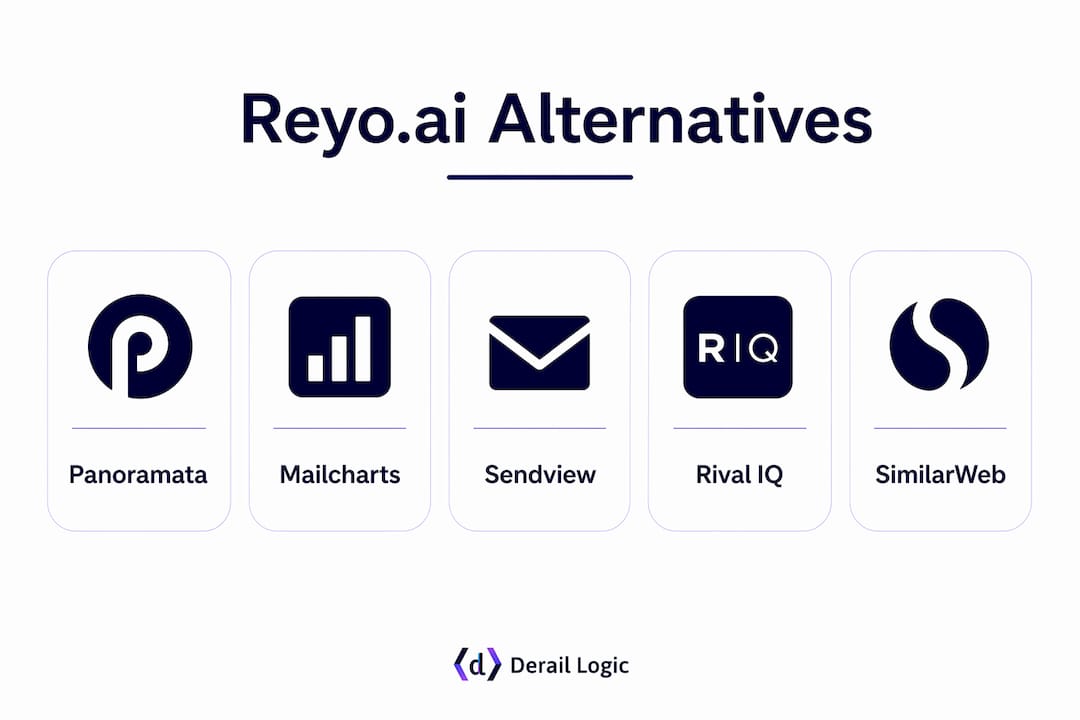
The strongest Reyo.ai alternatives for competitor email and campaign intelligence in 2026 are Panoramata, Mailcharts, Sendview, Newsletrix, Rival IQ, SimilarWeb, Alteryx, Miro, and Creately. Each solves a different slice of the problem. Panoramata covers multi-channel competitor monitoring. Mailcharts focuses on email benchmarking against major brands. Sendview archives competitor emails with basic analytics. Newsletrix applies structured AI analysis to newsletter campaigns. Rival IQ and SimilarWeb handle social and traffic intelligence. Alteryx powers complex data pipelines. Miro and Creately support visual campaign planning and team collaboration.
The core distinction that shapes every choice here: most of these tools are observation platforms. They show you what competitors did. A smaller group, led by Reyo AI itself, attempts to tell you what to do next, combining competitor data with timing recommendations, discount suggestions, and external market context like holidays and trending events.
| Tool | Primary Focus | AI Recommendations | GDPR / EU Hosting | Best For |
|---|---|---|---|---|
| Panoramata | Multi-channel competitor monitoring | Basic analysis only | Unclear | E-commerce teams wanting broad visibility |
| Mailcharts | Email benchmarking database | No | US/UK focused | Campaign inspiration from major brands |
| Sendview | Email archiving and tracking | No | No EU hosting | Teams needing historical email archives |
| Newsletrix | AI newsletter analysis | Structured insights | Not publicly listed | Structured benchmarking and analysis |
| Rival IQ | Social media competitive analytics | Limited | US-based | Social-first competitive positioning |
| SimilarWeb | Web traffic and audience data | No | US/Israel hosting | Analysts focused on traffic benchmarks |
| Alteryx | Advanced analytics and data pipelines | Automation-based | Enterprise options | Large teams with complex data needs |
| Miro | Visual collaboration and planning | No | EU hosting available | Teams planning campaigns visually |
| Creately | Diagramming and workflow mapping | No | Not publicly listed | Marketing workflow and project mapping |
What are the best Reyo.ai alternatives for feature depth?
The functional segmentation across these tools is sharper than most comparison articles admit. Sendview and Mailcharts sit firmly in the archiving and benchmarking category. Rival IQ and SimilarWeb operate at the strategic layer, answering questions about market share and traffic trends. Panoramata and Newsletrix sit closer to operational campaign intelligence, though neither delivers the timing and discount recommendation layer that Reyo AI built its positioning around.

Panoramata tracks over 80,000 brands globally, covering email, Meta ads, landing pages, and SMS flows. Its breadth makes it genuinely useful for agencies managing diverse client portfolios. The limitation is that it stops at monitoring. There are no AI-driven campaign timing suggestions, no discount recommendations, and no integration with external context factors like seasonality or local events.
Mailcharts is the go-to for email inspiration. Its database of campaigns from major US and UK brands is searchable by industry, making it practical for benchmarking send frequency, subject line patterns, and promotional cadence. Coverage skews heavily toward English-language markets, which matters if your competitive set includes European or DACH brands.
Sendview captures competitor emails through dedicated tracking addresses. New accounts face a 2–4 week cold start before enough data accumulates for meaningful reporting. It delivers analytical raw data: send frequency, spam scores, ESP detection. The gap is interpretation. Sendview tells you what happened; it does not suggest what to do next. It also lacks EU hosting, which creates compliance friction for teams with GDPR obligations.
Rival IQ is built for social media competitive analysis, with email tracking as a secondary feature. If your competitive intelligence need centers on social engagement benchmarks, it performs well. For email-first teams, it is a supplementary tool rather than a primary one.
SimilarWeb answers strategic questions about traffic volume, audience demographics, and traffic sources. It is built for analysts and investors, not campaign managers who need to decide what to send on Thursday. Pricing reflects that positioning: the Team plan runs approximately $14,000 per year, and Enterprise contracts reach $35,000–$150,000 annually.
Alteryx operates at a different scale entirely. It is an analytics pipeline platform suited to large marketing operations teams that need to integrate data from multiple sources and automate complex workflows. It is not a competitor email tracking tool in the traditional sense.
Miro and Creately are collaboration and diagramming platforms. They appear in some alternative lists because marketing teams use them for campaign planning visualization, but neither monitors competitor campaigns or generates intelligence. They solve a workflow problem, not an intelligence problem.
Newsletrix applies structured AI analysis to newsletter campaigns, producing categorized insights and benchmarks. It sits closer to the intelligence layer than pure archiving tools, though its AI recommendation depth is not publicly detailed at the same level as Reyo AI’s decision layer.
A key differentiator across all these platforms is CRM integration. Platforms that connect directly to Klaviyo, HubSpot, or Brevo allow teams to move from insight to execution without manual exports. Panoramata, Sendview, and most observation-layer tools require manual data handling. That friction is invisible waste for teams running weekly campaign cycles.
How do pricing models compare across these alternatives?
Pricing across this category spans a wide range, and the gap between entry-level and enterprise tiers reflects genuine differences in capability, not just seat counts.
- Panoramata: Entry at approximately €99–149/month (Starter limits you to 20 competitors; Professional removes that cap). Enterprise tiers start at €379+/month.
- Sendview: Entry at $69–99/month (Starter/Pro), with an Enterprise tier at $149/month.
- SimilarWeb: Starter at $149/month for one user with limited data. Professional at $399/month. Team plans run approximately $14,000/year.
- Mailcharts, Newsletrix, Rival IQ, Miro, Creately, and Alteryx: Pricing varies by plan tier and is best confirmed directly with each vendor, as public pricing changes frequently.
The ROI question is where the observation vs. decision-support divide becomes financial. A tool at €99/month that shows you competitor emails still requires a campaign manager to interpret the data, form a hypothesis, and decide on timing and discount levels. A platform that delivers those recommendations directly reduces the labor cost of that interpretation cycle. For teams running multiple campaigns per month, that time difference compounds quickly.
Pro Tip: Before committing to any plan, request a demo that includes a live walkthrough of how the tool handles your specific competitor set, not a generic product tour. The cold start problem is real: platforms without pre-existing historical data for your competitors will deliver limited value for the first 2–4 weeks after signup.
How to choose the right Reyo.ai alternative for your team
The right choice depends on what question you actually need answered, not on feature lists.
- If you need email inspiration and benchmarking: Mailcharts is purpose-built for this. Its database of major brand campaigns is the most practical resource for teams that want to see what industry leaders are doing before planning their own sends.
- If you need broad multi-channel competitor monitoring: Panoramata covers the most ground for e-commerce teams, tracking email, ads, landing pages, and SMS in one place.
- If you need strategic traffic and audience data: SimilarWeb is the category leader. Pair it with a campaign intelligence tool rather than replacing one with the other.
- If you need AI-driven campaign decisions: The observation-layer tools listed here do not fully replace Reyo AI’s decision layer. Newsletrix comes closest among the alternatives, but the depth of timing and discount recommendations varies.
- If GDPR compliance is non-negotiable: Sendview and SimilarWeb both host outside the EU. Teams with strict data privacy requirements, particularly those serving DACH markets, need to verify hosting location and data processing agreements before signing.
Tracking fewer, more relevant competitors consistently outperforms broad monitoring in terms of ROI. Prioritizing 5–10 key competitors gives your team focused, usable intelligence rather than a data volume that causes analysis paralysis.
The multi-tool approach works well when each tool has a distinct job: SimilarWeb for strategic traffic analysis, a campaign intelligence platform for operational decisions, and a CRM like Klaviyo or HubSpot for execution. Forcing one tool to do all three usually means it does none of them well.
What should you know before migrating away from Reyo AI?
Switching platforms is rarely just a data export. The practical steps matter.
- Export your competitor lists first. Most platforms accept CSV imports of competitor domains or email addresses. Confirm the import format before you cancel your current subscription.
- Plan for the cold start. Platforms without pre-existing historical data for your competitors will take 2–4 weeks to accumulate enough data for meaningful reporting. Immediate access to historical data at onboarding is a genuine differentiator, not a marketing claim.
- Check CRM integration compatibility. If your team relies on Klaviyo, HubSpot, or Brevo for campaign execution, confirm that your new platform connects directly. Manual exports add friction to every campaign cycle.
- Review GDPR and data hosting terms. For US teams, this may be a lower priority. For teams with European customers or DACH operations, EU hosting and legally reviewed AI usage are compliance requirements, not preferences.
- Assess onboarding support. Some platforms include a personal setup call. Others provide documentation only. For teams switching from a tool with a decision-support layer, the learning curve on a pure observation platform can be steeper than expected.
What does the 2026 market context tell us about these tools?
The tension between observation and recommendation is the defining dynamic in this category right now. Marketing teams increasingly want AI that integrates external factors like holidays, trending events, and seasonality into campaign guidance, not just a dashboard showing what competitors sent last week.
The market segments clearly by function. Email archiving tools like Sendview occupy the entry tier. Benchmarking platforms like Mailcharts serve teams focused on creative inspiration. Traffic and social analytics platforms like SimilarWeb and Rival IQ serve strategic analysts. The operational campaign intelligence layer, where AI recommendations connect competitor data to your next send, is the fastest-growing segment and the least crowded.
GDPR compliance is a growing factor even for US-based teams with European customers. EU-hosted platforms reduce cross-border data risk and typically offer better regional coverage for DACH and broader European markets. Many US-built alternatives use Standard Contractual Clauses for EU data transfers, which is formally compliant but carries more legal overhead than native EU hosting.
The role of AI in marketing strategy has shifted from automation of repetitive tasks to active decision support. The tools that will define this category in the next two years are those that embed market context directly into campaign recommendations, not those that simply surface more data.
Which alternatives offer a free trial or demo?
Most platforms in this category offer at least a demo or limited trial, though terms vary.
- Panoramata: Offers a free trial period; no minimum contract on entry plans.
- Mailcharts: Provides a free plan with limited access to its email database, allowing teams to evaluate coverage before upgrading.
- Miro: Offers a free tier with limited boards, suitable for evaluating collaboration features.
- Creately: Provides a free plan with basic diagramming capabilities.
- SimilarWeb: Offers a limited free version with restricted data access; full features require a paid plan.
- Rival IQ: Offers a free trial period; contact sales for enterprise demos.
- Sendview, Newsletrix, and Alteryx: Demo availability varies; check each vendor’s current offering directly, as trial terms change.
Before committing to any paid plan, use the trial period specifically to test your actual competitor set, not the demo data the vendor provides. The difference between a tool that covers your competitors well and one that has gaps in your niche only becomes visible when you run your real use case.
Derail Logic brings unified AI marketing intelligence to your stack
If you’ve evaluated the tools above and found that the real gap isn’t just competitor monitoring but the fragmentation across your entire marketing operation, Derail Logic’s MartechAI platform addresses that directly.
Rather than adding another point solution to an already crowded stack, MartechAI connects your campaign studio, CRM, analytics, and marketing automation into a single workflow. Its AI engine surfaces opportunities proactively, so your team spends less time pulling data from disconnected tools and more time acting on it. For marketing and e-commerce teams that have outgrown the “one tool per problem” model, MartechAI’s integrated feature set covers campaign planning, execution, and measurement without the invisible waste of manual handoffs between platforms.
FAQ
What is the main difference between Reyo AI and its alternatives?
Reyo AI delivers AI-driven campaign recommendations including timing and discount suggestions, while most alternatives like Sendview, Mailcharts, and Panoramata focus on data observation and monitoring without prescriptive guidance.
Which Reyo.ai alternative is best for GDPR compliance?
Teams with strict GDPR requirements should prioritize platforms with EU-based data hosting. Sendview and SimilarWeb host outside the EU, which creates compliance risk for DACH and European-facing teams.
How long does it take to get value after switching platforms?
Platforms without pre-existing historical competitor data typically require 2–4 weeks before reporting becomes meaningful. Choosing a platform with an existing competitor database reduces that cold start significantly.
Can I use multiple tools instead of one Reyo AI alternative?
Yes. A common approach pairs SimilarWeb for strategic traffic analysis with a campaign intelligence platform for operational decisions, connected to a CRM like Klaviyo or HubSpot for execution.
Does Derail Logic’s MartechAI replace competitor email tracking tools?
MartechAI is a unified marketing operations platform rather than a dedicated competitor email tracker. It complements intelligence tools by connecting campaign planning, CRM, and analytics into one workflow, reducing the overhead of managing multiple disconnected platforms.
Key Takeaways
The strongest Reyo.ai alternatives each serve a distinct function, and the right choice depends on whether your team needs observation, benchmarking, or AI-driven campaign decisions.
| Point | Details |
|---|---|
| Observation vs. decision support | Most alternatives track competitor activity; only a few deliver timing and discount recommendations. |
| Cold start risk | Platforms without historical data take 2–4 weeks to deliver meaningful reporting after onboarding. |
| GDPR and EU hosting | Sendview and SimilarWeb host outside the EU, creating compliance friction for DACH-focused teams. |
| Pricing range | Entry-level options start around €99–149/month (Panoramata); enterprise platforms like SimilarWeb reach $14,000+/year for team plans. |
| Derail Logic MartechAI | For teams needing unified campaign planning, CRM, and analytics in one place, MartechAI reduces stack fragmentation beyond what point solutions address. |