



What is the six-step system for managing multiple client campaigns?
The core problem with multi-client campaign management isn’t capacity. It’s the absence of a repeatable system. Agencies managing many simultaneous campaigns face significantly higher operational stress, and the root cause is almost always the same: each account runs on its own ad hoc process, so every new client degrades the quality of service you give the existing ones. The fix is one operational rhythm applied across every account, with client-specific judgment layered on top.
Here is the six-step framework agencies use to scale from 5 to 25 clients without proportional headcount growth.
Step 1: Standardize client onboarding and research
Every client enters through the same door. Build a comprehensive intake questionnaire covering business goals, target audiences, brand guidelines, competitive landscape, budget parameters, and success metrics. The more you capture upfront, the fewer back-and-forth conversations you need mid-campaign when your team is already stretched.
Set up a dedicated workspace for each client immediately. This creates a mental and operational barrier that prevents one of the most expensive mistakes in multi-client work: launching ads in the wrong account or using Client A’s creative assets for Client B’s campaign.
Step 2: Implement a client-agnostic naming convention
Naming conventions prevent confusion and reduce errors across accounts. The format is straightforward:
- Client code: Two to four letters, registered in a master spreadsheet. No duplicates across your portfolio.
- Date: YYYY-MM format only. Never “Q3” or “Summer” since quarter logic breaks when campaigns run across months.
- Version number: Sequential (v1, v2, v3). Never “FINAL.” There is no final version.
An account touched by three people over 18 months, each using their own shorthand, becomes unreadable. A consistent schema makes any account legible to any team member in under five minutes.
Step 3: Build a fixed weekly cadence
Past five clients, ad hoc task management stops working. Cognitive switching costs between clients compound quickly, and the only structural fix is a designated task type for each day of the week.

| Day | Task type | Time block |
|---|---|---|
| Monday | Research and competitive intelligence | 2 hours across all active clients |
| Tuesday | Creative briefs | 1 hour per brief, 2–3 briefs max |
| Wednesday | Creative review and revision | 1 hour per client with active creative |
| Thursday | Campaign launches and ad set builds | Focused execution block |
| Friday | Performance review and reporting | 30 minutes per client |
Keeping all campaign launches on Thursday batches your QA work. You review naming, pixel events, and audience selection once, for all launches. Mixing launches across days means constant context-switching between review and execution all week.
Step 4: Set up white-label reporting templates
White-label reporting produced in under 30 minutes lets agencies scale from 5 to 25 clients without reporting becoming a bottleneck. Three report formats cover the full client relationship:
- Weekly pulse (1 page): Spend, CPA or ROAS, impressions, top-performing ad. Clients see this every Friday.
- Monthly deep-dive (5–7 pages): Full-funnel metrics, creative performance table, next-month hypotheses.
- Quarterly review (10–12 pages): Year-over-year trends, audience saturation analysis, account structure recommendations.
Strip all third-party tool branding from your templates. Your client sees your agency’s colors and logo.
Step 5: Document escalation thresholds
Build an escalation playbook and have clients sign off on it at onboarding. The key distinction is escalating on structural problems, not on noise. Clients who receive too many escalations lose confidence; clients who receive zero and then encounter a surprise will leave.
Escalate immediately (same-day client call) when:
- Spend stops delivery with no approved budget increase
- CPA spikes more than 50% over the 7-day baseline with no creative or audience change
- The account gets flagged for a policy violation
- A pixel stops firing on the purchase event
Escalate within 24 hours (email plus next-call agenda) for performance trends that fall outside agreed thresholds but don’t require immediate action.
Step 6: Maintain turnover-safe documentation
Three documents per client account, maintained live:
- Account brief (1 page): Business context, ICP, primary conversion event, approved audiences, budget authority, escalation contact.
- Campaign decision log: Every structural decision recorded with date, rationale, and outcome.
- Creative brief archive: Every brief filed with the output ads it produced and their 30-day performance data.
A new hire should understand what has and hasn’t worked in a client’s category within 20 minutes of reading the archive.
Pro Tip: Tier your clients by budget and complexity using a three-level system: platinum, gold, and standard. Define deliverables and touchpoint frequency for each tier. This prevents over-serving smaller clients at the expense of larger ones, which is one of the most common resource allocation failures in growing agencies.
Which platforms handle multi-client campaign management best in 2026?
Effective campaign management platforms must integrate project management, reporting, digital asset management, and client communication in cohesive workflows. No single tool does all four perfectly, which is why most agencies run a deliberate stack of 3–5 specialized tools. The platforms below cover the full range from ad-specific to project-level management.

| Platform | Channels supported | Client data isolation | Automation/AI | Bulk operations | Role-based access | Best fit |
|---|---|---|---|---|---|---|
| Synter | 20+ platforms | Yes | AI agents execute | Yes | Yes | Full-stack agencies |
| Smartly.io | Social only | Yes | Rule-based | Yes | Yes | Large social agencies |
| Marin Software | Google, Microsoft, Meta | Yes | Rules-based bidding | Yes | Yes | Enterprise search agencies |
| Skai | Search, social, Amazon | Yes | Recommendations | Yes | Yes | Retail media agencies |
| Asana | N/A (PM tool) | Yes (workspaces) | Limited | Yes (templates) | Yes | Enterprise-client agencies |
| Trello | N/A (PM tool) | Yes (boards) | Limited | No | Limited | Small teams |
| Adzooma | Google, Meta, Microsoft | Yes | Recommendations | Yes | Yes | SMB agencies |
| Google Ads MCC | Google only | Yes | No | Yes | Yes | Google-focused agencies |
Synter is the most capable option for agencies that need true AI execution across multiple clients. Rather than rule-based automation, Synter’s AI agents actively manage campaigns across 20+ connected platforms within isolated client workspaces. You direct the agent to a specific client and platform, and it executes. The ability to run cross-client benchmark reports (“compare CPM and CTR across all e-commerce clients running Meta this month”) is a genuine operational advantage that no other platform on this list matches at that level of automation.
Smartly.io excels specifically in social media. Its creative testing tools and deep automation for Meta and other social channels make it the right choice for agencies where the majority of client spend lives in social. Outside social, its coverage drops off sharply.
Marin Software targets agencies running complex search and social campaigns simultaneously. Its bidding algorithms and cross-channel integration are built for enterprise-scale spend levels, and the analytics layer gives media buyers the kind of granular view that justifies the platform’s positioning.
Skai brings together search, social, and Amazon data in a single interface, which makes it particularly useful for retail media agencies managing clients with e-commerce revenue goals. The unified performance view across those three channels is Skai’s clearest differentiator.
Asana earns its place in agency stacks through portfolio-level visibility. Its Portfolio views give leadership a cross-client health check without drilling into individual tasks, and the enterprise polish matters when you’re pitching to larger clients who want to see how their work is being managed. For agencies where project coordination is the primary pain point rather than ad platform management, Asana is the strongest choice.
Trello suits smaller teams or agencies in early growth stages. The card-based workflow is fast to set up and easy for clients to navigate, but it lacks the structural depth needed once client count climbs past 10–12.
Adzooma covers the three major ad platforms (Google, Meta, and Microsoft) with automated budget allocation and optimization recommendations. It’s well-suited to SMB-focused agencies that don’t need the enterprise feature set of Marin or Skai but want more automation than Google Ads MCC provides natively.
Google Ads MCC remains the baseline for any agency managing Google Ads accounts. Native integration means no data translation layer, and account-level management across all client Google accounts from a single login is genuinely efficient. Its limitation is obvious: it only covers Google.
How do you manage multiple client campaigns without burning out?
Burnout in multi-client work rarely comes from a single bad week. It accumulates through constant context-switching, unclear priorities, and the absence of protected focus time. The operational fixes are practical and specific.
Time-blocking and task batching are the highest-leverage changes most teams can make. Grouping similar tasks across all clients on the same day (all creative reviews on Wednesday, all launches on Thursday) cuts the mental overhead of switching between clients and task types repeatedly. The cognitive load reduction is real and compounds over weeks.
Prioritization requires a daily framework, not just a gut check. Use a simple two-axis filter: impact (how much does this move a client’s key metric?) and urgency (what breaks if this doesn’t happen today?). High-impact, high-urgency tasks go first. Low-impact, low-urgency tasks get scheduled or delegated.
Client communication boundaries prevent the slow erosion of focus time that kills productivity. Set these expectations at onboarding:
- Define which channels clients use to reach you (email only, or a shared Slack channel with response windows)
- Establish response time commitments (same-day for urgent issues, 24 hours for standard questions)
- Clarify what triggers an unscheduled call versus what goes on the next scheduled agenda
Delegation works only when roles are clearly defined. An account manager owns the client relationship and strategy. A media buyer owns campaign execution and optimization. An analyst owns performance data and reporting. When those lanes blur, work falls through the cracks and the most senior person ends up doing everything.
Pro Tip: Build 20% buffer time into every workweek before assigning tasks. If your team has 40 available hours, plan for 32 hours of scheduled work. The remaining 8 hours absorb client emergencies, revision requests, and the unexpected issues that appear in every agency week. Teams that plan to 100% capacity operate in constant crisis mode.
Reducing your marketing software stack also directly reduces cognitive load. Every tool your team has to check is another context switch. Consolidating where possible keeps attention focused on client work rather than tool management.
What features should you look for in a multi-client campaign management platform?
Not all campaign management tools are built for multi-client use. A platform that works well for a single brand’s internal team often creates friction at agency scale. These are the features that separate adequate from genuinely useful.
Client data isolation is the non-negotiable baseline. Each client’s ad accounts, creative assets, and performance data must be completely separated. Cross-client data contamination is not just an operational error; it’s a trust violation that can end client relationships.
Automation and AI capabilities determine how much manual work your team carries. The distinction worth understanding: rule-based automation (pause a campaign if CPA exceeds X) reduces errors but still requires a human to set every rule. AI execution (an agent that reviews performance, identifies issues, and takes action within defined parameters) reduces the cognitive load of decision-making itself. Synter operates at the AI execution level; most other platforms on this list operate at the rule-based level.
Bulk operations matter more than most teams realize until they’re managing 15+ clients. The ability to launch, pause, or update campaigns across multiple client accounts simultaneously can compress hours of work into minutes.
Role-based access controls serve two functions: internal security (junior team members see only what they need) and client transparency (clients can view their own performance data without seeing other clients’ information). Both matter at agency scale.
Integration support across channels determines whether your reporting is complete or partial. The platforms worth evaluating in 2026 should connect to Meta, Google Ads, TikTok, LinkedIn, Microsoft Advertising, and major e-commerce platforms like Shopify and Amazon. Cross-channel campaigns coordinating messaging across at least three channels achieve conversion rates 287% higher than single-channel campaigns, which means your platform’s channel coverage directly affects client results.
| Feature | Why it matters | What to check |
|---|---|---|
| Client data isolation | Prevents cross-client errors and protects confidentiality | Separate workspaces with access controls per client |
| AI/automation depth | Reduces manual optimization work | Rule-based vs. AI-agent execution |
| Bulk operations | Compresses multi-client launch and update time | Can you update 10 clients’ budgets in one action? |
| Role-based access | Enables delegation and client-facing views | Granular permission settings per user |
| Channel integrations | Determines reporting completeness | List of native API connections |
| Scalability | Platform should grow with your client count | Pricing model per client vs. flat fee |
| Security and privacy | Protects client data from breaches and leaks | SOC 2 compliance, data residency options |
Security deserves specific attention. Agencies hold access to client ad accounts, payment methods, and audience data. At minimum, any platform you use should offer two-factor authentication, audit logs, and clear data retention policies. SOC 2 Type II compliance is the standard to look for in 2026.
How should you set up a campaign asset management system?
Campaign asset management is where most agencies accumulate invisible waste. Files live in Slack threads, Google Drive folders named “FINAL v2,” and individual team members’ desktops. When someone leaves or a client asks for a specific creative from six months ago, the search begins.
A functional asset management system has three components: a central repository, version control, and client-specific access. Shared Google Drive or Dropbox works adequately up to roughly 5 clients and 2–3 years of asset accumulation. Beyond that, search and version control break down. Dedicated digital asset management tools like Air, Bynder, or Filecamp add AI-powered search, version history, and client-specific access controls that belong in any mature agency stack.
The folder structure should mirror your campaign naming convention. If your campaigns follow the CLIENT-YYYY-MM-OBJECTIVE-v1 schema, your asset folders should follow the same logic. This makes it possible for any team member to find the right creative for any campaign without asking anyone.
Version control is the piece most teams skip until it causes a problem. Every creative file should have a clear version number, a date, and a status (draft, in review, approved, live). Approval workflows in tools like Frame.io for video or Bynder for static assets provide timestamped, version-controlled feedback that email cannot. The record of who approved which version and when becomes important when a client disputes a creative decision three months later.
How do you onboard team members to handle multiple client accounts?
New team members handling multiple client accounts face a specific challenge: they need to understand both the agency’s operational system and each client’s individual context simultaneously. Trying to absorb both at once leads to errors.
Structure onboarding in two phases. The first phase covers the agency’s operational system: naming conventions, weekly cadence, reporting templates, escalation thresholds, and the tools your team uses. This phase should take no more than one week and should be documented in a written guide, not delivered verbally. The second phase covers individual client accounts, using the account briefs and campaign decision logs from your documentation system.
Pair new hires with a senior team member for their first two weeks of live client work. The goal isn’t supervision; it’s pattern recognition. A new media buyer who sees how a senior colleague handles a CPA spike on a Thursday launch day learns more in one real situation than in five hours of training documentation.
Marketing managers using agile project management report higher project success rates in multi-client campaigns. Apply the same principle to team onboarding: short feedback loops, regular check-ins, and iterative improvement rather than a single long training block followed by independent work.
Build a knowledge base that new hires can search independently. Internal wikis in Notion or Confluence store client histories, brand guidelines, and past campaign data so institutional knowledge doesn’t walk out the door when someone leaves. Make documentation a non-negotiable part of the account management role from day one, not an afterthought added when someone gives notice.
What does the research say about optimizing multi-client campaign management?
The operational evidence for structured multi-client systems is consistent across agency research. Campaign management complexity increases when each account uses ad hoc processes instead of a unified system, and service quality degrades as client count rises. The agencies that scale without proportional headcount growth are the ones that treat their own operational stack with the same analytical rigor they apply to client campaigns.
Tiered client service frameworks that categorize clients by budget and complexity prevent over-serving smaller clients at the expense of larger ones. This isn’t just a resource allocation strategy; it’s a quality control mechanism. When senior talent is spread equally across all accounts regardless of revenue or complexity, the clients who need the most attention often get the least.
The agile project management correlation with campaign success points to something specific: iterative workflows with short feedback loops outperform long planning cycles followed by large launches. For multi-client agencies, this means weekly optimization reviews rather than monthly check-ins, and creative testing cycles measured in days rather than weeks.
Cross-channel campaign coordination across at least three channels produces conversion rates 287% higher than single-channel campaigns. For agencies managing clients with multi-channel budgets, this figure has direct implications for how you structure platform coverage and reporting. A client running only on one channel is leaving performance on the table, and your platform stack should make the case for expansion visible in the data.
Scaling multi-client campaigns non-linearly requires one rigid operational rhythm applied universally, with bespoke client layers added on top. The agencies that try to customize their operational system per client end up hiring linearly: one new coordinator for every two or three new clients. The agencies running a standardized system add clients without adding headcount at the same rate.
The AI productivity gains for agencies in 2026 are most pronounced in reporting, competitive intelligence, and campaign QA. These are also the three areas where multi-client agencies spend the most time on repetitive work. The compounding advantage goes to agencies that build AI into their operational rhythm rather than using it as a one-off productivity tool.
Derail Logic offers a connected alternative for agencies managing multiple clients
If you’ve been evaluating the platforms above and finding that none of them quite connects your campaign execution, reporting, and client communication in one place, Derail Logic takes a different approach.
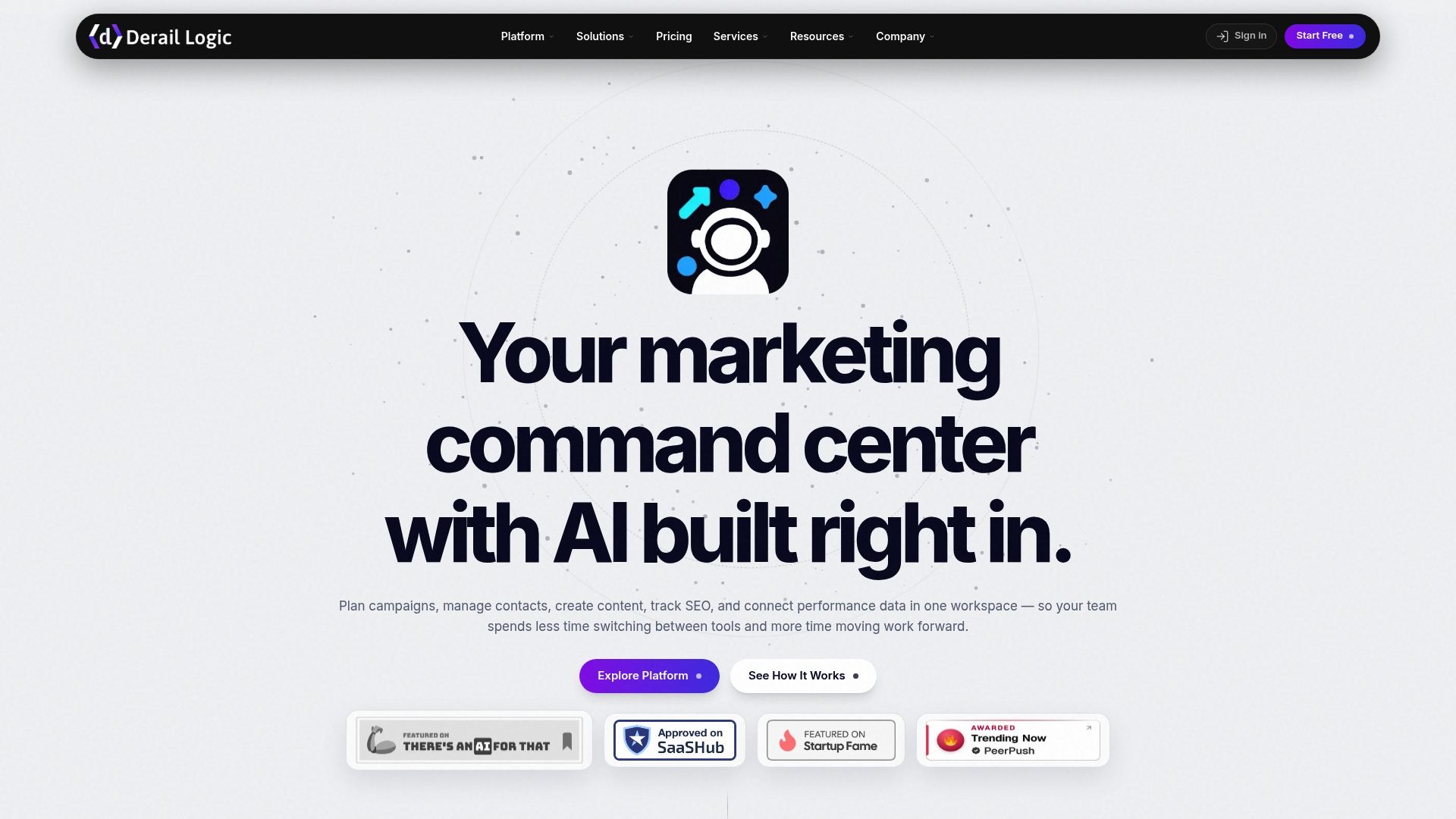
Derail Logic’s platform unifies the tools that agency teams typically run in parallel: a visual campaign studio, an intelligent CRM, analytics dashboards, and content management, all connected in a single workflow. For agencies where the real friction isn’t the ad platforms themselves but the coordination layer between campaigns, clients, and team members, that integration is where the time savings show up. The marketing automation capabilities handle the repetitive operational work so your team focuses on the judgment calls that actually move client results. If you’re managing multiple client campaigns and want a platform built around connected workflows rather than point solutions, Derail Logic is worth a close look.
Key Takeaways
The most effective multi-client campaign management system combines a standardized operational rhythm, client-specific documentation, and a platform stack that handles reporting and automation without adding coordination overhead.
| Point | Details |
|---|---|
| Standardized system beats capacity | Agencies running one operational rhythm across all clients scale without proportional headcount growth. |
| Naming conventions prevent errors | Client codes, YYYY-MM dates, and sequential version numbers keep any account readable by any team member. |
| Cross-channel coverage drives results | Campaigns coordinating across at least three channels achieve conversion rates 287% higher than single-channel campaigns. |
| Tiered client frameworks protect quality | Categorizing clients by budget and complexity prevents over-serving smaller accounts at the expense of larger ones. |
| Derail Logic for connected workflows | Derail Logic unifies campaign studio, CRM, analytics, and automation for agencies managing multiple client accounts. |
FAQ
How do you manage multiple clients at the same time?
The most effective approach is a single repeatable operational system applied across every client account: standardized naming conventions, a fixed weekly task cadence, tiered service frameworks, and templated reporting. Running each client on its own ad hoc process is what causes quality to degrade as client count grows.
How do you prioritize tasks when managing multiple clients?
Filter daily tasks by two criteria: impact (how much does this move a client’s key metric?) and urgency (what breaks if this doesn’t happen today?). High-impact, high-urgency tasks go first. Use tiered client frameworks to allocate senior talent to higher-value accounts rather than dividing attention equally across all clients.
What strategies help you handle multiple client queries without getting overwhelmed?
Set communication boundaries at onboarding: define which channels clients use to reach you, establish response time commitments, and clarify what triggers an unscheduled call versus what goes on the next scheduled agenda. Structured check-in schedules reduce the volume of ad hoc queries because clients already know when they’ll hear from you.
How can you improve campaign management across multiple accounts?
Agile project management practices correlate with higher campaign success rates in multi-client environments. Concretely, this means short optimization cycles, weekly performance reviews rather than monthly check-ins, and documented escalation thresholds so problems get flagged before clients notice them. Platforms like Synter, Asana, or Adzooma support these workflows depending on your agency’s size and channel mix.