



A low-budget digital marketing strategy is a focused set of cost-effective tactics that build measurable online visibility and sales without significant ad spend. The term “low-budget” is informal. The recognized industry framing is “owned and earned media marketing,” which covers assets you control, like SEO content, email lists, and organic social presence, rather than paid placements. Small business owners who build owned assets consistently outperform those who chase one-off paid campaigns. Email marketing ROI averages $36–$42 per $1 spent, which makes it the highest-return channel available to a small business on a tight budget.
What are the most effective low-budget digital marketing tactics?
The most effective affordable online marketing tactics share one trait: they compound over time. Each piece of SEO content, each email subscriber, and each five-star review adds to a foundation that keeps generating returns long after you created it.
- SEO content marketing. Publish one high-quality article per week targeting a specific search question your customers ask. Content marketing needs a 2–4 month ramp-up before organic traffic grows steadily, so start now and stay consistent. The payoff is free, recurring traffic that paid ads cannot replicate.
- Google Business Profile optimization. Claim and fully complete your profile, add photos weekly, and respond to every review. Optimizing your Google Business Profile and collecting 25+ reviews can generate 10–25+ leads per month at zero cost. That is a lead volume most small businesses pay hundreds of dollars to match with ads.
- Email list building. Offer a simple lead magnet, a checklist, a template, or a short guide, and capture emails on your website. Email reaches an opted-in audience that already trusts you, which is why its ROI outperforms paid advertising and SEO measured over 12 months.
- Referral marketing. Ask your best customers to refer one friend. Referrals carry trust and context, so they convert at higher rates than cold traffic. A simple referral incentive, like a discount or a free consultation, costs almost nothing.
- Selective paid testing. Once your messaging is proven organically, run a small paid test. Concentrate your budget on one channel for 4–6 weeks and measure before expanding. Paid ads without tested messaging burn money fast.
Pro Tip: Before you spend a dollar on ads, collect at least 10 organic customer conversations. The language your customers use to describe their problem is your best ad copy.
Measuring results matters as much as executing tactics. Track three metrics weekly: website sessions, email list growth, and leads generated. Small business owners who track marketing results systematically catch underperforming tactics early and redirect effort before wasting weeks.

What tools do you need to set up budget-friendly marketing?
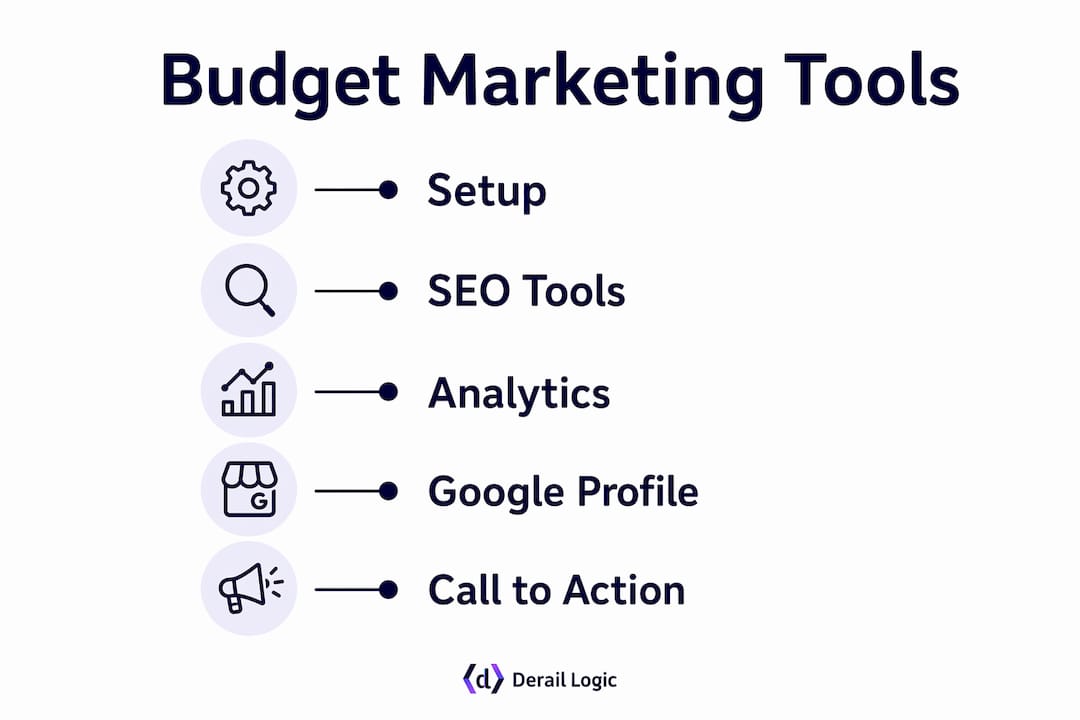
The right infrastructure costs little but saves enormous amounts of time. The table below covers the core categories and what to look for in each.
| Category | Free or low-cost options | What to set up first |
|---|---|---|
| SEO and keyword research | Google Search Console, Ubersuggest free tier | Connect Search Console to your website immediately |
| Email marketing | Mailchimp free plan, Brevo free tier | Create a single opt-in form and a 3-email welcome sequence |
| Social scheduling | Meta Business Suite (free), Buffer free plan | Schedule one week of posts in advance |
| Analytics | Google Analytics 4 (free) | Install on your website before any other step |
| Reputation management | Google Business Profile (free) | Set up review request templates |
Pro Tip: Set up Google Analytics 4 and Google Search Console on day one. Without baseline data, you cannot tell what is working three months from now.
Your Google Business Profile deserves special attention. 94% of consumers say online reviews influence their decision to use a business. That means your review count and rating are visible sales tools. Send a direct review request link to every satisfied customer within 24 hours of a positive interaction. Automating this follow-up with a simple email template takes 30 minutes to set up and runs indefinitely.
Your website needs one clear call to action per page. A cluttered homepage with five different offers converts poorly regardless of traffic volume. Pick one primary action, book a call, join the email list, or request a quote, and make it the dominant element on every key page.
Online reviews also connect directly to revenue. Reviews drive measurable SMB revenue growth when collected consistently, making reputation management one of the highest-leverage free activities available to small business owners.
How to build a weekly marketing routine on a budget
Consistency beats intensity in low-cost marketing. A repeatable weekly routine prevents the “feast or famine” cycle where you market hard for two weeks, get busy, and go silent for a month.
- Monday: Write and publish one SEO article. Target a specific question from Google’s “People Also Ask” section. Aim for 800–1,200 words with a clear answer in the first paragraph. High-insight-density content like a well-structured Google Doc or blog post outperforms costly video production in low-budget content marketing.
- Tuesday: Community engagement. Spend 20 minutes in two or three online communities where your customers gather. Answer questions genuinely. Do not pitch. Relationship-building in local and online communities generates referrals and brand recognition that paid ads rarely replicate.
- Wednesday: Email send or sequence check. Send a short, value-focused email to your list or review your automated welcome sequence for gaps. Keep emails under 300 words. One clear point per email outperforms newsletters that try to cover everything.
- Thursday: Review and reputation check. Respond to any new Google reviews, positive or negative. Send review request messages to customers from the past week. This takes 15 minutes and compounds your local search ranking over time.
- Friday: Metrics review. Check your three core metrics: website sessions, email subscribers added, and leads generated. Note what changed and why. Adjust next week’s content topic based on what search queries brought traffic.
A few additional habits keep the routine from breaking down:
- Batch your content writing. Write two or three articles in one session rather than one per day.
- Repurpose each article into three social posts. One quote, one tip, and one question to your audience.
- Keep a running list of customer questions. Every question is a future article topic.
Focus on one or two primary channels for the first 60–90 days. Spreading effort across too many platforms at once reduces effectiveness across all of them.
Common mistakes in DIY digital marketing strategies
The most common mistake is starting on too many channels at once. Prioritizing one channel for 60–90 days creates a repeatable growth path. Splitting attention across five platforms produces mediocre results on all five.
- Underestimating time commitment. Effective budget marketing is not free. It trades money for time. Plan for 8–12 hours per week of focused marketing activity, especially in the first three months.
- Ignoring conversion rate optimization. Driving traffic to a website that does not convert is invisible waste. Before publishing more content, check that your opt-in form works, your call to action is clear, and your page loads in under three seconds.
- Skipping review collection systems. Most small business owners ask for reviews occasionally. The ones who grow fastest build a system: a templated message, a direct link, and a consistent send schedule after every transaction.
- Running paid ads too early. Paid advertising without tested messaging and a conversion-ready landing page wastes budget. Validate your offer organically first. When customers respond to your free content and referrals, you have proof the message works before you pay to amplify it.
- No clear positioning. Early marketing success depends on clear positioning and community trust more than follower counts or broad branding. Define exactly who you serve and what problem you solve before creating any content.
Pro Tip: Run a “message test” before any paid campaign. Post your offer in three online communities or send it to your email list. If you get no responses, the message needs work, not a bigger budget.
Key takeaways
A focused, consistent approach to owned and earned media marketing outperforms scattered spending across paid channels for small business owners operating on a tight budget.
| Point | Details |
|---|---|
| Own your assets first | Build your email list and SEO content before spending on paid ads. |
| Reviews drive real leads | Collecting 25+ Google reviews can generate 10–25+ leads per month at zero cost. |
| Email delivers the best ROI | Email marketing returns $36–$42 per $1 spent, more than any other digital channel. |
| Focus beats breadth | Commit to one primary channel for 60–90 days before adding a second. |
| Measure from day one | Install Google Analytics 4 and Search Console before publishing any content. |
Why I think most small business owners market in the wrong order
The pattern I see most often is this: a small business owner spends money on Facebook ads before they have a working email list, a clear offer, or a single customer review. The ads underperform. They conclude that digital marketing does not work for their business. The real problem was sequence, not budget.
The right order is unglamorous. Build your Google Business Profile. Collect reviews. Write ten articles answering the questions your customers actually ask. Build an email list of 200 people who opted in because your content helped them. Then, and only then, test a small paid campaign to amplify what is already working.
No-budget marketing forces prioritization on problem-first content and direct outreach. That constraint is actually an advantage. It forces you to talk to customers, understand their language, and build messaging that resonates before you spend a dollar to broadcast it.
The solopreneurs I have seen grow fastest share one habit: they treat their email list as their most valuable business asset, not their social media following. Followers are rented. Your email list is owned. When a platform changes its algorithm, your list keeps working.
Patience is the real budget. Most small business owners quit SEO content after six weeks because they do not see traffic yet. The 2–4 month ramp-up period is not a failure signal. It is the cost of entry for a channel that will generate free leads for years.
— Zachary
When marketing automation makes sense for your budget strategy
Growing a small business on a tight budget means every hour counts. Once your core tactics are running, the next constraint is time, not ideas. That is where Derail Logic’s marketing automation platform changes the equation.
Derail Logic connects your email sequences, CRM, campaign calendar, and analytics into one workflow. You stop copying data between tools and start seeing which campaigns actually drive revenue. The platform’s AI-powered insights surface what is working before you have to dig for it, so you spend your limited hours acting on signals rather than hunting for them. For small business owners ready to scale what is already working, Derail Logic removes the operational drag that holds growth back.
FAQ
What is a low-budget digital marketing strategy?
A low-budget digital marketing strategy uses owned and earned media tactics, like SEO content, email marketing, and Google Business Profile optimization, to generate leads and sales without significant ad spend. It trades money for consistent time and effort.
How long does it take to see results from low-budget marketing?
SEO content marketing requires a 2–4 month ramp-up with consistent weekly publishing before organic traffic grows steadily. Email and review collection can generate leads within the first 30 days.
What is the highest-ROI low-budget marketing tactic?
Email marketing delivers the highest measured ROI, averaging $36–$42 per $1 spent, which outperforms paid advertising and SEO over a 12-month period.
How many marketing channels should a small business start with?
Start with one primary channel and commit to it for 60–90 days. Spreading effort across multiple platforms simultaneously reduces effectiveness on all of them and slows your ability to find a repeatable growth path.
Do online reviews really affect small business growth?
94% of consumers say online reviews influence their decision to use a business. Collecting 25 or more Google reviews, combined with an optimized Google Business Profile, can generate 10–25+ leads per month at no cost.