



Generative engine optimization (GEO) is the practice of structuring, evidencing, and formatting content so AI systems like ChatGPT, Perplexity, and Google’s AI Overviews cite it when synthesizing answers. Three moves matter most right now: add citations from authoritative outside sources, back claims with verifiable statistics, and package answers into short, extractable capsules a model can lift cleanly. Get those three right before touching anything else.
TL;DR:
- Adding citations from authoritative sources and verifiable statistics can increase your content’s likelihood of being referenced in AI-generated answers, especially for lower-ranked pages.
- Structuring content into short, answer-focused capsules and including comparison tables significantly improves the chance of being lifted by generative engines.
- Ensuring crawlability, proper schema implementation, and current data verification are essential for maximizing AI citations and avoiding content decay over time.
- Measurement of GEO success centers on citation rate, impression score, share-of-model, and AI referral traffic, not traditional search rankings.
- Effective GEO strategies require coordinated efforts across content, subject matter experts, analytics, and engineering to maintain evidence accuracy and adapt to evolving AI models.
Table of Contents
- What Is Generative Engine Optimization and How Does the Citation Pipeline Work?
- How Does GEO Differ From SEO?
- What Are the Highest-Impact GEO Tactics Right Now?
- How Do You Make Content Machine-Readable for AI Ingestion?
- How Do You Measure GEO Performance?
- How Should GEO Fit Into Content Operations?
- A Practitioner’s View: How Integrated Tooling Supports GEO Workflows
- What Are the Real Limitations of Generative Engine Optimization?
- What Prompt Engineering Practices Actually Support GEO?
- What Ethical Issues Come With Generative Engine Optimization?
- What Do Successful GEO Implementations Look Like?
- Editorial Take: What the Research Actually Supports
- How MartechAI Helps Teams Ship GEO Workflows
- Sources
- FAQ
What Is Generative Engine Optimization and How Does the Citation Pipeline Work?
Every generative engine runs the same basic sequence: retrieval, synthesis, citation. It retrieves candidate documents for a query, synthesizes an answer by blending information across those documents, then attaches citations to the sources it leaned on hardest. GEO is the work of making your content survive all three stages, not just the first one.
This is the part traditional SEO teams miss. Ranking #1 used to be the finish line. Now it’s just the entry ticket. A page can rank near the top and still get skipped in synthesis if a lower-ranked competitor states the same fact more clearly, with a number attached. Research from Aggarwal et al. frames this as a retrieval-augmented generation (RAG) problem: the model doesn’t “read” your page like a person does, it extracts fragments it can defend.
What actually determines whether a fragment gets extracted:
- Whether the claim is stated as a discrete, quotable sentence rather than buried in a long paragraph
- Whether a number or statistic anchors the claim
- Whether the source carries independent authority the model can point to
- Whether the surrounding content is unambiguous enough to lift without misrepresenting it
Google’s own guidance on optimizing for generative AI features confirms these systems are grounded in core Search infrastructure. Ranking well and getting cited are related, but they’re not the same reward.
How Does GEO Differ From SEO?
SEO optimizes for retrieval: getting the page to show up. GEO optimizes for what happens after that, when the model decides which retrieved passages actually earn a place in the answer. That’s a real shift in the unit of value. SEO’s currency is rank position and click-through. GEO’s currency is citation recall (how often your content gets pulled into an AI answer) and impression score (how visible your brand is across sampled AI responses for a topic).
None of this means SEO’s foundation gets thrown out. GEO builds directly on top of it. As Google’s own framing puts it, generative features are grounded in the same crawlable, indexable substrate that classic Search has always required.
What stays from SEO:
- Crawlability and clean indexation
- Fast, mobile-usable pages
- Topical authority built over time
- Internal linking that clarifies site structure
What GEO adds on top:
- Explicit, quotable claims with statistics attached
- Named sources and quotations that lend third-party weight
- Content structured into extractable units (short answer blocks, comparison tables)
- Measurement built around citation frequency, not just rank
Teams that treat GEO as a replacement for SEO waste effort rebuilding what already works. Teams that treat it as a bolt-on skip the highest-leverage tactics entirely.
What Are the Highest-Impact GEO Tactics Right Now?
Not every GEO tactic carries equal weight, and the data on this is more specific than most guides let on. Controlled experiments behind the GEO-Bench research found that adding citations, statistics, and quotations to existing content produced notable visibility lifts on average, with pages that started ranked lower in search seeing the largest gains according to some tests. Pages already sitting in top positions showed minimal change, as they had little room left to climb.
Here’s the priority order that evidence supports:
- Add citations to Tier-1 sources. Linking claims to recognized, authoritative outside references gives the model a defensible basis for repeating your framing rather than a competitor’s.
- Attach verifiable statistics to every major claim. A number the model can quote is far more liftable than an adjective. “Fast” gets ignored. “40% lift” gets cited.
- Include direct quotations. Quoted language from a named expert or study reads as evidence rather than assertion, and models tend to preserve quotes verbatim when they cite them.
- Build answer capsules. Short, self-contained 40 to 60 word blocks that fully answer one specific question tend to get lifted whole, according to practitioner analysis from Semrush’s GEO guide.
- Use scannable comparison structures. Pros/cons lists and short tables give a model clean, low-ambiguity fragments to extract instead of forcing it to summarize a dense paragraph.
Pro Tip: Rewrite your strongest existing paragraph as a 45-word answer capsule before writing anything new. Retrofitting proven content is faster than producing fresh pages, and it’s where the GEO-Bench lift numbers were actually measured.
What to avoid is just as important as what to add. Keyword stuffing does nothing for citation odds. Fabricated statistics or inflated claims get flagged by fact-checking layers in some engines and can actively suppress citation. Fake or paid mentions designed to simulate third-party corroboration are also a bad bet. CXL’s analysis of Google’s AI search guidance warns specifically against brittle, AI-only hacks. GEO tactics improve citation probability. They don’t guarantee it, because engines weigh dozens of signals at once, and no single tactic overrides the rest.
How Do You Make Content Machine-Readable for AI Ingestion?
Structured data is not a magic switch, but it removes ambiguity a model would otherwise have to resolve on its own. Google is explicit that structured data helps but isn’t required for generative features. The bigger lever is crawlability: if a crawler can’t reliably access and parse the page, no amount of schema fixes that.
Prioritize schema types in this order:
- Article schema, so the model can identify authorship, publish date, and topic scope cleanly.
- FAQPage schema, which maps naturally onto the question-and-answer format generative engines already favor.
- Person schema for named authors, which supports the credential signals models weigh when judging source trust.
- Product schema for anything with a price, spec, or availability status.
Microsoft’s guidance on AI-driven discovery goes further, framing the website itself as an API-like data source: price, specs, and availability need to be machine-readable so AI agents can act on them directly, not just describe them. That means putting prices in plain text near the schema markup, not only inside an image or a JavaScript-rendered widget a crawler might not execute.
Canonical URLs matter more in a multi-engine world than they did under single-engine SEO, since duplicate or near-duplicate pages splinter the citation signal across URLs instead of consolidating it on one. A structured-data workflow that checks JSON-LD accuracy against the visible page content on every publish catches the drift that breaks this over time.
Industry tracking shows AI search adoption climbing fast enough that marketing teams increasingly treat AI visibility as its own budget line rather than a subset of SEO reporting. That shift alone justifies the engineering time schema and crawlability work requires.
How Do You Measure GEO Performance?
Four metrics matter, and none of them come from a standard rank tracker.
- Citation rate: how often your domain gets cited in AI-generated answers for your target queries, sampled manually or through a monitoring tool.
- Impression score: how visible your brand is across a basket of AI answers for a topic, whether cited or just mentioned.
- Share-of-model: your citation share relative to competitors within the same query set, tracked per engine.
- AI referral traffic: sessions arriving from AI chat interfaces and AI Overview click-throughs, visible in analytics referral data once you segment for it.
Google Search Console’s generative AI reporting is the first place to check, since it surfaces impressions tied specifically to AI Overviews. Beyond that, manual sampling across engines still matters: run the same query set through several AI tools weekly and log which domains get cited. GEO-Bench’s findings note that different engines favor different domain ecosystems, so a single-engine check will miss real movement elsewhere.
For experimentation, run staggered rollouts rather than blanket changes: add citations and stats to one batch of pages, leave a matched control batch untouched, then compare citation rate after several weeks. That isolates which specific tactic moved the needle instead of crediting a general content refresh.
How Should GEO Fit Into Content Operations?
GEO breaks when it’s treated as one person’s side project. It works when four roles touch every piece before publish:
- Content strategist owns the answer structure and capsule format, deciding what question each section actually answers.
- Subject-matter expert supplies and verifies the statistics and quotations, so nothing gets cited that can’t be defended.
- Analytics owner tracks citation rate and impression score against a baseline, flagging pages worth retrofitting first.
- Engineering maintains schema accuracy and crawlability, catching drift between markup and visible content.
Editorial QA should check evidence sourcing, correct attribution, and schema validity before anything ships. Distribution deserves equal weight: earned mentions in third-party outlets measurably raise citation odds, because engines show a documented bias toward independent corroboration over brand-owned claims. A page with strong on-site GEO work and zero outside mentions will underperform one with modest on-site work and real third-party coverage.
A Practitioner’s View: How Integrated Tooling Supports GEO Workflows
Most GEO failures aren’t tactical. They’re operational. A team writes a strong, well-cited page, then nobody checks six months later whether the statistic still matches the source, or whether the schema still reflects a price that changed twice since launch. GEO decays quietly unless something is watching it.
That’s the gap an integrated system needs to close: pulling live business data, verifying it against what’s published, and flagging drift before it costs a citation. MartechAI’s AI engine is built around that exact problem, using RAG-style retrieval across connected data sources so content teams can check that a published claim still matches current pricing, specs, or performance numbers before an AI engine cites (or stops citing) a stale fact.
The workflow sketch is simple: pull current data, verify claims against it, publish with accurate schema, then monitor. That loop is where most teams lose the thread.
What Are the Real Limitations of Generative Engine Optimization?
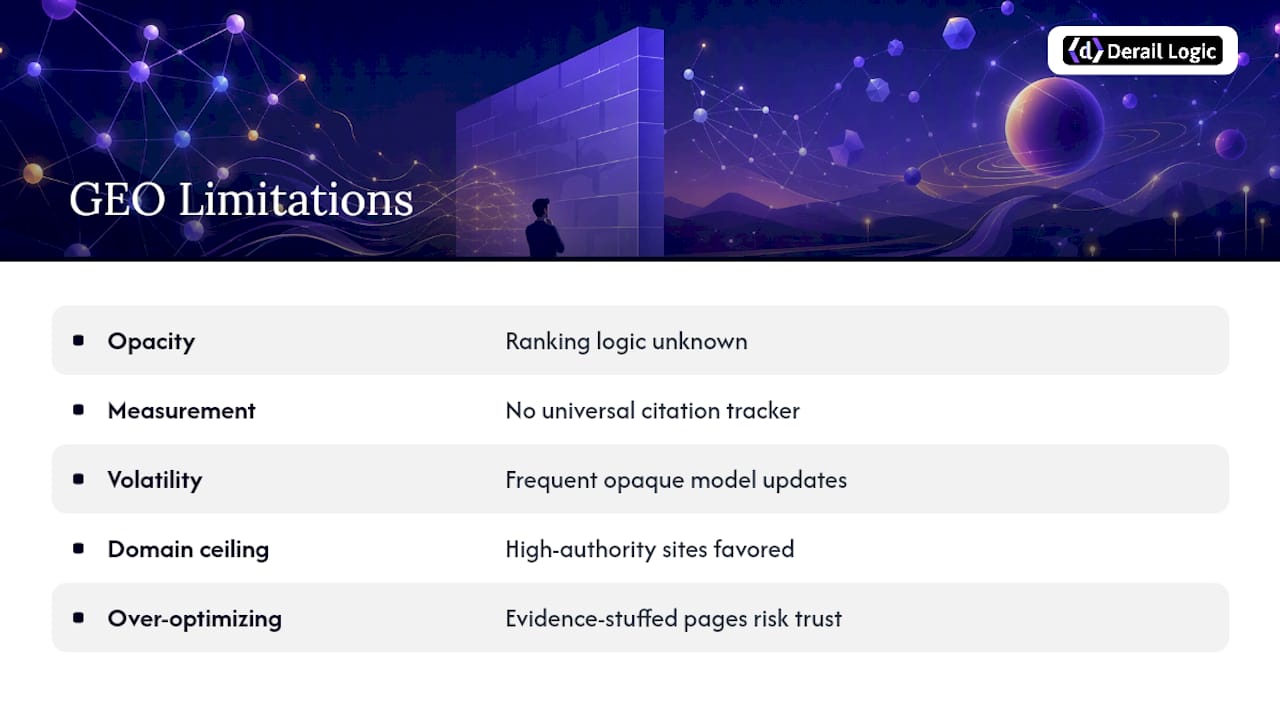
GEO tactics raise citation probability. They don’t guarantee it, and pretending otherwise sets up unrealistic expectations with stakeholders.
The biggest limitation is opacity. No engine publishes its full ranking or citation logic, so every tactic here is inferred from controlled experiments and observed patterns, not a documented algorithm. What lifts citation odds on one engine may do less on another, since different engines favor different domain ecosystems and weight signals differently.
Measurement is also harder than SEO measurement ever was. There’s no universal citation-tracking dashboard equivalent to a rank tracker. Teams are stuck sampling manually across multiple engines, which is slower and less precise than pulling a keyword position report.
Volatility compounds this. Generative engines update their models and retrieval logic more frequently, and less transparently, than search engines update ranking algorithms. A tactic that worked in one quarter can quietly stop working the next, with no changelog explaining why.
There’s also a structural ceiling for smaller sites: engines lean toward established, high-authority domains for anything touching health, finance, or safety topics, regardless of how well a smaller site structures its content. GEO can close some of that gap through evidence and earned mentions, but it can’t fully override domain authority the way a clever technical fix sometimes can in SEO.
Finally, CXL’s caution against over-optimizing for AI-only signals holds up: chasing citation at the expense of genuinely useful content risks producing pages that read as evidence-stuffed rather than helpful, which can backfire with both readers and the ranking systems feeding the AI layer in the first place.
What Prompt Engineering Practices Actually Support GEO?
Prompt engineering shows up in GEO in two places: how you use AI tools to draft or research content, and how you anticipate the prompts real users will type into AI engines.
On the drafting side, the most useful prompts ask a generative tool to produce content in the exact extractable shapes described earlier: a 45-word answer capsule for a specific question, a comparison table with named criteria, a numbered list with one clear action per item. Vague prompts like “write about X” produce vague, unliftable prose. Specific prompts like “answer this exact question in under 60 words, include one statistic” produce content shaped the way engines actually want to consume it.
On the research side, prompting an AI tool to surface the actual phrasing users type into chat interfaces, not just search-style keywords, tends to reveal more conversational, multi-part questions than a traditional keyword tool shows. That’s useful because generative engines are answering conversational questions, not matching keyword strings.
The Mind Reader approach from ACL 2026 pushes this further with query-augmentation techniques: generating multiple phrasings of the same underlying question and checking whether content addresses the reasoning behind each variant, not just the literal words. That requires more engineering investment than most content teams have on hand, but it’s the direction advanced GEO work is heading.
The discipline in both cases is the same: treat the prompt as a specification for structure, not just a request for words.
What Ethical Issues Come With Generative Engine Optimization?
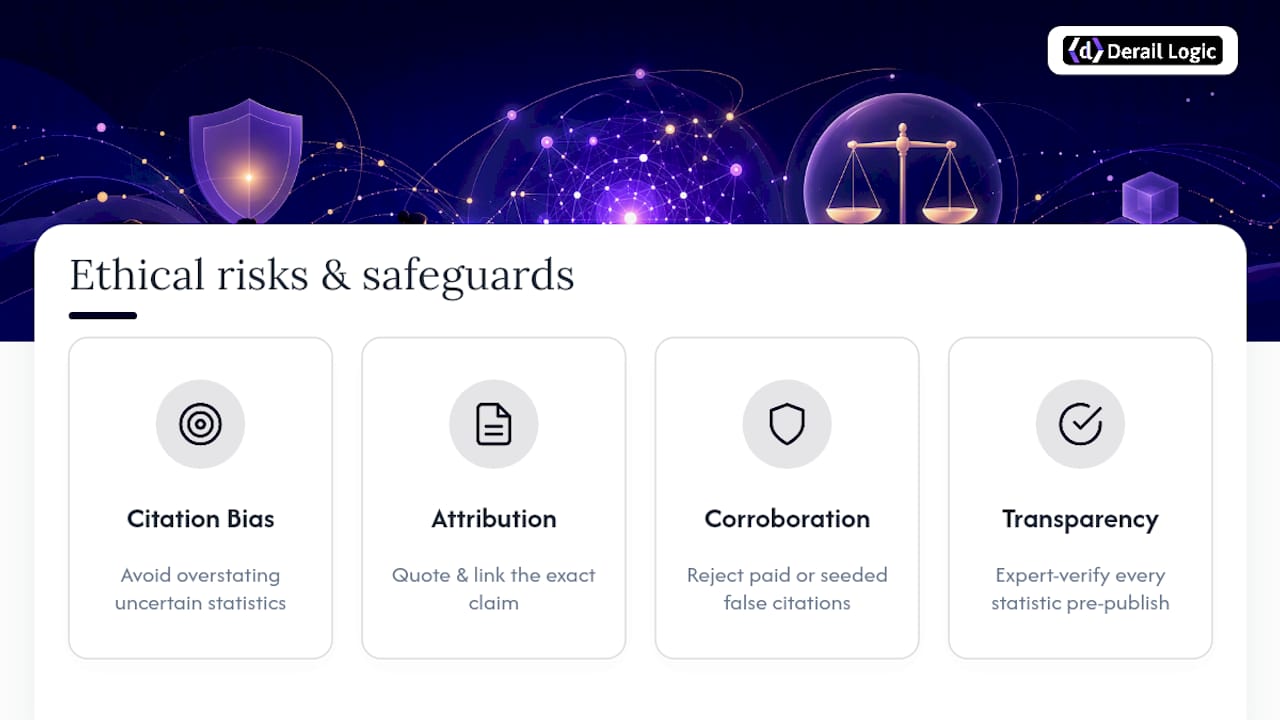
The core ethical risk in GEO is straightforward: it’s tempting to optimize for what gets cited rather than what’s true. A statistic phrased confidently gets lifted more often than a hedged one, which creates pressure to overstate certainty on claims that don’t deserve it.
Attribution integrity matters just as much. Quoting a source correctly, linking the actual claim it makes rather than a claim it merely resembles, and never inventing a statistic to hit a “numbers get cited more” pattern are baseline requirements, not aspirational ones. An engine that cites a fabricated figure is repeating your error to every user who asks that question, at scale, with your domain attached to it.
There’s a subtler issue in manufactured corroboration: seeding fake mentions, paid placements disguised as independent coverage, or coordinated “third-party” citations to simulate the earned-media signal engines actually reward. This isn’t just risky because engines are getting better at detecting it. It corrodes the actual value of earned corroboration for everyone, including the site doing it, once detection catches up.
Transparency about AI-assisted content production is the last piece. Using AI tools to draft, structure, or research content is now standard practice, but presenting AI-assisted claims as independently verified human expertise when they haven’t been checked is a trust problem, not just a compliance one. The fix is procedural: have a subject-matter expert verify every statistic and quotation before publish, regardless of how the draft was produced.
What Do Successful GEO Implementations Look Like?
The clearest evidence of what works comes from the controlled testing itself rather than isolated success stories. The GEO-Bench experiments tested the same interventions, citations, statistics, and quotations, across a large set of pages and queries, and found the pattern held consistently: pages that started in weaker positions saw the largest visibility gains after adding evidence-based content, while pages already dominant saw little change. That’s a repeatable result, not a one-off case study, which makes it more useful for planning than any single anecdote would be.
Practitioner-side patterns point the same direction. Ecommerce teams applying short answer capsules, comparison tables, and named-author schema to product content report the pattern holds at the page level: a product page answering “does this fit X use case” in a tight, quotable block outperforms a page burying the same answer in marketing copy. The product page optimization checklist approach, structured specs, clear comparison points, verified pricing, maps directly onto what these tests reward.
The common thread across both the research and the applied examples is specificity. Vague, well-written brand content underperforms plainer content that states a number, names a source, and answers one question completely. That’s a harder discipline than it sounds, because it means cutting language that reads well but says nothing measurable.
Editorial Take: What the Research Actually Supports
Most GEO advice online treats every tactic as equally important, which the evidence doesn’t support. The controlled experiments behind GEO-Bench are unusually specific: citations, statistics, and quotations drove the visibility lift, and the gain concentrated in pages that started ranked lower, not the ones already winning. That’s a narrower, more useful finding than “add more evidence,” and it should reorder most teams’ priority lists.
The conventional advice oversells structured data. Schema markup gets treated as a GEO silver bullet in a lot of guides, but Google says plainly that it’s helpful, not required, and crawlability matters more. Teams spending a quarter on schema before fixing basic evidence gaps are optimizing the wrong layer first.
What I’d prioritize, in order: retrofit your weakest-ranked, highest-intent pages with real statistics and named sources first, since that’s where the documented lift concentrates. Fix crawlability issues second. Treat schema and advanced query-augmentation work as a third-phase investment once the evidence layer is solid. Skipping straight to the technical work because it feels more actionable is the most common misallocation I see.
— Zachary
How MartechAI Helps Teams Ship GEO Workflows
MartechAI is the alternative to stitching together five disconnected tools to run a GEO program: one workflow instead of a spreadsheet tracking citations, a separate SEO tool auditing schema, and a CMS nobody’s checking against current pricing. The platform’s visual campaign studio and AI engine pull from live business data across connected sources, so the statistics and specs you publish stay verified against what’s actually true today, not what was true when the page launched.

The analytics layer tracks signals relevant for GEO work, alongside SEO audits, keyword tracking, and structured-data checks often managed across separate tools. If you’re evaluating whether to bring GEO workflow ownership into one system, the Free plan is the fastest way to see how campaign planning and structured content review sit together in one workspace, and the Core, Growth, and Agency tiers scale up from there as your evidence-sourcing and schema QA workload grows.
Sources
For deeper technical grounding, read Aggarwal et al.’s GEO research, the controlled study behind most of the citation-lift figures in this guide. Google’s official generative AI optimization guidance is the most authoritative word on crawlability and structured data. Semrush’s practical GEO guide and this independent GEO explainer round out the applied, checklist-driven side of the discipline.
- 2509.08919 Generative Engine Optimization: How to Dominate AI Search
- Optimizing your website for generative AI features on Google Search
- Mind Reader: Latent User Demand-Guided Content Optimization for Generative Search Engine
FAQ
Is GEO Replacing SEO?
No. GEO builds on SEO’s crawlable, authoritative foundation and adds synthesis-focused evidence, like statistics and citations, that models can lift into answers. Google’s own generative AI guidance explicitly frames these features as grounded in core Search systems, not a separate discipline replacing it.
Which GEO Tactics Move Citation Odds the Most?
Adding citations to Tier-1 sources, verifiable statistics, and direct quotations produced the largest measured gains, roughly a 40% visibility lift on average in controlled GEO-Bench experiments. Lower-ranked pages saw the biggest jumps, since top-ranked pages had less room to improve.
How Long Does It Take to See GEO Results?
There’s no fixed timeline, since generative engines update models and retrieval logic on their own schedules with little public documentation. Most teams start seeing measurable citation-rate movement within a few weeks of adding evidence to a retrofitted page, but consistent tracking across multiple engines is needed to confirm it’s real and not sampling noise.
Do I Need Schema Markup for GEO?
Structured data helps but isn’t required, according to Google’s own guidance. Crawlability and clear, evidence-backed content matter more than schema completeness, though Article, FAQPage, and Person schema still support how models judge source credibility.
What Does MartechAI Cost for a Team Starting GEO Work?
MartechAI offers a Free plan at $0 per month, with the Core plan at $69 per month, Growth at $129 per month, and Agency at $299 per month, each scaling features and workspace limits. Current details on all plans, including add-ons like extra workspaces, are listed on the pricing page.