



Brand voice AI analyzes and applies your company’s tone, vocabulary, and style rules so that content, whether a support reply or a landing page draft, sounds like it came from the same person. The technology earns its place once a team has more than one writer or channel to manage: it cuts review cycles, speeds up onboarding for new hires and freelancers, and keeps tone consistent when volume outpaces what a human editor can check line by line.
TL;DR:
- Building a detailed voice profile involves defining specific personality traits, restrictions, and collecting diverse examples from internal sources beyond edited marketing content.
- Testing the AI across various emotional states and channels before deployment helps prevent tone drift and ensures consistent customer experience.
- Separating tone guidelines from procedural rules makes it easier to update and maintain the voice profile without unintended distortions.
- Using a centralized platform for applying the same brand voice across all customer-facing channels reduces inconsistency and streamlines content management.
- Regular governance practices, including ongoing monitoring, threshold setting, and version control, are crucial to sustain authentic and on-brand AI-generated content.
Table of Contents
- What Brand Voice AI Actually Does
- How to Build a Brand Voice Profile an AI Can Use
- What Data Actually Trains an Authentic Voice Model
- Testing, Governance, and Monitoring to Prevent Tone Drift
- Common Pitfalls and Short Fixes
- The Platform Case for Brand Voice AI
- How MartechAI Helps Teams Apply One Voice Everywhere
- Recommended Reading and Docs
- Sources
- FAQ
What Brand Voice AI Actually Does
Most marketing teams assume brand voice AI just paraphrases text into a friendlier tone. In practice, the better tools work off a profile, a set of rules and examples that tells the model how your brand talks before it writes a single word. That profile then gets applied across every channel that produces customer-facing text.
The practical use cases fall into a few buckets:
- Profile-driven drafting: blog posts, product descriptions, and ad copy generated from a single voice reference instead of a generic prompt.
- Social comment moderation: automated replies to comments and reviews that match your tone instead of sounding like a canned bot response.
- Support responses: helpdesk tools like Gorgias let teams configure a custom tone field so AI replies match the brand instead of defaulting to generic customer-service language.
- Email templates and campaign variations: dozens of subject-line or CTA variants that still read like one brand wrote them.
The measurable payoff shows up in three places: shorter review time because drafts arrive closer to final, faster ramp-up for new hires who can lean on the profile instead of a style guide nobody reads, and steadier customer experience because a reply written at 9 a.m. sounds like one written at 9 p.m. Applying a voice profile at draft time, rather than fixing tone after the fact, is what actually cuts down on manual rewriting for freelancers and in-house writers alike.
How to Build a Brand Voice Profile an AI Can Use
A voice profile is not a mission statement. It is a working document the AI references every time it drafts something, and it needs enough specificity that two different writers using it would produce nearly identical output. Here’s how to build one.
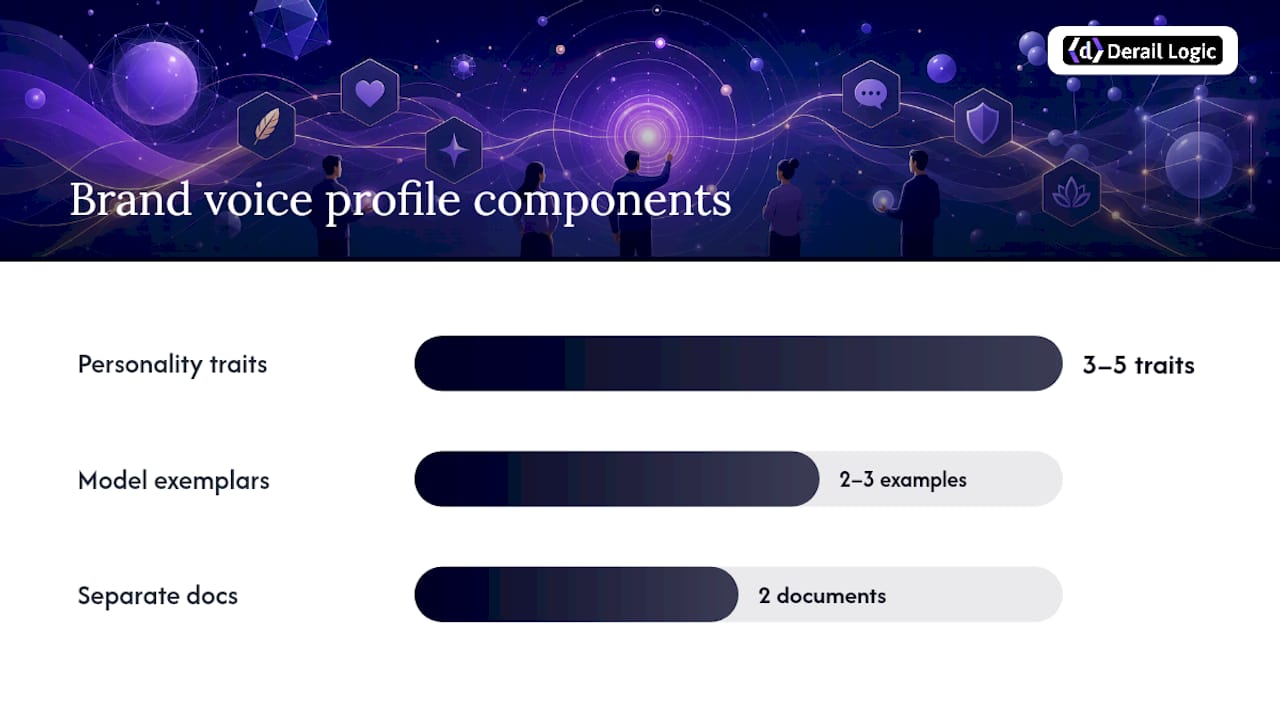
- Define personality attributes and hard rules. List three to five traits (direct, warm, technical) and pair each with a concrete rule: banned phrases, preferred vocabulary, sentence-length limits, whether contractions are allowed.
- Decide channel scope and persona variations. Marketing copy, support replies, and social comments often need the same core voice with different formality levels. Map which channels share one profile and which need a lighter variant.
- Collect exemplars for key scenarios. Write two or three model replies for common situations: a complaint, a refund request, a product question. These examples teach nuance that abstract rules miss.
- Separate persona instructions from procedural guidance. Keep tone rules (how the brand sounds) in one document and behavior rules (what the brand is legally or operationally required to say) in another. Vendor guidance on AI tone design recommends this split explicitly, because blending the two makes both harder to update.
Many platforms offer starting presets, friendly, professional, sophisticated, or custom, as a baseline before you layer in your own rules, which is worth using rather than building from a blank page.
Pro Tip: Write your banned-phrases list before your approved-vocabulary list. Teams find it easier to agree on what sounds off-brand than to agree on what sounds perfectly on-brand, and the exclusion list catches more real mistakes.
What Data Actually Trains an Authentic Voice Model
Blog posts alone will not teach an AI your brand’s real voice. Published content is polished and edited, which means it strips out the phrasing quirks and pragmatic shortcuts that actually make your brand sound human. The stronger approach pulls from Slack threads, support transcripts, internal emails, and meeting notes alongside your marketing copy, because that mix captures how your team talks under normal, unpolished conditions.
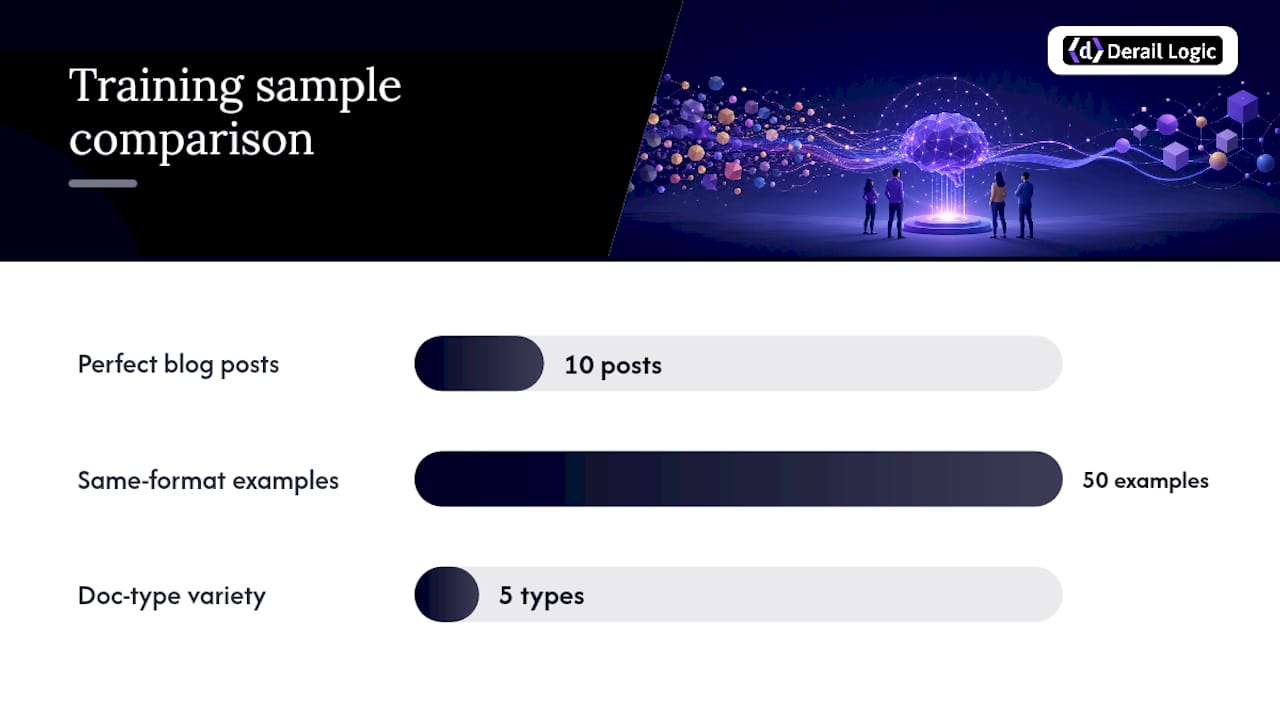
Tools built for this, including Anthropic’s Brand Voice plugin, work by aggregating scattered internal sources, Notion pages, Google Drive docs, Slack history, meeting transcripts, into one reference the AI treats as ground truth. That breadth matters more than volume. A narrow set of ten perfect blog posts trains a model to sound like a press release, not like your brand.
Before any of that goes into a training set or a profile document, run it through a quick checklist:
- Strip customer names, account numbers, and any personally identifiable information.
- Remove one-off exceptions (a legal disclaimer written for a single incident) that don’t represent standard voice.
- Flag and label edge cases separately, angry customer replies, apology emails, so the model learns tone range rather than treating them as noise.
- Aim for source variety over a single content type; a mix of five or six document types beats fifty examples of the same format.
There’s no universal minimum sample size that works across every brand, but teams that pull from only one channel consistently produce profiles that sound flat outside that channel.
Testing, Governance, and Monitoring to Prevent Tone Drift
A voice profile that looks right on paper can still fail in production if nobody tests it against real conversations first. Product documentation for AI support tools consistently points to a playground or test-conversation workflow as the step teams skip and then regret.
Before any profile goes live, run it through every channel it will touch, support, social, email, with a batch of sample inputs and read the outputs as a customer would. Tone needs to flex without breaking character: an AI that stays chipper through a refund complaint has failed the test even if the grammar is perfect. Guidance on tone design specifically calls for testing across emotional states, so the same brand voice escalates empathy for a complaint while staying casual for a routine question.
Ongoing governance needs a few fixed habits:
- Set confidence thresholds that route uncertain drafts to a human before publishing.
- Track CSAT alongside tone-drift sampling, not tone in isolation.
- Version every profile update so you can trace when and why output changed.
- Log escalations and edits so patterns in AI mistakes surface over time.
Pro Tip: Schedule a monthly ten-minute audit where someone reads twenty random AI-generated replies cold, without knowing which ones were flagged. Drift shows up faster in a blind read than in a metrics dashboard.
Common Pitfalls and Short Fixes
Most brand voice AI failures trace back to a handful of repeatable mistakes, and each one has a straightforward fix.
- Mixing tone and procedure in one document. When persona instructions and behavioral rules live in the same file, updates to one accidentally break the other. Fix: keep separate documents for how the brand sounds and what it’s required to say.
- Training on a small, homogenous dataset. A profile built only from finished marketing copy produces stiff, over-formal output. Fix: widen sources to Slack, transcripts, and internal docs, and deliberately sample edge cases.
- Skipping emotional-state testing. A profile that never gets tested against a complaint or refund scenario will eventually mishandle one live. Fix: build a standing test set covering anger, confusion, and gratitude before launch.
- Automating without a fallback. Full automation with no human checkpoint turns one bad draft into a public mistake. Fix: set review thresholds for high-stakes categories like refunds, legal language, and executive communication.
The Platform Case for Brand Voice AI
Most teams build a voice profile once and then watch it fragment. The support team’s tone guide lives in one doc, the CRM’s email templates carry another, and the social calendar runs on whatever the newest hire remembers from onboarding. A centralized profile fixes that only if it actually reaches every tool touching customer-facing text, campaign studio, CRM follow-ups, content drafts, and scheduled social posts, not just the one channel someone remembered to update.
That’s the gap a unified platform is built to close. Applying one voice reference across campaign planning and creator workflows, an intelligent CRM, and a content studio means a support reply and a landing page draft pull from the same source instead of drifting apart. Pairing that with retrieval-based AI insights and on-brand visual generation keeps messaging and imagery aligned instead of managed in separate tools.
If you’re piloting this, start narrow: one channel, one stakeholder group, one clear win to measure before expanding scope.
— Zachary
How MartechAI Helps Teams Apply One Voice Everywhere
Derail Logic is the alternative to juggling five disconnected tools to keep tone consistent, one centralized profile applies across your content studio, CRM follow-ups, campaign copy, and social scheduling instead of living in a doc nobody opens.
MartechAI’s engine uses your actual business data, campaign history, support patterns, past copy, to draft on-brand content and generate branded visuals from the same reference points, rather than treating writing and imagery as separate problems. That’s useful whether you’re an e-commerce team standardizing product descriptions at scale, an agency managing voice profiles across multiple clients, or a sales team keeping CRM follow-ups on-brand without hand-editing every message.
If tone inconsistency is already costing you review time, start with the marketing automation service page to see how the platform applies a voice profile across channels, or head to MartechAI to start a trial and test it against your own content before committing to anything.
Recommended Reading and Docs
For deeper implementation detail, review Anthropic’s Brand Voice plugin documentation on aggregating internal sources, Decagon’s explainer on AI tone of voice for emotional-state testing, and Gorgias’s tone configuration docs for a practical playground workflow. For broader strategy, this guide to building a brand online with AI covers adoption beyond voice alone.
Sources
- Brand Voice Plugin | Claude by Anthropic
- What is tone of voice in AI? | Decagon
- Customize AI Agent’s tone of voice | Gorgias
- Make AI write in your voice, not a stock one | Frase
FAQ
What is brand voice AI?
Brand voice AI refers to tools that use a defined tone, vocabulary, and style profile to generate or moderate content so it consistently sounds like your brand across channels.
How much content do I need to train a voice profile?
There’s no fixed minimum, but profiles built from a single content type tend to sound flat outside that channel; mixing blog copy, support transcripts, and internal Slack threads produces more authentic range.
Should tone instructions and procedural rules live in the same document?
No. Keeping persona instructions (how the brand sounds) separate from behavioral rules (what must legally or operationally be said) makes both easier to update without breaking the other.
How do I test an AI voice profile before launch?
Run sample inputs through a playground or test-conversation workflow for every channel it will touch, and specifically test emotional scenarios like complaints and refund requests, not just routine replies.
Can one platform apply a single brand voice across marketing, CRM, and support?
Yes. Platforms like MartechAI centralize a voice profile so campaign copy, CRM follow-ups, and content drafts all reference the same source instead of drifting apart across separate tools.