



AI marketing insights are the data-driven predictions, contextual signals, and recommended actions that machine learning and agentic systems generate from campaign, customer, and market data. The primary outcome is speed and accuracy: teams move from noticing a problem to fixing it in hours instead of weeks. With 91% of marketing teams now using AI daily, the gap is no longer access to AI. It’s whether a team can turn that output into a decision.
TL;DR:
- Most marketing teams already use AI daily, but connecting AI outputs into actionable workflows remains a widespread gap.
- Prioritizing AI use cases that replace manual, repetitive tasks like lead scoring and campaign diagnostics delivers faster measurable ROI.
- Centralized, clean data and clear ownership are critical for scaling AI insights into consistent, effective marketing actions.
- Achieving ROI typically takes around four months, with most programs reporting positive results within six months of implementation.
- Trust-building practices such as using zero-party data, explaining AI decisions, and monitoring for bias are essential to protect consumer confidence at scale.
Table of Contents
- What Are AI Marketing Insights, Exactly?
- Which Use Cases Deliver the Fastest ROI?
- How Do You Operationalize AI Marketing Insights?
- What Does a Realistic ROI Timeline Look Like?
- How Do You Protect Consumer Trust While Scaling AI?
- How MartechAI Turns Insights Into Action
- Getting the Operating Model Ready for Enterprise AI
- Seven Priorities for Marketing Leaders Right Now
- Put AI Marketing Insights to Work With MartechAI
- Sources
- FAQ
What Are AI Marketing Insights, Exactly?
AI marketing insights aren’t a dashboard with more charts. They’re the product of three layers working together: data pipelines that pull from your CRM, ad platforms, and website analytics; models that find patterns humans would miss; and increasingly, agents that act on those patterns without waiting for a human to click “approve.”
Traditional analytics tells you what happened. AI marketing insights tell you why it dropped, which segment drove the decline, and what to do about it in the next campaign. That shift from descriptive to prescriptive is the entire value proposition.
The technical building blocks break down into a few categories:
- Data ingestion and unification. Pulling CRM records, ad spend, email engagement, and web behavior into one queryable source instead of five disconnected tools.
- Machine learning models. Predictive models that score leads, forecast churn, or estimate lifetime value based on historical patterns.
- Natural language processing (NLP). Systems that read customer feedback, support tickets, and campaign copy to extract sentiment and themes at scale.
- Agentic AI. Autonomous or semi-autonomous systems that don’t just flag an anomaly. They investigate it, form a hypothesis, and recommend or execute a fix.
That last layer is where 2026 marketing diverges sharply from the analytics-heavy 2020s. According to BCG’s research on agentic AI, agentic systems create a new category of customer intelligence. They surface the contextual reasons behind a purchase decision, not just the click that preceded it. That richer signal doesn’t stay in marketing. BCG found it increasingly informs product development and go-to-market strategy, because the “why” behind customer behavior is useful well beyond the campaign that generated it.
Adoption backs up how quickly this has become table stakes rather than an experiment. Near-universal daily use is now the norm, but execution maturity lags participation. Most teams have AI running somewhere in their stack. Few have connected it end to end, which is exactly the gap the rest of this guide addresses.
Which Use Cases Deliver the Fastest ROI?
Not every AI use case is created equal. Some produce measurable lift within a quarter. Others sound impressive in a vendor deck but take a year to show up in revenue.
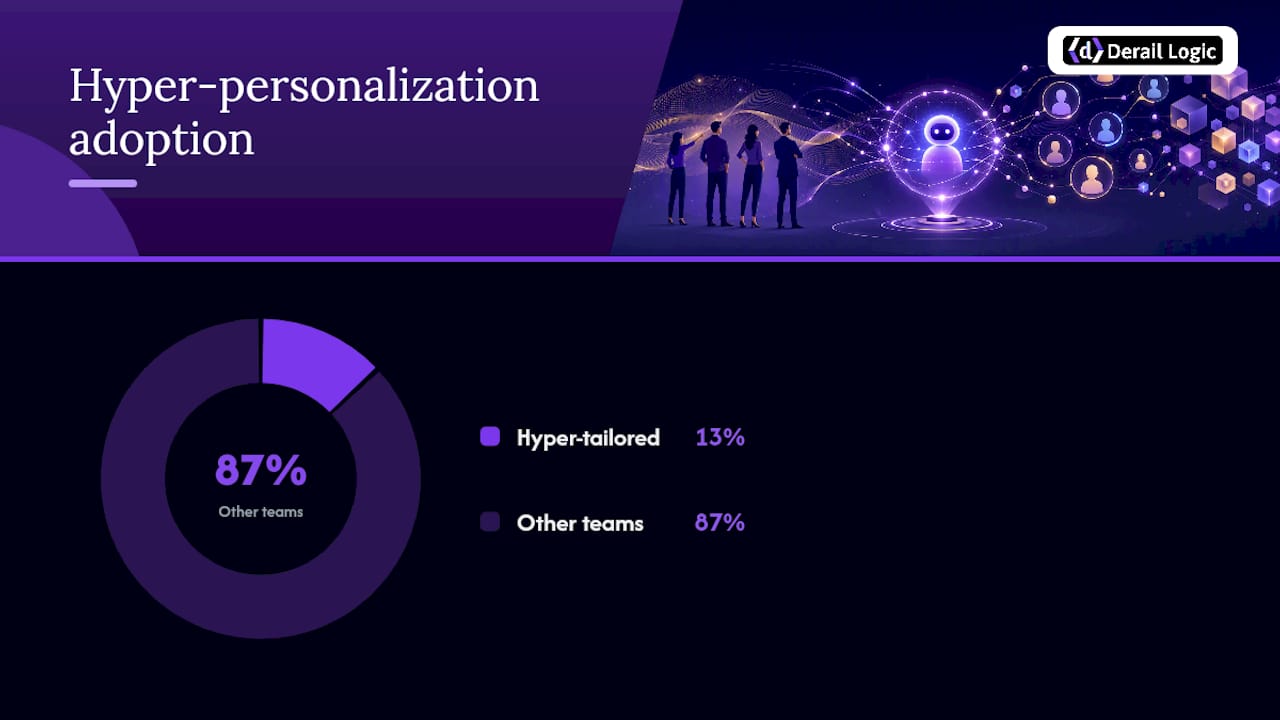
- Personalization at the segment or individual level. Basic personalization (swapping a first name into an email) has been standard for a decade. Hyper-personalization, tailoring offers, timing, and creative to an individual’s behavior pattern, is where the real ROI lives, and it’s rare: only 13% of teams currently hyper-personalize, even though personalization engines show some of the strongest returns in the entire AI marketing stack. That gap between what’s possible and what’s deployed is the single biggest opportunity most marketing teams are sitting on right now.
- Predictive lead scoring. Instead of scoring leads on static criteria like job title or company size, ML models weigh hundreds of behavioral signals, email opens, page visits, time on site, to predict which leads will actually convert. Sales teams stop chasing warm leads that never close and start prioritizing the ones the model flags as high intent.
- Campaign diagnostics through conversational insights agents. This is the use case that changes daily workflow the most. Instead of a marketer digging through spreadsheets to figure out why a campaign underperformed, a conversational agent analyzes performance data, cross-references it against the workspace’s own historical results, and answers in plain language: “Your click-through rate dropped because the creative variant B audience overlaps 40% with variant A, splitting your reach.” Products like MoEngage’s Campaign Insights Agent already do this kind of diagnosis, grounded in a specific account’s own performance history rather than generic best practices.
- Multi-touch attribution. Long sales cycles and multiple channels make it nearly impossible to know which touchpoint actually drove a conversion using spreadsheet math. AI-driven attribution models weigh every touchpoint’s contribution, which matters most for B2B and enterprise sales cycles that stretch past 90 days.
- Content drafting and creative variation. Content drafting is one of the highest-ROI use cases in the current data, showing roughly two to three times return on the time invested, largely because it removes the blank-page bottleneck rather than replacing strategic judgment.
Pro Tip: Don’t start your AI pilot with attribution modeling, even though it sounds like the highest-value problem. Attribution requires clean, unified data across every channel first. Start with campaign diagnostics or lead scoring, where a single data source can prove value fast, then expand once you’ve built internal trust in the outputs.
The pattern across all five: the use cases that win fastest are the ones where AI replaces a slow, manual, repeatable task, not the ones where it’s asked to replace judgment. Forbes’ analysis of AI-powered marketing makes this exact point: strategy clarity, knowing precisely what AI should accelerate versus what a human must still own, is what determines whether a team gets real value or just more activity.
How Do You Operationalize AI Marketing Insights?
Generating an insight is the easy part. Getting it acted on, consistently, is where most programs stall. Here’s the operational sequence that actually works.
- Centralize your data before you model anything. Fragmented tools that don’t talk to each other are the number one reason AI pilots fail to scale. If your CRM, ad platforms, and analytics dashboards live in silos, no model can see the full picture. Tool sprawl doesn’t get fixed by adding more AI on top of a disconnected stack; it gets fixed by connecting the stack first.
- Audit data quality before you trust any output. Duplicate contact records, inconsistent UTM tagging, and stale CRM fields will quietly poison a predictive model’s accuracy. Run a data quality pass, not a full data warehouse rebuild, before your first model goes live.
- Choose the simplest model that solves the problem. A lead-scoring model doesn’t need deep learning. Logistic regression or gradient-boosted trees, trained on your own historical conversion data, will usually outperform a black-box system your team can’t explain to sales leadership.
- Validate against a holdout period, not just historical accuracy. Train the model on data through last quarter, then test it against this quarter’s actual results before rolling it out company-wide. A model that fits history perfectly but predicts poorly going forward is a common failure mode.
- Activate insights where the work already happens. An insight sitting in a separate AI dashboard that nobody opens is worthless. Route recommendations into the CRM, the campaign builder, or wherever the marketer or salesperson is already working, so the insight becomes a task, not a report.
- Automate the repeatable, flag the judgment calls. Let the system auto-adjust bid pacing or send-time optimization without a human in the loop. Route anything touching brand voice, pricing, or a strategic pivot to a person for review before it ships.
- Assign clear ownership for monitoring and retraining. Models drift. Customer behavior shifts with seasonality, new competitors, or economic conditions, and a model trained on last year’s data degrades quietly if nobody’s watching. Someone, not “the team,” needs explicit responsibility for reviewing model performance monthly and retraining when accuracy drops.
Teams that skip step one and jump straight to sophisticated modeling almost always end up rebuilding from scratch six months later. The unglamorous data centralization work is what separates a pilot that scales from one that quietly dies in a slide deck.
What Does a Realistic ROI Timeline Look Like?
The honest answer: faster than most CMOs expect, but not instant. Payback on AI marketing tooling now averages 4.2 months, with 71% of marketing leaders reporting positive ROI within six months of adoption. That’s a materially shorter runway than the twelve-to-eighteen-month payback cycles common in earlier martech waves.
The metrics worth tracking depend on the use case, but a few show up across nearly every successful program:
| Metric | Why it matters | Typical benchmark signal |
|---|---|---|
| Time-to-insight | How fast a question gets answered, hours vs. days | Should trend toward same-day for standard queries |
| Model lift over baseline | Whether the AI outperforms your prior manual process | Lead scoring models often beat static criteria by a wide margin |
| Content ROI | Output value relative to time invested in drafting | Roughly 2 to 3 times return in current benchmarks |
| Personalization conversion lift | Incremental conversion from tailored vs. generic experiences | Highest-ROI category, but only realized by the 13% who hyper-personalize |
| Payback period | Time until the tool pays for its own cost | Median around 4.2 months |
Design your experiments the way you’d design any controlled test: hold out a control group that doesn’t receive the AI-driven treatment, run it for at least one full sales or campaign cycle, and measure against the metric you actually care about, not a proxy. A model that improves click-through rate but doesn’t move revenue isn’t a win; it’s a distraction with good optics.
The realistic expectation for most mid-sized marketing teams: a narrow, well-scoped pilot (lead scoring or campaign diagnostics) proving measurable value within one quarter, with broader personalization and attribution gains compounding over the following two to three quarters as data quality and model confidence improve.
How Do You Protect Consumer Trust While Scaling AI?
Trust is moving in the wrong direction, and pretending otherwise is how programs backfire. Consumer comfort with brands using AI fell from 57% to 46%, and only about 26% of consumers trust brands to use AI responsibly at all. That’s not a minor headwind. It means the same personalization engine that lifts conversion can also erode trust if it feels invasive rather than helpful.
The fix isn’t less AI. It’s more deliberate data practices. A few tactics hold up well against that trust gap:
- Lean on zero-party data. Information customers volunteer directly, preference centers, quiz answers, explicit opt-ins, carries far less creep factor than inferred behavioral data, and it tends to be more accurate anyway.
- **Make consent the default entry point for personalization, not an afterthought buried in a privacy policy nobody reads.
- Explain the “why” behind a recommendation when it’s reasonable to do so. A simple “because you viewed X” line does more for trust than any legal disclaimer.
- Audit model outputs for bias on a fixed schedule, particularly for lead scoring and audience targeting, where skewed training data can quietly exclude entire customer segments.
- Document data provenance for every model in production, so when a customer or regulator asks where a prediction came from, you have an answer better than “the algorithm decided.”
Pro Tip: Publish a one-page internal governance summary, plain language, no legal jargon, for every AI model your marketing team runs. If you can’t explain what a model does and why in five sentences, it’s not ready for production, regardless of how good its accuracy metrics look.
How MartechAI Turns Insights Into Action
Most of the operational steps above fail for a simple reason: the insight and the action live in different tools. A model flags a high-intent lead in one dashboard while the salesperson works entirely inside a separate CRM. Derail Logic built MartechAI specifically to close that gap.
The visual campaign studio gives marketers a single workspace to plan and launch campaigns instead of stitching together a calendar tool, a content system, and an ad platform by hand. The intelligent CRM feeds real customer behavior directly into that planning layer, so segmentation and lead scoring aren’t running on stale exports.
Autopilot is the piece that most directly answers the agentic AI shift the whole industry is moving toward. Rather than waiting for a marketer to open a dashboard and go looking for a problem, Autopilot surfaces opportunities and anomalies proactively, the campaign underperforming, the segment worth a follow-up send, before a human would have noticed on their own.
Underneath both sits the AI Engine, which draws on eight live, connected data sources rather than a single static export, so the recommendations it generates reflect what’s actually happening in the account right now, not last month’s snapshot. For a marketing team running the operational playbook above, that means data centralization, activation, and monitoring aren’t three separate projects. They’re one connected system, which is the exact structural fix small teams and enterprise marketing groups both need.
Getting the Operating Model Ready for Enterprise AI
Technology is rarely the bottleneck once you’re past the pilot stage. The operating model is. BCG’s research on agentic AI notes that these systems don’t just optimize existing campaigns, they generate customer intelligence rich enough to influence product and business model decisions well outside marketing’s traditional lane. That means marketing operations can no longer sit in a silo reporting quarterly metrics upward. It needs a seat where product and go-to-market decisions get made.
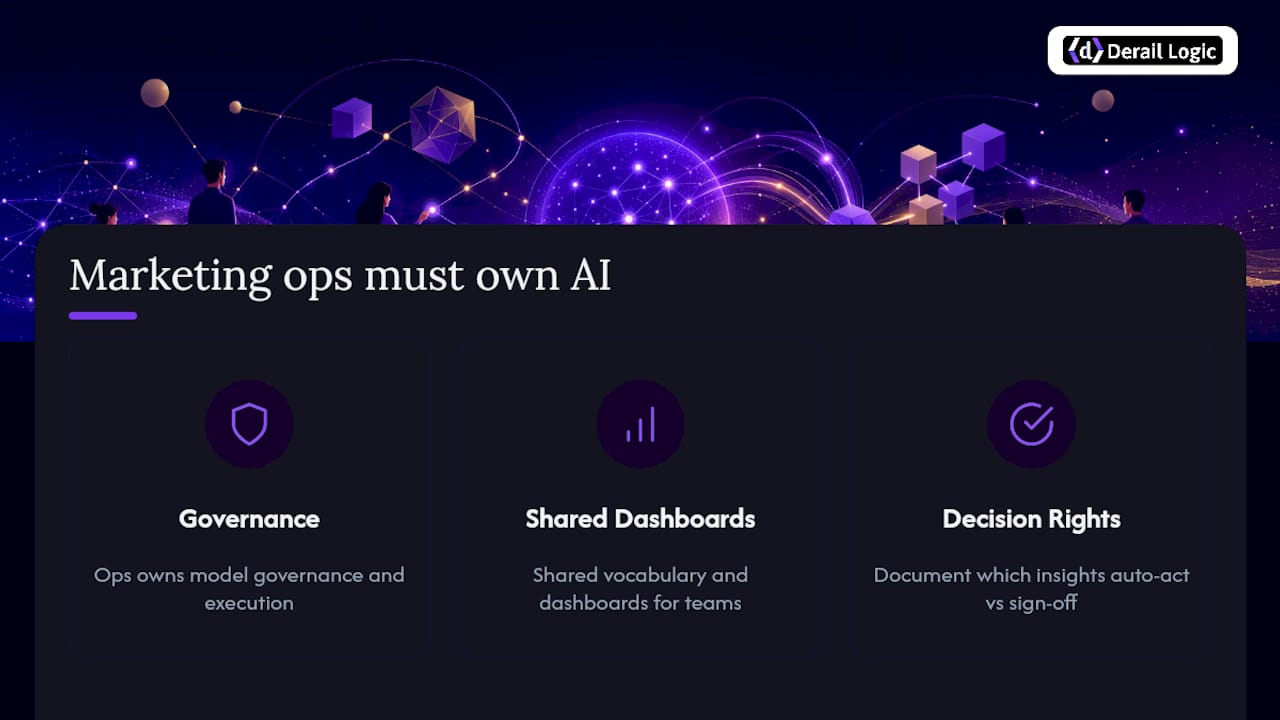
Practically, that shows up in a few structural shifts. Marketing ops teams increasingly own model governance alongside campaign execution, not as a separate compliance function bolted on afterward. Data scientists and marketers need shared vocabulary and shared dashboards, not two teams translating findings back and forth through Slack. And decision rights need to be explicit: which insights trigger automatic action, and which require a human sign-off, has to be documented rather than assumed.
The organizations struggling most with enterprise AI adoption aren’t the ones with worse models. They’re the ones where the model output lands on someone’s desk with no clear owner for what happens next. Fixing that is a management decision, not an engineering one, and it usually costs nothing beyond a clear org chart and an honest conversation about who’s accountable when a model is wrong.
Seven Priorities for Marketing Leaders Right Now
If you’re weighing where to spend the next two quarters, start here. First, pick one narrow, measurable pilot, lead scoring or campaign diagnostics, and prove it before expanding. Second, fix data quality before adding another model. Third, assign a named owner for monitoring and retraining; “the team” isn’t an owner. Fourth, build a lightweight governance document before scaling personalization, not after a trust incident forces one. Fifth, separate what AI should automate from what a human must still approve. Sixth, measure payback against revenue, not vanity engagement metrics. Seventh, treat your data infrastructure as the actual product, because every insight downstream depends on it.
The biggest mistake I see is chasing sophistication before infrastructure is ready. A brilliant model on top of fragmented data produces confident, wrong answers faster than a mediocre model on top of clean data ever would.
— Zachary
Put AI Marketing Insights to Work With MartechAI
Derail Logic gives marketing teams a faster path to the operational playbook above than stitching together five separate point solutions. Where most teams spend months connecting a CRM, an analytics dashboard, and a separate AI tool by hand, MartechAI runs campaign planning, the intelligent CRM, and insight generation in one connected workspace from day one.
During a trial, put three things to the test: run Autopilot against a live campaign to see what it flags before you would have caught it yourself, connect your existing CRM data to the AI Engine and check whether the recommendations reflect your actual account history, and try building one campaign inside the visual campaign studio start to finish. If you’re preparing for a demo, bring one real underperforming campaign and one segment you suspect is under-personalized. Those two examples will show you more about fit than any feature list. Start a marketing automation trial and see how quickly the insight-to-action gap actually closes.
Sources
- Agentic AI Is Redefining Marketing Growth | BCG
- The New Rules Of AI-Powered Marketing | Forbes
- AI Marketing Statistics 2026: Adoption, ROI, Consumer Trust Data Trends
FAQ
What Is the 30% Rule in AI?
There’s no universally recognized “30% rule” in AI marketing; the phrase gets used inconsistently across sources, so treat any specific number attached to it with caution rather than as an industry standard.
How Is AI Used in Marketing?
AI powers predictive lead scoring, personalization at scale, campaign diagnostics, attribution modeling, and content drafting, with adoption now near-universal among marketing teams using it in some form daily.
Can ChatGPT Help With Marketing?
Yes, general-purpose tools like ChatGPT can help draft copy, brainstorm campaign angles, and summarize research, but they lack the connected campaign, CRM, and performance data that platforms like MartechAI use to ground recommendations in your actual account history.
Can AI Do a Market Analysis?
AI can accelerate market analysis by processing large volumes of customer, competitor, and campaign data to surface patterns, but interpreting strategic implications and making the final call still requires human judgment.