



Small businesses struggle with marketing ROI because they measure the wrong things, do incomplete cost math, and work with fractured data that can’t tie spend to revenue. Only a minority of small businesses actively analyze their marketing data regularly (https://designloud.com/state-of-small-business-marketing-2026/), and many small businesses report difficulty measuring ROI with any confidence (https://designloud.com/state-of-small-business-marketing-2026/). The fastest corrections are specific: fix the cost denominator, extend the measurement window past last-click, and unify your tracking into one place.
- Incomplete cost math (labor and tools left out of ROI formulas)
- Measurement windows too short for the actual sales cycle
- Fractured data across disconnected tools and channels
Key Takeaways
Small business marketing ROI improves when owners fix the cost denominator, extend measurement windows to match sales cycles, and unify fragmented data into one repeatable workflow.
| Point | Details |
|---|---|
| Fix the cost basis first | Include labor, tools, and overhead in every ROI calculation, not just ad spend. |
| Match your measurement window | Set review periods to match your actual sales cycle, often 60 to 90 days. |
| Replace last-click attribution | Use CRM-based rules that credit assisted conversions, not just the final touch. |
| Prioritize owned channels | Email and CRM outreach typically deliver stronger ROI than rising-cost paid acquisition. |
| Unify your data workflow | A connected platform like Derail Logic centralizes tagging, attribution, and reporting in one place. |
Table of Contents
- Why Small Businesses Struggle With Marketing ROI
- What’s Quietly Killing Your Marketing ROI?
- How Measurement and Attribution Hide Your True ROI
- The Fixes That Actually Move Your ROI Number
- Which Metrics and Tools Actually Make ROI Repeatable?
- Your 30/60/90-Day Plan to Fix Marketing ROI
- Connecting Marketing Goals to the Business You’re Actually Running
- The Behavioral Traps That Distort Marketing Decisions
- Does Personalization Actually Improve Marketing ROI?
- What Small Business ROI Turnarounds Actually Look Like
- How Do You Prioritize Channels With a Small Budget?
- A Measurement Discipline That Actually Holds Up
- A Simpler Way to Keep Your ROI Numbers Honest
- Sources
- FAQ
Why Small Businesses Struggle With Marketing ROI
Marketing ROI problems rarely come from one bad decision. They stack. A missing tracking pixel here, a skipped labor cost there, a dashboard that only shows last-click credit. By the time you’re staring at a number that says “ROI: 40%,” you’ve usually made three or four small measurement errors that compound into one big wrong answer.
The scale of the problem is bigger than most owners assume. A large portion of marketing leaders struggle to demonstrate financial impact and frequently miscalculate ROI due to poor data and flawed math(https://red27creative.com/the-data-backed-guide-to-improving-your-marketing-roi) because of poor data and flawed math. That’s not a small-business problem exclusively. It’s an industry-wide measurement problem that hits resource-constrained teams hardest, because they don’t have a dedicated analyst to catch the errors before they shape a budget decision.
What’s Quietly Killing Your Marketing ROI?
Run through this list against your own numbers. Most businesses find at least two or three of these apply right now.
- Tracking gaps and consent loss. Check whether your analytics tool shows a sudden, unexplained dip in conversions with no change in traffic. That’s often signal loss, not a real drop in performance.
- Revenue instead of gross profit. If your ROI formula uses total revenue rather than what’s left after cost of goods sold, your numbers look better than reality.
- Last-click attribution bias. Look at which channels get “credit” for sales. If one channel always wins and upper-funnel channels always show zero value, the model is broken, not the channel.
- Review windows too short for the sales cycle. A 30-day reporting window on a product with a 90-day consideration period will always undercount the channels that start the relationship.
- Small, fragmented budgets. Spreading $2,000 across five channels rarely generates enough data volume in any one channel to draw a real conclusion.
- Skills and time constraints. Many small businesses cite limited staff as their biggest constraint(https://designloud.com/state-of-small-business-marketing-2026/) on executing marketing well, which directly limits how carefully anyone can track results.
- Creative and offer problems. Low conversion rates sometimes have nothing to do with targeting. The offer or the landing page copy is the actual weak link.
- Vanity metrics focus. Likes, impressions, and reach feel good in a monthly report but rarely map to revenue.
Pro Tip: Run this one-hour check: pull your last marketing budget and ask whether owner hours and software subscriptions are included as costs. Most small business owners find they’re not, which means every ROI number they’ve reported has been inflated.
| Common Cause | Quick Symptom Check |
|---|---|
| Tracking gaps | Conversions drop with no traffic change |
| Wrong cost basis | ROI uses revenue, not gross profit |
| Last-click bias | One channel gets 90%+ of the credit |
| Short review window | Reporting period shorter than sales cycle |
How Measurement and Attribution Hide Your True ROI
Most small businesses calculate ROAS (return on ad spend) and call it ROI. Those are not the same number, and the gap between them is usually where the disappointment lives.
- ROAS only counts ad spend against revenue. Spend $1,000 on ads, generate $4,000 in revenue, and you get a 4:1 ROAS that looks great in a screenshot.
- Fully-loaded ROI adds the real costs. Factor in cost of goods sold, the hours you or your team spent managing the campaign, and the monthly tool subscriptions that made it possible. That same $4,000 in revenue might carry $2,600 in real costs once labor and overhead are included, cutting your effective return by more than half.
- The gap is rarely small. Small businesses that only count ad spend and ignore labor, tools, and overhead often see their real costs increase substantially when fully loaded(https://statscheap.com/marketing-roi-formula-small-businesses-get-wrong/), which changes a campaign from profitable to break-even overnight.
Signal loss compounds the cost problem. Privacy updates, ad blockers, and browser restrictions mean traditional tracking is losing 15% to 30% of conversion data before it ever reaches your dashboard. Add a short measurement window and last-click attribution on top of that, and you’re systematically undercounting the channels that start long sales cycles. Attribution errors like these routinely hide the true value of upper-funnel and long-consideration channels.
- Track cost inputs separately from revenue inputs, never blended
- Extend your review window to match your actual sales cycle length
- Flag any month with an unexplained conversion drop for signal-loss review
Pro Tip: An incrementality (holdout) test is worth running once you have at least 4 to 6 weeks of consistent spend in a channel and enough volume to split your audience into a test and control group. Holdout testing is the method that separates defensible measurement from flattering guesses, especially once consent decay makes your dashboard numbers unreliable on their own.
The Fixes That Actually Move Your ROI Number
Not every fix belongs on this week’s to-do list. Sequence matters, and small teams waste time when they try to unify their entire data stack before they’ve even built a basic tracking plan.
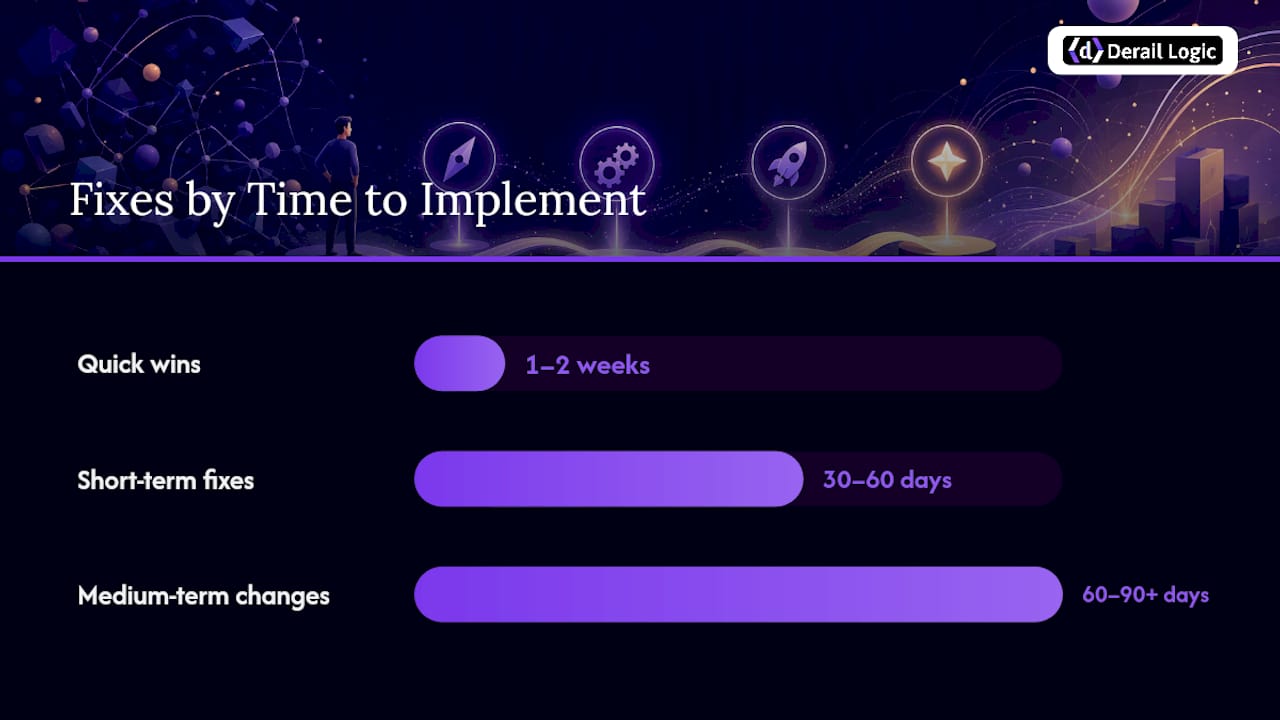
Quick wins (1 to 2 weeks):
- Write a minimal tracking plan: which channels, which UTMs, which conversion events matter.
- Add owner time and tool subscriptions into your cost formula, even as a rough estimate.
- Run one landing page conversion test on your highest-traffic offer page.
Short-term fixes (30 to 60 days):
- Build a fully-loaded CAC formula that includes labor and overhead, not just ad spend.
- Set a measurement window that matches your real sales cycle, often 60 to 90 days for considered purchases.
- Fix attribution rules inside your CRM so credit isn’t automatically handed to the last touchpoint.
Medium-term, high-impact changes (60 to 90+ days):
- Unify your data into a single workflow or platform so channel performance and closed revenue live in one view.
- Run a real incrementality test on your largest channel.
- Optimize your offer and creative based on cohort lifetime value, not last month’s conversion rate alone.
Think of these three tiers as an impact-versus-effort matrix. Quick wins cost almost nothing and take a few hours of focused work. The medium-term changes take real budget, sometimes a few hundred dollars a month for a platform subscription plus a week or two of setup time, but they’re the difference between guessing and knowing.
Pro Tip: If you only have time for one fix this month, fix your cost denominator first. A wrong attribution model still points you in roughly the right direction. A wrong cost basis tells you a losing campaign is profitable, and that’s the mistake that drains a budget for months before anyone notices.
Which Metrics and Tools Actually Make ROI Repeatable?
A short list of well-defined metrics beats a dashboard full of vanity numbers.
| Metric | Definition |
|---|---|
| Fully-loaded CAC | Total cost (ad spend + labor + tools) divided by new customers acquired |
| 12-month LTV | Gross profit generated per customer over their first 12 months |
| Conversion rate by channel | Conversions divided by visits, tracked separately per channel |
| Payback period | Time required for a customer’s gross profit to cover their acquisition cost |
| Assisted conversions | Conversions where a channel contributed but wasn’t the last touch |
The workflow that ties these together is simple in concept, even if it takes real setup work: capture UTM and source data at the point of entry, send it into your CRM, tag closed revenue against the original source, calculate gross profit by cohort, then compute fully-loaded ROI from there.
Owned channels tend to reward this effort more than rented ones. Email and CRM-driven marketing typically produce higher ROI for small businesses, while paid acquisition costs have increased sharply since recent years(https://designloud.com/state-of-small-business-marketing-2026/). That’s a strong argument for tracking marketing results with more discipline before increasing paid spend further.
This is also where tool sprawl becomes its own tax on your time. Adding more point solutions without connecting them doesn’t fix attribution; it just adds more places for data to get lost between systems. A unified platform that centralizes campaign tagging, CRM data, and reporting removes that translation layer entirely.
Pro Tip: Before buying another tool, map where your UTM data currently dies. If it stops at your ad platform and never reaches your CRM, that’s the actual gap, not a lack of software.
| Workflow Step | What It Solves |
|---|---|
| Capture UTM at entry | Prevents source data loss before it starts |
| Sync to CRM | Connects marketing activity to sales outcomes |
| Tag closed revenue | Enables gross profit calculation by source |
| Compute fully-loaded ROI | Replaces ROAS with a defensible profit number |
Your 30/60/90-Day Plan to Fix Marketing ROI
Copy this into your calendar and assign an owner to each milestone, even if that owner is you.
Days 1 to 30:
- Document a tracking plan covering every active channel and conversion event.
- Build a minimally-loaded CAC formula that includes at least labor time.
- Ship one landing page conversion improvement based on your highest-traffic offer.
Days 31 to 60:
- Set attribution rules in your CRM so multi-touch credit is visible, not just last-click.
- Launch an incrementality or holdout test on your top-spending channel.
- Start pairing SEO or content work with your owned channels to reduce paid dependency.
Days 61 to 90:
- Unify your dashboards so channel data and closed revenue sit in one report.
- Calculate 12-month LTV by acquisition cohort.
- Reallocate budget toward the channels your new, defensible ROI signal actually supports.
Role assignments shift with team size. A solo operator should focus on the tracking plan and CAC formula first, since a marketing team of one benefits most from automating repetitive tracking tasks rather than manual spreadsheet work. Teams of two to five can split attribution setup and creative testing between two people. Teams working with a freelancer or agency should hand off the incrementality test, since it requires the most technical setup and the least ongoing maintenance.
Pro Tip: Put a recurring 30-minute review on the calendar for day 30, 60, and 90. Skipping the review is the single most common reason this plan stalls after week one.
Connecting Marketing Goals to the Business You’re Actually Running
Marketing ROI numbers mean nothing if they’re not measuring progress toward what the business actually needs. A campaign that generates leads but not the right kind of customer can post a great ROI number while quietly hurting margins.
Start by naming the actual business objective before setting a marketing target. If the goal is cash flow stability, a campaign optimized for volume of leads is the wrong lever. If the goal is higher average order value, a campaign optimized for cost-per-click is measuring the wrong thing entirely.
This misalignment shows up constantly in small businesses that inherited a marketing plan from a template or a past hire. The KPI on the dashboard doesn’t map to what the owner actually cares about at the end of the quarter. Revenue targets, margin targets, and customer retention targets each demand a different marketing metric as the yardstick.
A practical fix: write your top business objective for the quarter in one sentence, then ask whether your primary marketing metric would move if that objective were achieved. If a 20% increase in email conversions wouldn’t meaningfully affect your stated business goal, you’re tracking the wrong number, even if it’s trending in the right direction. Reconnecting the two isn’t a one-time exercise. Business priorities shift quarter to quarter, and the marketing metrics that mattered in Q1 might be irrelevant by Q3 if the business goal has moved from growth to profitability.
The Behavioral Traps That Distort Marketing Decisions
Owners aren’t just fighting bad data. They’re fighting their own decision-making patterns, and these show up in predictable ways.
Sunk cost thinking keeps underperforming channels alive far longer than the numbers justify. If you’ve spent six months building a presence on a platform, walking away feels like admitting the first six months were wasted, even when the data clearly says to stop.
Recency bias skews budget decisions toward whatever channel had a good week. One strong month of Instagram ads can convince an owner to double the budget, even if the broader trend over the past six months was flat or negative.
Confirmation bias affects how owners read their own dashboards. If you believe a channel works, you’ll notice the wins and explain away the losses as “off months” or seasonal noise.
There’s also a comfort bias with familiar channels. Many owners keep spending on the platform they understand best, not the one their own data says performs best, because switching feels riskier than sticking with something familiar even if it’s underperforming.
The fix for all four isn’t more willpower. It’s a fixed review cadence with predefined metrics decided in advance, before you see the results. Deciding what “success” looks like before the campaign runs removes most of the room for these biases to creep in after the fact.
Does Personalization Actually Improve Marketing ROI?
Segmentation and personalization work because they fix a very specific problem: generic messaging asks every prospect to do the mental work of figuring out if an offer applies to them. Most won’t bother.
A small business selling to both new parents and empty nesters, for example, sending the same email to both groups is diluting the message for everyone. Splitting that list into two segments and adjusting the offer for each one typically lifts conversion rates because the message finally matches the reader’s actual situation.
The ROI impact shows up in two places at once. Conversion rates improve because the message is more relevant, and cost per acquisition drops because you’re not paying to reach people with an offer that was never going to land. Personalization also tends to improve retention and lifetime value, since a customer who felt understood in their first interaction is more likely to trust a follow-up offer later.

The mistake most small businesses make with segmentation is overbuilding it before they have the data to support it. Ten micro-segments sound sophisticated, but if each one only contains a handful of customers, you can’t draw a reliable conclusion from any of them. Start with two or three segments based on your clearest behavioral or demographic difference, measure the ROI difference between them, then split further only once a segment has enough volume to justify it.
What Small Business ROI Turnarounds Actually Look Like
The pattern in most real ROI turnarounds isn’t a clever new channel. It’s a fix to the measurement itself.
A local service business that switches from tracking raw lead volume to tracking fully-loaded cost per booked job typically discovers that its “best” lead source was actually its most expensive once labor time for follow-up calls got counted. Reallocating budget toward the channel with the better fully-loaded number, even if it generated fewer total leads, usually improves margin within a single quarter.
An e-commerce business correcting its attribution model from last-click to a more balanced view often finds that email and retargeting were doing more work than the dashboard credited them for. Once that credit shows up correctly, budget decisions shift toward nurturing existing customers rather than only chasing new cold traffic, and the fully-loaded CAC improves because retention is cheaper to sustain than acquisition.
A small B2B firm with a long sales cycle correcting its measurement window from 30 days to 90 days frequently uncovers that a content or SEO channel it was about to cut was actually the first touchpoint for a large share of eventual closed deals. It just took two extra months for that value to show up in the data.
None of these turnarounds required a bigger budget. They required a more honest formula and a longer, more patient look at the same numbers the business already had.
How Do You Prioritize Channels With a Small Budget?
Channel prioritization comes down to two questions: where does your specific audience actually spend attention, and which channel can you measure well enough to trust the result.
Owned channels, particularly email and CRM-driven outreach, deserve priority for most small businesses because they’re both cost-efficient and easier to measure cleanly since you control the full data path from send to conversion. Paid channels deserve a smaller, tightly measured test budget rather than the lion’s share of spend, especially with acquisition costs having climbed significantly since 2023.
A useful starting split allocates roughly 70% of budget to activities you can measure directly within a quarter, and 30% to longer-build activities like SEO and brand content that pay off over a longer horizon but still matter for future ROI. Each bucket needs its own yardstick. Judging an SEO investment by its 30-day conversion rate will always make it look like a failure, because that’s not the timeframe it was built to succeed in.
For businesses with a highly specific niche audience, a platform like social media advertising can outperform broader paid search if the targeting options let you reach that niche precisely. For advisory or professional services firms with long sales cycles, channel prioritization should weight heavily toward relationship-building content and referral tracking over short-window paid campaigns, since the sales cycle itself makes fast attribution unreliable.
A Measurement Discipline That Actually Holds Up
I’ve watched enough small business budgets get reallocated on bad data to trust one thing above all else: a roughly-right number, tracked the same way every month, beats a precise-looking number that changes its own definition every quarter. Consistency in how you measure matters more than chasing decimal-point accuracy. Start the 30-day diagnostic this week, and let the checklist do the rest.
A Simpler Way to Keep Your ROI Numbers Honest
Every fix in this article, from fully-loaded CAC to unified attribution, gets harder to sustain when your campaign data, CRM, and analytics live in three different logins. Derail Logic exists for exactly that gap: a single workspace where campaign tagging, CRM data, and reporting connect automatically instead of requiring a manual export-and-match process every month.
That matters most for the fixes that take real discipline to maintain, like tracking cohort LTV or keeping attribution rules consistent across every channel. Instead of rebuilding your tracking plan in a spreadsheet each quarter, Derail Logic’s Campaign Studio keeps campaign structure, tagging, and performance data connected from the moment a campaign launches. If you’re tired of reconciling numbers between four tools before you can even answer “did this work,” start a free trial of Derail Logic’s marketing automation and see how much of that manual reconciliation disappears on its own.
Sources
- Improve Marketing ROI: Proven 2026 Guide
- Marketing ROI for Small Business: How to Measure What Works 2026 | Searchlab
- Marketing ROI: Formula, Benchmarks, and Examples | Attrock
FAQ
Why Do Small Businesses Struggle With Marketing ROI?
Small businesses struggle with marketing ROI mainly because of incomplete cost math, measurement windows too short for their sales cycle, and fractured data across disconnected tools, which together makes it hard to trust any single ROI number.
What’s the Difference Between ROAS and Marketing ROI?
ROAS only divides revenue by ad spend, while fully-loaded ROI subtracts cost of goods sold, labor, and tool costs from that revenue first, which typically produces a much lower and more accurate number.
How Long Should I Measure a Marketing Campaign Before Judging Its ROI?
Your measurement window should match your actual sales cycle length, often 60 to 90 days for considered purchases, rather than a fixed 30-day reporting period that undercounts longer buying decisions.
What’s the Fastest Fix for Low Marketing ROI?
The fastest fix is correcting your cost denominator by adding owner labor time and tool subscriptions into your ROI formula, since this single change often reveals that a “profitable” campaign was actually break-even or worse.
Can a Unified Platform Actually Improve My Marketing ROI?
A unified platform like Derail Logic won’t fix a bad offer or wrong targeting, but it removes the manual reconciliation between campaign tools, CRM data, and reporting that causes most attribution errors in the first place.