



Why marketing teams lose campaign oversight: the core reasons
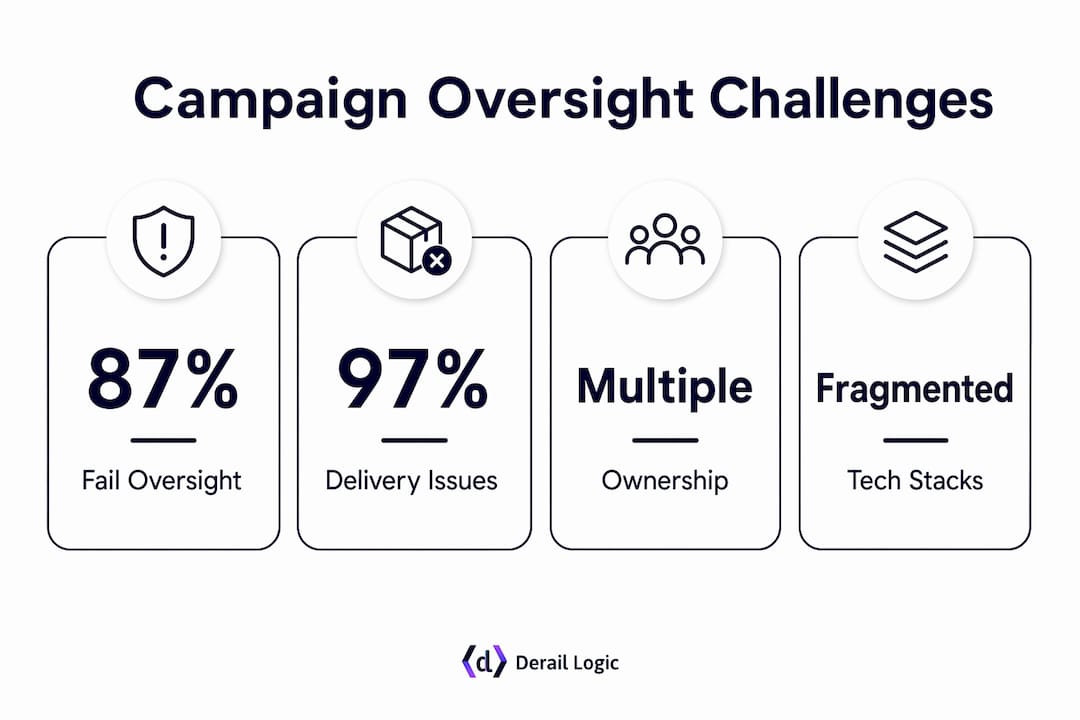
Campaign oversight breaks down not because teams lack creativity or tools, but because the structures holding campaigns together are fundamentally fragmented. Research from the Project Management Institute found that Almost all creative marketing campaigns faced significant delivery challenges in the past year, with over-budget delivery and missed deadlines topping the list. That is not a creativity problem. It is an operational one.
The root causes cluster into a few recurring patterns:
- Siloed teams that design and execute campaigns in isolation, with no single owner accountable for the end-to-end experience
- Weak governance, meaning no clear decision rights, no defined escalation paths, and no shared success criteria across functions
- Slow iteration cycles that create bottlenecks and erode momentum before campaigns reach their audience
- Over-reliance on automation without the human judgment needed to catch strategic errors
- Fragmented technology stacks where tools don’t connect, forcing manual data transfers and creating blind spots
- Unclear accountability, where roles exist on paper but authority is never assigned in practice
- High staff turnover that breaks institutional knowledge and disrupts campaign continuity
Each of these compounds the others. A siloed team with weak governance and a fragmented tech stack is not just inefficient. It is flying blind.
Table of Contents
- How broken structures and weak processes erode campaign control
- How slow iteration quietly kills campaign momentum
- Why automation alone can’t replace human judgment in campaigns
- Accountability gaps, communication failures, and the turnover problem
- What the research says about why campaign oversight breaks down
- Take back control with Derail Logic
- Key Takeaways
- FAQ
How broken structures and weak processes erode campaign control
The most common structural failure is the absence of end-to-end campaign ownership. Everyone owns a piece: content produces assets, demand generation activates channels, marketing operations manages the tech stack. But no one owns the coherence of the whole system. The result is a campaign that looks integrated on a slide deck and falls apart in execution.

Weak handoffs between functions are where campaigns quietly lose ground. When Marketing Operations is brought in late, automation flows don’t reflect the intended customer journey. When content is treated as a production factory rather than a strategic function, assets get created without a clear role in the campaign. Measurement gets set up around what’s easy to track, not what actually matters.
Inconsistent workflows make this worse. Without a shared operating model, every campaign becomes a negotiation between functions, priorities, and individual agendas. Trade-offs between channels, messages, and assets get resolved by convenience or hierarchy rather than by customer logic.
- Disconnected roles create decision paralysis at critical moments
- Measurement misalignment means teams optimize for local KPIs, not campaign-level performance
- Weak handoffs between functions cause rework after the fact, not before launch
Pro Tip: Good governance doesn’t mean more meetings. It means clarifying who owns what decision, who arbitrates conflicts, and how exceptions get handled. That clarity reduces friction rather than adding it.
How slow iteration quietly kills campaign momentum
Slow iteration is one of the least-discussed reasons campaigns lose control. When teams can’t move quickly from insight to adjustment, small problems compound into large ones. Nearly half of marketers (46%) identify budget approvals as a major workflow bottleneck, which means campaigns stall not because of creative or strategic failures, but because of finance process friction.
The consequences extend beyond missed deadlines. When iteration slows, stakeholder alignment drifts. Teams that were aligned at launch are working from different assumptions by week three. Budget gets consumed by campaigns that should have been adjusted or paused, and the window to course-correct closes before anyone with authority has reviewed the data.
- Approval chains that require multiple sign-offs delay tactical pivots
- Lack of real-time performance visibility means teams react to last week’s data, not today’s
- Briefs that shift mid-campaign without a formal change process create cascading rework
- Teams that skip post-launch review cycles lose the feedback loop that drives improvement
The fix most teams overlook is separating tactical decisions from strategic ones. Tactical adjustments, like pausing an underperforming ad set or swapping creative, should have a fast-track approval path. Strategic decisions, like repositioning the campaign narrative, warrant a fuller review. Conflating the two is what creates the bottlenecks.
Why automation alone can’t replace human judgment in campaigns
Automation handles repetitive, rule-based tasks well. It can monitor spend pacing, flag anomalies, and trigger workflows without human intervention. But oversight doesn’t scale linearly with spend or campaign volume. As budgets grow and campaigns multiply across platforms, the surface area of what needs watching expands combinatorially while the human capacity to watch stays fixed.
The risk of over-relying on automation is that it acts without context. An automated rule might pause a campaign that’s underperforming on a single metric while ignoring that it’s driving brand awareness at a critical moment. AI can accelerate production and surface patterns, but it can’t make the judgment call about whether a campaign still aligns with a shifting business priority.
The teams that maintain control at scale tend to separate watching from deciding. Automated systems handle continuous monitoring and surface what needs attention. Humans review and decide. That division keeps lean teams in control of large campaign volumes without burning out senior staff on surveillance work.
- Use automation for spend monitoring, anomaly detection, and workflow triggers
- Keep humans in the loop for messaging decisions, audience strategy, and budget reallocation
- Build an audit trail so that when a campaign breaks, “what changed?” has a fast answer
- Review automation rules regularly; rules written for last quarter’s campaigns may not fit this quarter’s
The role of marketing automation in campaign oversight is most effective when it’s designed as a support layer for human decision-making, not a replacement for it.
Accountability gaps, communication failures, and the turnover problem
Accountability failures in marketing teams tend to follow a predictable pattern. There is a campaign owner in name but not in authority. Decisions get made in meetings, but tactical execution happens in silos. When something goes wrong, the absence of clear ownership means the response is slow and the fix is reactive.

Communication gaps between functions are a close second. When product marketing, content, demand generation, and marketing operations don’t share a common view of campaign status, updates get lost, duplicated work accumulates, and critical dependencies get missed. External partners and agencies add another layer of complexity, particularly when they’re operating without a shared system that defines how their outputs connect to the rest of the campaign.
High staff turnover amplifies every one of these problems. Unclear role definitions and turnover increase the risk of oversight gaps by breaking the institutional knowledge that holds campaigns together. When the person who built the automation logic leaves, the team inherits a system nobody fully understands.
- Campaigns need a single owner with actual authority over messaging, assets, and channel sequencing
- Communication cadences should be structured around decisions, not status updates
- Onboarding documentation for campaigns reduces the knowledge loss from turnover
- Resource constraints force prioritization; without explicit criteria, teams default to whoever shouts loudest
Aligning your marketing and sales campaign view is one practical step toward closing the communication gap between functions that share campaign goals but rarely share a common dashboard.
What the research says about why campaign oversight breaks down
The data on campaign oversight failures is consistent and sobering. 87% of senior marketing decision-makers reported campaign performance issues in the past 12 months, and 45% considered terminating campaigns early due to poor results. Meanwhile, 30 à 40 % des assets créatifs produits ne sont jamais mis sur le marché, ce qui représente un coût direct des failles de supervision décrites dans cet article.
Pierre Le Manh, also of the Project Management Institute, put the operational dimension plainly: “Project professionals fight waste, manage complex assets, teams, cultures, and tech stacks, and turn ideas into results. Ultimately, they drive more execution efficiency and speed, which translates into more profit for both agencies and clients.”
Marketing consultant Julien Rio frames the problem as a governance deficit rather than a creative or technology gap. As he writes, campaigns fail “because there is no clear operating model that defines how those ideas, skills, and efforts are supposed to work together.” Teams use only about a third of their martech capabilities due to poor governance and unclear operating models, which means the tools aren’t the problem. The system around them is.
The analytics in marketing discipline offers a parallel lesson: visibility into campaign performance is only useful when the governance structure exists to act on what the data shows. Data without decision rights is just noise.
Take back control with Derail Logic
Derail Logic’s MartechAI platform is built for exactly the conditions described in this article: fragmented teams, disconnected tools, and campaigns that lose coherence between planning and execution. By connecting your calendar, CRM, analytics dashboard, and content management into a single workflow, MartechAI gives your team a shared view of every campaign in motion.
The visual campaign studio makes ownership visible. The integrated analytics surface performance gaps before they become budget problems. And the AI-driven insights are tailored to your specific business context, not generic benchmarks. Whether you’re managing a lean in-house team or coordinating across agencies and partners, Derail Logic gives you the connected campaign workspace your team needs to stay in control.
Explore MartechAI’s full feature set and see how unified campaign management changes what your team can actually deliver.
Key Takeaways
Campaigns fail most often because governance is absent, not because creativity or technology is lacking.
| Point | Details |
|---|---|
| Oversight is a structural problem | 97% des campagnes rencontrent des problèmes de livraison, ce qui souligne des défaillances opérationnelles et de gouvernance, plutôt que créatives. |
| Governance clarifies authority | Without explicit decision rights and ownership, campaigns become a negotiation space between functions. |
| Automation needs human oversight | Automated systems should handle monitoring; humans should retain control over strategic decisions. |
| Slow iteration compounds losses | Budget approval bottlenecks and missing fast-track paths let small problems grow into campaign failures. |
| Turnover breaks continuity | Unclear roles and staff changes erode the institutional knowledge that holds campaign execution together. |
FAQ
Why do marketing campaigns fail so often?
97% of campaigns face significant delivery challenges, with over-budget delivery and missed deadlines as the leading causes. The core issue is a lack of orchestration across people, assets, and technology rather than a shortage of ideas.
What causes marketing teams to lose campaign visibility?
Fragmented technology stacks, siloed teams, and unclear ownership of the end-to-end campaign experience are the primary drivers. When no single person is accountable for campaign coherence, visibility gaps accumulate across every function involved.
How does governance improve campaign oversight?
Good governance clarifies who owns which decisions, how trade-offs between channels and assets get resolved, and how accountability is enforced as campaigns evolve. It reduces rework by preventing the misalignments that require correction after the fact.
Why are marketing agencies struggling with campaign delivery?
Agencies face the same structural pressures as in-house teams: fragmented workflows, unclear client-side decision authority, and the growing complexity of multi-platform campaigns. 87% of senior marketing decision-makers reported performance issues in the past year, reflecting an industry-wide execution gap.
How can teams improve campaign oversight without adding headcount?
Systematizing the oversight function before adding people is the key step. Automated monitoring handles rule-based checks continuously, while structured decision rights and audit trails ensure humans can act quickly when something needs attention.