



Omnichannel presence for creators means connecting every platform, email list, and storefront so a viewer’s context follows them from a video to your inbox to a checkout page. The BLUF: creators who unify these touchpoints convert casual viewers into repeat buyers instead of one-time views, because omnichannel shoppers make purchases 70% more often than single-channel shoppers. Tools like a CDP or a platform such as MartechAI make that connective work possible without a full marketing team.
Key Takeaways
Omnichannel presence works because it connects every platform to one audience profile, turning scattered views into repeat engagement and revenue.
| Point | Details |
|---|---|
| Definition matters | Omnichannel connects channels through shared data; multichannel just posts the same content everywhere. |
| Commerce upside is real | Omnichannel shoppers spend 34% more overall and buy 70% more often than single-channel shoppers. |
| Start with the minimum | One commerce point, one owned channel, and one automated sequence covers the essentials. |
| Follow the 70/30 rule | Keep 70% of content platform-native and 30% lightly adapted repost to protect algorithmic reach. |
| MartechAI centralizes execution | Its campaign studio, CRM, and analytics run from one workspace, replacing several disconnected tools. |
Table of Contents
- What Is Omnichannel Presence for Creators?
- Why Omnichannel Presence Pays Off for Creators
- Core Components Every Omnichannel Creator Needs
- How to Build an Omnichannel Presence in 30, 60, and 90 Days
- What Tools Do Creators Need for Omnichannel Marketing?
- How Do You Measure Omnichannel Success?
- Real-World Examples of Omnichannel Creator Journeys
- Common Omnichannel Mistakes Creators Make
- Why Omnichannel Is a System, Not a Checklist
- Build Your Omnichannel System Without Hiring a Team
- Sources
- FAQ
What Is Omnichannel Presence for Creators?
Omnichannel means your channels talk to each other. A subscriber who watches your YouTube tutorial, clicks your bio link, and joins your email list should feel like one continuous relationship, not three separate strangers you happen to reach. That requires unified customer profiles, consistent branding, and real-time data connecting each touchpoint, which is exactly what most solo creators skip.
Multichannel, by contrast, is just being present everywhere without any of that plumbing. You post the same clip on TikTok, Instagram, and X, but none of those platforms know what the others already showed your audience.
Here’s the contrast in practice:
- Multichannel: Same video posted five places, no shared data, no idea which platform actually drove a sale.
- Omnichannel: One pillar video atomized into platform-native cuts, each one tagged and tracked back to a single audience profile.
- Multichannel: Email list exists but never talks to your storefront or your content calendar.
- Omnichannel: Email signups trigger a welcome sequence tied to your latest product drop and your content release schedule.
Pro Tip: Creators who blindly repost identical content across platforms lose reach because algorithms penalize off-format posts. Reframe each platform’s version around what that platform’s audience actually does there, then link every version back to one owned destination.
Why Omnichannel Presence Pays Off for Creators
The commerce math is hard to ignore. Omnichannel shoppers spend 34% more overall than single-channel shoppers, and online omnichannel buyers spend more than those shopping through one channel alone. For a creator selling a course, a preset pack, or a limited drop, that gap is the difference between one sale and a repeat customer.
The benefits compound beyond the transaction:
- Higher discovery: Platform-native content spreads further because it isn’t fighting the algorithm’s format bias.
- Deeper retention: Owned channels like email keep your audience even when a platform’s algorithm shifts overnight.
- Better monetization: A connected funnel turns passive followers into paying subscribers or customers.
- Stronger brand partnerships: Sponsors pay more for creators who can prove cross-channel reach, not just view counts.
Put simply, an omnichannel setup turns scattered views into an owned audience that actually converts into revenue.
Core Components Every Omnichannel Creator Needs
A working omnichannel setup rests on a handful of parts, and Shopify’s framework for unified customer experience maps closely to what creators need too:
- Unified audience profile (CDP or CRM): One record per follower, tracking what they’ve watched, bought, or clicked.
- Pillar content: The single long-form asset (a video, article, or podcast episode) that everything else derives from.
- Content atomization: Cutting that pillar into platform-specific clips, carousels, or threads.
- Commerce point: Wherever money changes hands, a store, a checkout link, a booking page.
- Email or owned channels: The list you control regardless of what a platform’s algorithm does next.
- Analytics: Tracking that shows which channel actually drove the sale, not just the view.
- Consistent branding: Same visual language and voice so followers recognize you across platforms.
- Cross-promotion loops: Each platform nudging followers toward the next step in your funnel.
For a solo creator, the unified profile, pillar content, and one commerce point are non-negotiable. Cross-promotion loops and deep analytics can wait until the basics are running.
How to Build an Omnichannel Presence in 30, 60, and 90 Days
Start with an audit. List every channel you’re active on, what job each one does for your audience (discovery, depth, or ownership), and which pillar assets you already have sitting unused.
- Days 1 to 30: Pick one owned channel, usually email, and set up a basic signup flow from your bio link. Choose one commerce point (a store, a digital product, or a booking page) and connect it.
- Days 31 to 60: Build your atomization workflow. Take your next pillar asset and cut it into three to five platform-native pieces, following Digiday’s 70/30 rule: 70% tailored to each platform, 30% lightly adapted repost.
- Days 61 to 90: Layer in basic automation, a welcome email sequence, a cart-abandonment nudge, or a post-purchase follow-up, and start tagging traffic sources so you know which platform actually drives revenue.
Pro Tip: The minimum viable omnichannel setup is one commerce point, one audience capture channel, and one automated sequence. Everything else is optimization, not foundation.
What Tools Do Creators Need for Omnichannel Marketing?
Six tool categories cover most of what an omnichannel creator setup requires. Commerce platforms like Shopify handle checkout and inventory for digital or physical products. Link-in-bio tools like Linktree consolidate your scattered platform links into one trackable hub. Email and automation platforms like Mailchimp turn a signup into a sequence instead of a one-time blast. CDP or CRM systems, in the mold of Segment, unify what a follower did across channels into one profile. Analytics tools show which platform actually drove the click that mattered. Scheduling and repurposing tools handle the atomization workflow from pillar asset to platform-native cuts.
MartechAI sits differently in this stack because it doesn’t slot into just one category.
A creator juggling five separate logins for content, email, and analytics is spending time on tool management instead of audience building. MartechAI’s campaign studio, intelligent CRM, and analytics dashboard run from a single workspace, which is closer to how a marketing team would actually operate a creator brand.
Explore how the Content Studio handles pillar-to-platform repurposing if the atomization step above sounds like the bottleneck.
How Do You Measure Omnichannel Success?
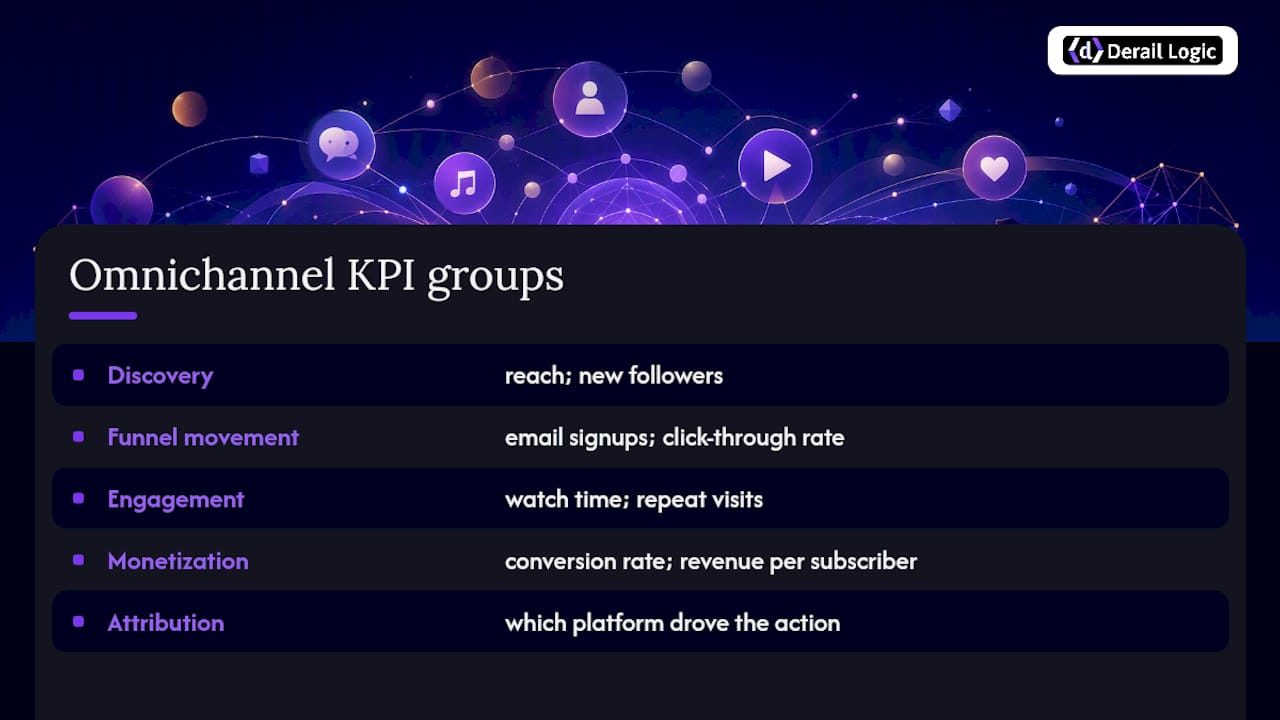
Track five KPI groups: discovery (reach, new followers), funnel movement (email signups, click-through rate), engagement (watch time, repeat visits), monetization (conversion rate, revenue per subscriber), and cross-channel attribution (which platform actually drove the action). Unified tracking across channels matters more than any single metric, because a follower discovered on TikTok might convert three weeks later through an email link.
Expect a rough timeline: 30 days shows early signup and click data, 60 days starts revealing which content format retains attention, and 90 days is when conversion and revenue patterns become reliable enough to act on.
Costs scale with ambition. A solo creator running free-tier tools and manual posting might spend little beyond time. A small team adding paid tools and light ad spend typically budgets a few hundred dollars monthly. Agency-assisted setups add production and ad management costs on top. Tool subscriptions and production time usually matter more than paid ads at this stage, since paid reach without a working funnel behind it wastes budget.
Real-World Examples of Omnichannel Creator Journeys
A course creator’s journey often looks like this: a YouTube tutorial (discovery) leads to a free email lead magnet (consideration), which nurtures into a paid course purchase (conversion) through a scheduled email sequence.

A fashion creator running limited drops might map differently: an Instagram teaser (discovery) drives bio-link traffic to a waitlist (consideration), and a launch-day email with early access converts that list into buyers before the general public even sees the product.
One workflow map: a single long-form podcast episode becomes a YouTube upload, three short clips for TikTok and Reels, and a quote graphic for X, each version linking back to an email signup that offers the extended episode notes.
Retailers use try-at-home flows and cart-recovery emails to keep buyers engaged; creators can adapt the same logic with a “save your cart” reminder for a course or a “still thinking it over” email for a limited drop.
Common Omnichannel Mistakes Creators Make
The most frequent mistake is over-posting the same content everywhere without adapting it, followed by ignoring owned channels entirely, having no unified data, inconsistent branding across platforms, and judging success by vanity metrics like views instead of referral paths.
Counter each one directly: build one pillar channel, atomize deliberately using the 70/30 split, centralize audience data in one profile, keep a simple brand guide for visuals and voice, and track where conversions actually originate. Authenticity survives scaling only if your voice and values stay consistent even as your channels multiply, not if you dilute your message chasing every new platform.
Why Omnichannel Is a System, Not a Checklist
Treating omnichannel as a posting schedule misses the point entirely. It’s a connected system where data, content, and commerce reinforce each other, and platforms like MartechAI exist precisely because managing that system by hand doesn’t scale past one or two channels.
Build Your Omnichannel System Without Hiring a Team
Running an omnichannel setup by hand means juggling a scheduling tool, an email platform, a spreadsheet for tracking referrals, and a separate analytics dashboard, and most solo creators simply don’t have the hours. Derail Logic’s MartechAI consolidates that work: the campaign studio plans and schedules your atomized content, the intelligent CRM tracks each follower’s journey from first click to purchase, and the analytics dashboard shows which platform actually drove revenue instead of just views.
For the 60 to 90 day window especially, where automation and cross-channel attribution start mattering most, marketing automation built into one workspace shortens setup time considerably compared to stitching together five separate tools. If you’re ready to see how your own content and audience data would look inside a single command center, start a trial and connect your first channel today.
Sources
For deeper research on the concepts covered here, Shopify’s omnichannel ecommerce research breaks down the commerce data in more detail, while Sleekpost’s content strategy framework covers pillar-asset atomization step by step. Digiday’s creator trends guide explains the 70/30 native content rule, and Babylovegrowth’s omnichannel marketing overview adds a broader marketing lens. For implementation specifics, MartechAI’s feature documentation is the more practical starting point.
- Omnichannel Ecommerce: Strategy, Benefits, Examples – Shopify
- Omnichannel Content Strategy: Your 2026 Framework
- Digiday’s guide to creator trends in 2026
FAQ
What is omnichannel presence for creators?
It’s a connected system where your content, audience data, and commerce work together across platforms, so a follower’s activity on one channel informs what happens on the next.
How is omnichannel different from multichannel?
Multichannel means posting on many platforms independently; omnichannel means those platforms share data and funnel toward one connected audience journey.
How long does it take to build an omnichannel presence?
Most creators see early signup and engagement data within 30 days, clearer content performance by 60 days, and reliable conversion patterns by 90 days.
What’s the minimum viable omnichannel setup?
One commerce or monetization point, one owned audience channel like email, and one basic automated sequence covers the essential foundation.
Can MartechAI help creators manage an omnichannel presence?
Yes. MartechAI’s campaign studio, CRM, and analytics dashboard run from one workspace, which shortens the setup time for scheduling, audience tracking, and cross-channel measurement.