



A unified marketing campaign is a coordinated effort that aligns messaging, channels, and teams around a single business goal to deliver consistent customer experiences and measurable results. The industry term for this practice is integrated marketing communications, or IMC, and it forms the backbone of every high-performing campaign strategy. 44% of businesses cannot accurately quantify their marketing’s impact because they lack structured plans linking goals, audiences, and channels. That gap is exactly what this unified marketing campaign planning guide addresses. You will find a step-by-step framework covering prerequisites, channel coordination, operational workflows, and measurement, all built for marketing professionals who need results they can actually prove.
What are the foundational elements of a unified marketing campaign?
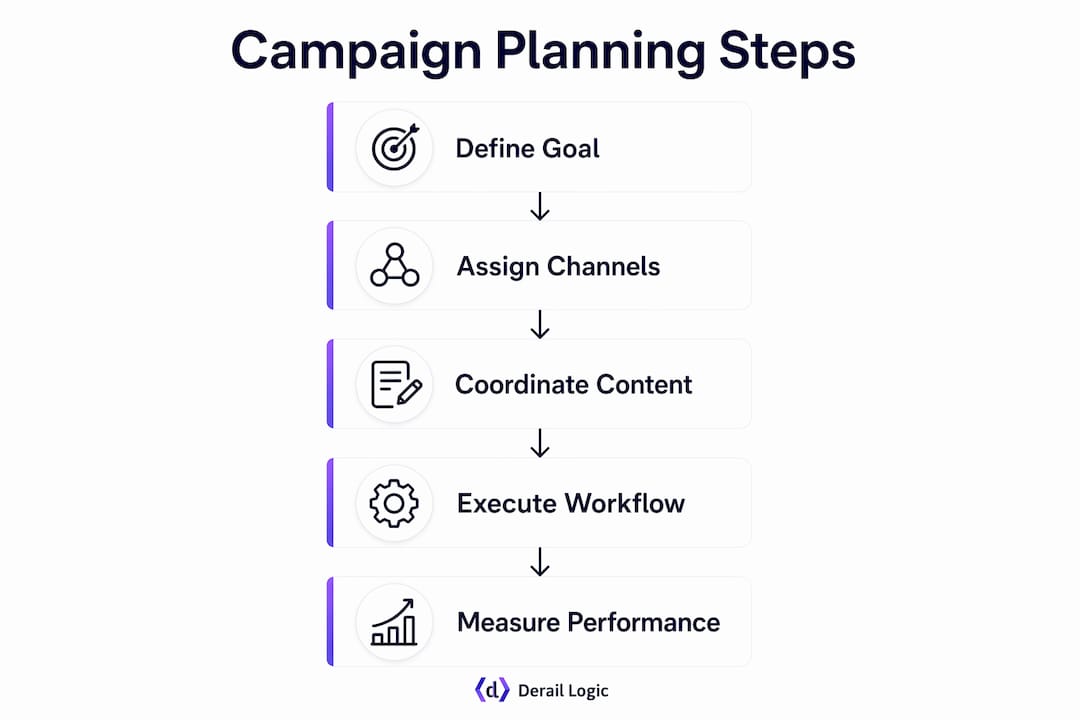
Starting with channels instead of a business goal is the most common and costly mistake in campaign planning. The right sequence begins with one precise, measurable business objective, then works outward to audiences, narrative, and channels. Without that sequence, you end up with a collection of disconnected tactics that feel like a campaign but function like noise.
Your objective must connect directly to a KPI. “Increase brand awareness” is not an objective. “Generate 500 qualified demo requests in eight weeks” is. That specificity forces every downstream decision, from budget allocation to content format, to serve the same outcome.

Audience segmentation comes next. You need to know not just who your audience is, but what they believe before they encounter your campaign and what they need to believe before they act. Segment by behavior and intent, not just demographics. A mid-market operations manager and a startup founder may share the same job title but respond to entirely different messages.
The third prerequisite is a unified strategic narrative. Every element of a campaign must answer three customer questions: what is offered, why should I care, and why should I act now. Build that narrative before you write a single piece of copy or choose a single channel. It becomes the filter through which every creative decision passes.
- Single business objective: One measurable goal tied to a KPI, not a list of desired outcomes
- Audience model: Segmented by intent and belief state, not just firmographic data
- Strategic narrative: Answers what, why, and urgency for the customer
- Living source of truth: One shared document updated weekly to prevent misalignment and document sprawl
Pro Tip: Keep your source of truth document to a single page. If it requires scrolling to find the core narrative, it will stop being read and start being ignored.
How do you assign channel roles and build a coordinated content strategy?
A multichannel campaign runs the same message across multiple platforms. An integrated campaign assigns each channel a specific role based on where the customer is in their decision process. The difference between the two is the difference between repetition and orchestration. Effective campaigns assign explicit roles to each channel based on unique strengths, which prevents diluted messaging and builds brand memory over time.
Here is how to build that channel architecture:
-
Map the customer journey. Identify the questions and emotional states your audience experiences at each stage: awareness, consideration, decision, and retention. Each stage has different informational needs.
-
Assign channel missions. Paid social earns attention at the awareness stage. Email nurtures consideration. A landing page converts at the decision stage. A post-purchase sequence drives retention. No channel should try to do all four jobs.
-
Build a content architecture. Create one core asset per campaign, such as a research report, a video series, or a detailed guide. Then repurpose that asset into channel-specific formats. A 2,000-word guide becomes a LinkedIn carousel, three email segments, and a short-form video script. The message stays unified; the format adapts to the channel.
-
Sequence the touchpoints. Campaign planning should focus on narrative flow and sequence rather than isolated deliverable lists. A customer who sees your paid ad on Monday, reads your email on Wednesday, and lands on your case study page on Friday should feel like they are moving through a single, coherent story.
-
Audit for message consistency. Before launch, read every piece of content in the order a customer would encounter it. If the tone shifts or the core promise changes between touchpoints, the campaign will feel disjointed even if the visual branding is consistent.
Pro Tip: Assign one person to read the full campaign sequence as a customer would, from first ad to final CTA. This “narrative audit” catches gaps that channel-specific reviews always miss.
For teams building their first integrated marketing plan, starting with two or three channels and mastering their interaction is far more effective than spreading thin across six.
What operational workflows keep unified campaign execution on track?
Execution is where most integrated campaigns fall apart. The strategy is sound, the creative is strong, but the operational discipline breaks down under the weight of competing priorities and ad-hoc requests. Getting the workflow right before launch prevents the “invisible waste” that drains team capacity without producing results.
Planning for a typical 6–8 week campaign should last 2–3 weeks. That timeline allows teams to test the narrative flow, adapt creative assets based on early feedback, and resolve dependencies before they become blockers. Teams that compress planning into a few days consistently produce campaigns that feel rushed because they are.
- Weekly 30-minute sync meetings: Weekly syncs focused on the narrative plan, not just deliverable status, keep teams aligned on the campaign’s purpose rather than its task list
- Intake gates: All new requests during execution must pass through a defined intake process before entering the workflow, which prevents scope creep from ad-hoc additions
- Approval checkpoints: Managing intake gates and approval workflows prevents the scope creep that derails timelines and dilutes the campaign message
- Single campaign lead: One person owns the narrative coherence of the entire campaign, not just their channel or deliverable
“Marketing campaigns function as engineered consistency, making the brand experienced as a unified entity rather than as disconnected outputs. The campaign lead’s job is to protect that consistency at every decision point, from copy edits to budget shifts.”
Cross-functional collaboration is the other half of operational success. Sales, customer success, and product teams all interact with the same customers your campaign targets. Looping them in during planning, not after launch, surfaces objections, use cases, and language that makes campaigns far more relevant. The alignment between marketing and sales during campaign planning is one of the highest-leverage activities a marketing team can invest in.
How do you measure and improve unified campaign performance?
Tracking cross-channel attribution toward a single primary goal is the correct measurement framework for integrated campaigns. Vanity metrics, such as impressions, open rates, and follower counts, measure channel activity, not campaign impact. The metrics that matter connect each channel’s contribution to the primary business objective.
| Metric type | What it measures | Why it matters |
|---|---|---|
| Pipeline contribution | Revenue influenced by campaign touchpoints | Connects marketing activity to business outcome |
| Journey progression rate | % of audience moving from awareness to consideration | Shows narrative effectiveness across stages |
| Cross-channel attribution | Which touchpoint sequence drives conversion | Informs budget allocation for future campaigns |
| Cost per qualified outcome | Spend divided by qualified leads or demos | Measures efficiency against the primary KPI |
Weekly performance reviews serve a specific purpose: they are budget and tactic decisions, not status updates. If paid social is driving awareness but email is not converting consideration-stage leads, shift budget and rewrite the email sequence. Do not wait for the campaign to end to act on that signal.
Post-campaign retrospectives that analyze gaps and successes compound learning and improve future campaign performance. Structure the retrospective around three questions: what worked and why, what did not work and why, and what one change would most improve the next campaign. Document the answers in your source of truth system so the next campaign team inherits real institutional knowledge, not vague impressions.
Pro Tip: In 2026, probabilistic attribution models and AI-driven personalization are replacing last-click attribution as the standard for measuring integrated campaigns. If your analytics stack still reports on last-click alone, you are making budget decisions with incomplete data.
For teams looking to build a structured planning approach that connects organic and paid efforts, the measurement framework must be established before the campaign launches, not retrofitted afterward.
Key Takeaways
A unified marketing campaign succeeds when it starts with one measurable business goal, assigns each channel a specific role in the customer journey, and maintains operational discipline through weekly syncs, intake gates, and a single campaign lead.
| Point | Details |
|---|---|
| Goal-first planning | Define one measurable KPI before selecting channels or creating content. |
| Strategic narrative | Answer what, why, and urgency for the customer before writing any copy. |
| Channel role assignment | Give each channel a specific job in the customer journey to prevent diluted messaging. |
| Operational discipline | Use 2–3 weeks of planning, weekly 30-minute syncs, and intake gates to protect execution quality. |
| Journey-oriented measurement | Track pipeline contribution and attribution sequences, not vanity metrics, to prove campaign impact. |
Why most marketing teams plan campaigns backward
The pattern I see most often is a team that starts with the channel calendar. Someone books the social posts, someone else drafts the email sequence, and a third person builds the landing page. Three weeks into execution, the team realizes the email is saying something different from the ads, and the landing page is optimized for a keyword that has nothing to do with the campaign’s actual offer. The campaign ships, the results are mediocre, and everyone blames the creative.
The real problem is that the campaign was never unified. It was a collection of channel outputs that happened to share a launch date. The fix is not better creative. It is starting with the business goal, building the narrative, and only then deciding which channels serve which stage of the customer journey.
Operational discipline matters more than most teams want to admit. Creativity gets the credit, but the weekly sync meeting, the intake gate, and the single campaign lead are what actually keep a campaign coherent from brief to launch. I have watched campaigns with average creative outperform campaigns with brilliant creative simply because the average ones were executed with consistency and the brilliant ones were not.
The shift toward AI-driven personalization in 2026 makes this discipline even more important. AI can personalize at scale, but it personalizes whatever narrative you give it. If the narrative is fragmented, AI amplifies the fragmentation. Give it a clear, unified story and it becomes a genuine force multiplier. The Derail Logic blog covers this intersection of operational discipline and AI-driven execution in depth for teams navigating that transition.
— Zachary
How Derail Logic supports unified campaign planning
Derail Logic’s MartechAI platform connects the tools that integrated campaign planning actually requires: a visual campaign studio for orchestrating cross-channel workflows, a CRM that shares data with your campaign analytics, and project management boards that keep approvals and intake gates visible to the whole team.
Teams using MartechAI report that centralizing their campaign source of truth inside the platform eliminates the document sprawl that causes misalignment during execution. The marketing automation layer handles channel sequencing and personalization, so your team focuses on narrative decisions rather than manual scheduling. For marketing teams ready to move from channel-centric to goal-driven campaign planning, MartechAI provides the connected workspace that makes that shift practical, not just theoretical.
FAQ
What is a unified marketing campaign?
A unified marketing campaign is a coordinated effort that aligns messaging, channels, and teams around a single measurable business goal. The industry term is integrated marketing communications (IMC), and it treats the brand as a single entity experienced consistently across every customer touchpoint.
How long should campaign planning take?
Planning for a typical 6–8 week campaign should take 2–3 weeks. That window allows teams to test narrative flow, resolve creative dependencies, and align cross-functional stakeholders before execution begins.
What is the biggest mistake in campaign planning?
Starting with channels instead of a business goal is the most common and costly planning error. Channel selection should follow goal definition, audience modeling, and narrative development, not precede them.
How do you measure a unified campaign’s success?
Measure contribution to the primary business goal using journey-oriented metrics like pipeline contribution, journey progression rate, and cross-channel attribution sequences. Vanity metrics like impressions and open rates measure channel activity, not campaign impact.
How often should campaign teams meet during execution?
Weekly 30-minute sync meetings focused on the narrative plan, not just deliverable status, are the recommended cadence. These meetings catch message drift and budget inefficiencies before they compound into campaign-level problems.