



Collaborative campaign planning is the structured process of bringing marketing teams across functions together to plan, prioritize, and execute campaigns around shared goals and synchronized workflows. Rather than each team building campaigns in isolation, this approach creates a single coordinated pipeline where strategy, creative, media, and analytics teams all operate from the same plan. The result is less duplication, cleaner messaging, and campaigns that actually reflect organizational priorities instead of whoever shouted loudest in the last meeting.
Table of Contents
- What is collaborative campaign planning, and why does it matter?
- What are the key components of a collaborative campaign plan?
- How does technology enable effective team-based campaign planning?
- What are the real challenges and benefits of campaign collaboration at scale?
- How SAP approaches global marketing collaboration at scale
- Expert insights on how to plan a collaborative campaign that actually works
- Key Takeaways
- FAQ
What is collaborative campaign planning, and why does it matter?
At its core, collaborative campaign planning is strategic preparation. Teams assess all campaigns collectively before any individual campaign enters production. According to Clarke & Esposito, campaign planning is “one of the foundations of marketing effectiveness” because it simultaneously improves team efficiency and amplifies campaign impact.
The foundational elements that make it work:
- Shared goals: Every team enters the planning cycle aligned on organizational priorities, not departmental ones.
- Structured intake: Campaigns are submitted through a standardized process before creative work begins, preventing chaotic feedback loops.
- Centralized campaign boards: A single dashboard gives all stakeholders visibility into what is in the queue, what is approved, and what is on hold.
- Campaign calendars: Scheduling tools that show every team when campaigns are live, preventing conflicts and audience fatigue.
- Metadata classification: Tagging campaigns by product, goal, and channel so leadership can pull consolidated views across the entire pipeline.
- Defined roles: Clear ownership at every stage, from intake through post-campaign review.
The practical payoff is real. Teams stop duplicating outreach to the same audience, budget conversations become grounded in actual priorities, and marketing leaders gain the standing to say no to low-value requests.
What are the key components of a collaborative campaign plan?
Campaign planning moves well beyond scheduling. It is a system for collecting, classifying, and prioritizing every campaign within a defined season before a single brief gets written.
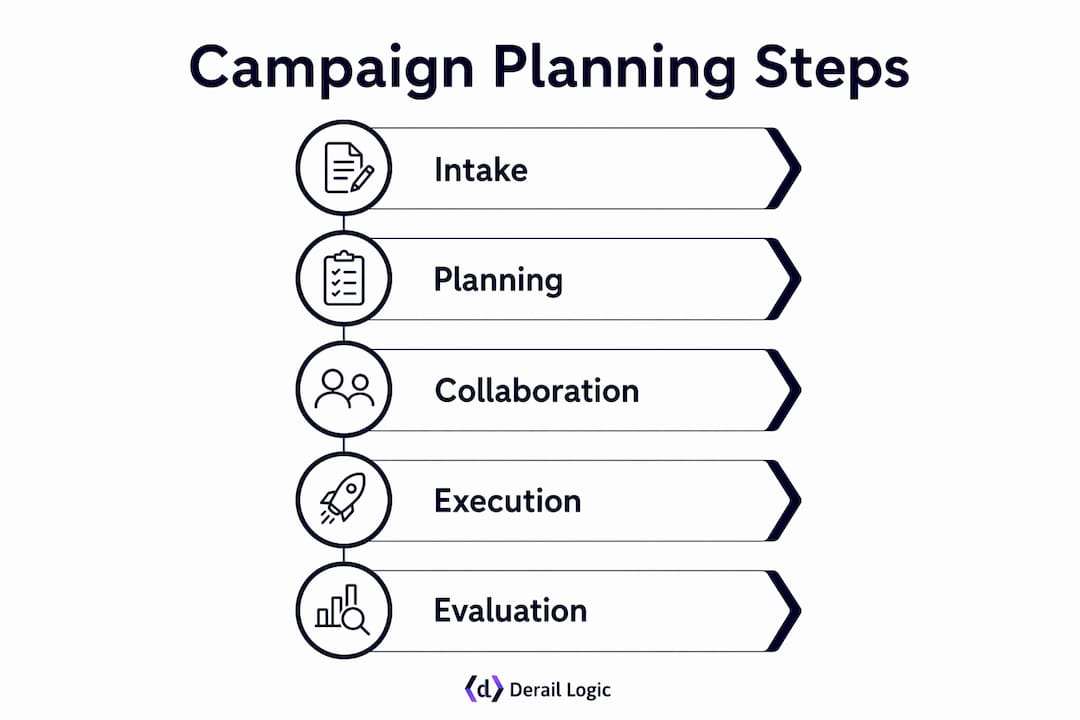
- Campaign intake process: Teams submit campaign requests using a standardized template that captures goals, audience, channel, budget estimate, and level of effort. Consistency here is what makes cross-team comparison possible.
- Campaign planning model: A relational data model goes further than a spreadsheet by enabling metadata classification and multi-dimensional sorting. You can filter campaigns by product line, goal type, or channel mix in seconds.
- Shared campaign board: A visual workspace where all campaigns live, showing status, owner, timeline, and dependencies at a glance.
- Campaign calendar: A shared calendar closes the information gap between marketing and every other team in the organization. Stakeholders outside marketing finally understand what is being worked on and when.
- Prioritization methodology: Scoring campaigns against criteria like strategic alignment, resource requirements, and expected impact forces the hard conversations about what actually moves the needle.
- RACI matrix: Assigning who is Responsible, Accountable, Consulted, and Informed for each campaign task eliminates the ambiguity that stalls execution.
- Post-campaign review loop: Structured retrospectives feed learnings back into the next planning cycle, so the process improves over time.
How does technology enable effective team-based campaign planning?
The right technology does not just organize work. It removes the friction between planning and execution so teams spend less time chasing information and more time on the actual campaign.
- Centralized planning hub: One platform where briefs, creative assets, approvals, and performance reviews all live. When information is scattered across Slack threads and email chains, collaboration breaks down fast.
- Ad platform integrations: Connecting your planning hub to Meta Ads Manager or Google Ads reduces manual data entry and keeps campaign specs synchronized between planning and live execution.
- CRM integration: Linking campaign data to your CRM means sales and marketing operate from the same customer view, which is especially important for account-based campaigns.
- Analytics dashboards: Real-time performance data surfaced inside the planning environment lets teams course-correct without waiting for a weekly report.
- Standardized templates: Brief templates, creative request forms, and approval checklists create consistency across campaigns and make onboarding new team members faster.
- Version control: Tracking creative revisions in the planning hub, rather than through email, means everyone works from the current file and feedback does not get lost.
- AI-driven insights: Platforms like Derail Logic’s AI Engine pull from multiple live data sources to surface targeting opportunities and flag performance gaps before they compound.
Pro Tip: Before selecting a planning platform, audit where your team currently loses the most time. If it is in approvals, prioritize workflow automation. If it is in reporting, prioritize analytics integration. The best tool is the one your team will actually use consistently.
What are the real challenges and benefits of campaign collaboration at scale?

Scaling collaborative campaign planning across a large organization surfaces problems that small teams never encounter. Understanding both sides helps you build a process that holds up under pressure.
Common challenges:
- Misaligned goals: When teams enter the planning cycle with conflicting priorities, the intake process becomes a negotiation rather than a coordination exercise.
- Unclear ownership: Without a RACI matrix, tasks fall through the gaps between teams, and accountability becomes a blame game after the fact.
- Communication fragmentation: Information spread across email, Slack, and spreadsheets creates invisible waste. Teams duplicate work because they cannot see what others are doing.
- Scope creep from reactive requests: Without a formal intake gate, every stakeholder with an idea can bypass the planning process and inject last-minute campaigns.
Benefits that justify the investment:
- Broader visibility: A shared campaign board gives leadership a consolidated view of all marketing activity, which is impossible when teams plan in silos.
- Prioritization discipline: The planning process forces organizations to confront their actual priorities rather than treating every request as equally urgent.
- Cost efficiencies: Co-marketing arrangements let teams share costs and maximize impact without doubling spend, a real advantage under tight budget scrutiny.
- Brand consistency: Centralized messaging guidelines and approval workflows prevent teams from sending contradictory signals to the same audience.
- Better resource allocation: Because campaign planning includes cost and effort estimates, budget conversations happen before commitments are made, not after.
“Campaign planning brings together marketing teams across an organization around common priorities. By convening regularly for campaign intake to discuss goals and intentions, they can work to foster greater alignment around strategic focus; collaborate to enhance, reduce, or combine outreach; and initiate collaborations that extend through the season.” — Clarke & Esposito
The strategic versus operational tension is worth naming directly. The real value of collaborative planning is in gaining a full picture of objectives across teams. If the process collapses into a project management exercise focused only on timelines and task assignments, you lose the strategic benefit entirely.
How SAP approaches global marketing collaboration at scale
SAP’s approach to global marketing coordination illustrates what collaborative campaign planning looks like when it is applied at enterprise scale. With marketing teams distributed across regions and product lines, SAP uses a structured campaign planning model to synchronize priorities before any regional team begins building campaigns independently.
The intake process is the backbone. Each team submits campaign proposals through a standardized model that captures goals, audience segments, product alignment, and channel mix. This consistent format makes it possible to compare campaigns across regions and identify where consolidation or coordination creates more impact than running parallel efforts.
“Campaign planning is strategic preparation, where marketers assess and analyze all campaigns collectively before building and executing specific campaigns.” — Clarke & Esposito
The outcome for SAP is improved strategic focus at the leadership level. Instead of receiving fragmented updates from dozens of regional teams, marketing leaders can view the entire global pipeline through a single metadata schema. Campaigns that duplicate effort get combined. Campaigns that conflict with organizational priorities get deprioritized before resources are committed. The lesson for other marketing organizations is straightforward: the intake model and the metadata structure matter as much as the collaboration culture. Without a consistent schema, even the best-intentioned cross-team planning produces data that cannot be compared or rolled up.
Expert insights on how to plan a collaborative campaign that actually works
Practitioners who have run collaborative planning at scale consistently point to the same failure modes and the same fixes.

Start with intake, not creative. The most common mistake is jumping into brainstorming before the intake process is in place. Without a standardized submission format, collaboration degrades into uncoordinated feedback loops where the loudest voice wins and priorities shift weekly.
Distinguish co-marketing from co-selling. Co-marketing sits upstream: it creates awareness and demand. Co-selling focuses on closing deals. Confusing the two produces conflicting KPIs and a partnership that satisfies neither goal. Define which motion you are running before you align on success metrics.
Define goals before creative. Ambiguity in success metrics is the single most common reason collaborative campaigns fail. Are you driving brand awareness, generating marketing-qualified leads, or accelerating pipeline? Each objective demands different tactics and different KPIs. Settle this before anyone opens a design file.
- Use a RACI matrix for every campaign: Clear role assignments reduce errors, increase transparency, and accelerate launches by eliminating the “I thought you were handling that” conversations.
- Leverage influencer and partner endorsements strategically: Third-party trust signals significantly affect consumer purchasing decisions, making partner selection a strategic choice, not just a reach play.
- Build feedback loops into the process: Post-campaign retrospectives that feed directly into the next intake cycle are what separate teams that improve from teams that repeat the same mistakes.
- Use AI and metadata for smarter orchestration: Platforms that connect campaign planning to live analytics data let teams adjust targeting and messaging based on real performance signals, not assumptions from the last campaign.
For teams looking to build a repeatable digital campaign process, the same principles apply: standardize the intake, define the goals, assign ownership, and measure what actually matters.
Derail Logic’s Campaign Studio brings these elements together in a visual workspace that connects planning, execution, and analytics. If your team is still coordinating campaigns across disconnected tools, it is worth seeing how a unified platform changes the dynamic.
Key Takeaways
Collaborative campaign planning works when teams align on shared goals through a standardized intake process, centralized visibility tools, and clearly assigned ownership before any creative work begins.
| Point | Details |
|---|---|
| Start with intake | Standardize how campaigns are submitted before creative work begins to prevent chaotic feedback loops. |
| Centralize visibility | A shared campaign board and calendar give all stakeholders a single view of priorities and pipeline. |
| Assign ownership clearly | A RACI matrix reduces errors and accelerates launches by eliminating ambiguity over who decides what. |
| Define goals before tactics | Ambiguity in success metrics is the most common reason co-marketing campaigns fail to deliver. |
| Distinguish co-marketing from co-selling | Co-marketing creates demand upstream; co-selling closes deals. Conflating the two produces conflicting KPIs. |
FAQ
What does collaborative campaign planning mean?
Collaborative campaign planning is the process of bringing cross-functional marketing teams together to plan, prioritize, and execute campaigns around shared goals using standardized workflows and centralized tools.
What is an example of collaborative marketing?
SAP uses a structured campaign planning model to synchronize global marketing teams, submitting all campaign proposals through a standardized intake process before any regional team begins independent execution.
What does campaign planning mean in a marketing context?
Campaign planning is the system of processes that brings marketing teams together to classify and prioritize all campaigns within a defined period, focusing on strategic preparation before execution begins.
What are the 5 Ps of collaboration in marketing?
Definitions vary across frameworks, but a widely used version covers Purpose (shared goals), People (defined roles), Process (standardized workflows), Platform (centralized tools), and Performance (agreed KPIs). These five elements map directly to the components of effective collaborative campaign planning.