



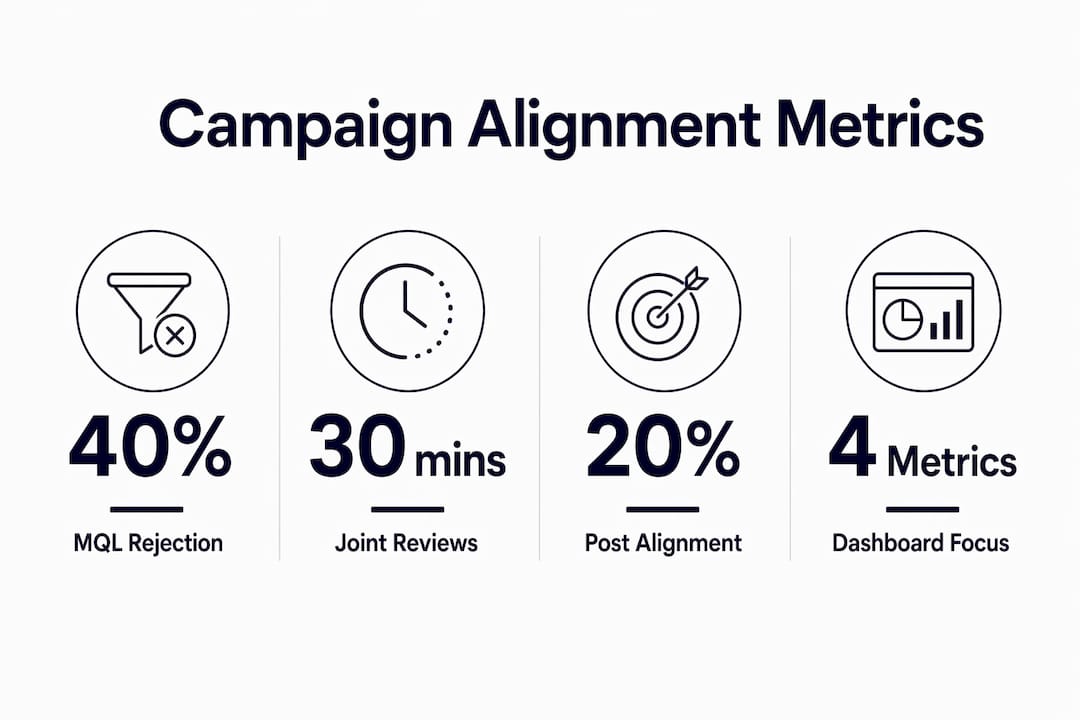
Sales and marketing alignment is defined as the state where both teams share the same goals, data, and campaign visibility to drive revenue together. When you align marketing and sales campaign view across your organization, the results are concrete: companies with strong alignment grow revenue up to 20% annually, while misaligned teams face a 4% decline. That gap is not a rounding error. It represents the difference between a team that wins together and one that spends its energy arguing over whose numbers are right. The good news is that alignment is achievable with the right foundations, processes, and cultural commitment.
What does it take to align marketing and sales campaign views?
Alignment starts with shared definitions, not shared tools. Before you connect a single dashboard or schedule a joint meeting, both teams need to agree on what a qualified lead actually looks like. That means documenting your Ideal Customer Profile (ICP), your Marketing Qualified Lead (MQL) criteria, and your Sales Qualified Lead (SQL) threshold in writing. Without documented lead definitions and SLAs, lead quality debates stay subjective and block collaboration at every stage.
The foundational requirements
Three elements form the operational base for unified campaign visibility:
- Shared ICP and lead definitions. Both teams sign off on one written document that defines MQL, SQL, and disqualification criteria. This removes the “marketing sends bad leads” narrative by replacing opinion with agreed standards.
- Service Level Agreements (SLAs). An SLA specifies what marketing commits to deliver (volume, quality, channel mix) and what sales commits to do with those leads (follow-up time, disposition feedback). Written SLAs transform vague expectations into measurable commitments.
- Integrated technology stack. Your CRM and marketing automation platform must share data in both directions. Marketing needs to see which leads converted and why. Sales needs to see which campaigns sourced their pipeline. A one-way data flow produces a one-sided view.
| Requirement | Purpose | Example |
|---|---|---|
| Shared ICP document | Aligns targeting criteria | One-page profile with firmographics and pain points |
| MQL/SQL definitions | Removes lead quality disputes | Scoring thresholds agreed by both teams |
| Documented SLA | Sets mutual accountability | 4-hour follow-up commitment from sales |
| Bi-directional CRM sync | Provides full campaign attribution | Marketing automation connected to CRM pipeline |
| Shared dashboard access | Creates one source of truth | Live view of leads, pipeline, and revenue by campaign |
Pro Tip: Start with a one-page SLA document before touching any technology. Teams that define expectations in writing first spend far less time reconfiguring their tools later.
How do you build and maintain a unified campaign view?
A unified campaign view is a live, shared data environment where both marketing and sales can see the same pipeline metrics, lead statuses, and campaign performance at the same time. The key word is “live.” Performance data in shared spreadsheets updated infrequently causes misalignment. Teams with live views reduce their reaction lag from weeks to hours when pipeline changes occur.

Setting up shared dashboards
Your dashboard needs to surface four metrics at minimum: leads generated by campaign, MQL to SQL conversion rate, sales follow-up speed, and marketing-sourced pipeline value. Connect your CRM and marketing automation platform so these numbers update automatically. Both teams should access the same dashboard, not separate reports that each team curates to tell its own story.
Operationalizing alignment with joint reviews
Shared data only works if teams act on it together. Weekly 30-minute joint pipeline reviews are the gold standard for real-time accountability. Monthly reviews are the minimum cadence, but weekly meetings sustain momentum and catch problems before they compound. The agenda is simple: review the dashboard together, flag any leads that missed SLA, and agree on one adjustment for the coming week.
Pro Tip: Keep joint pipeline reviews to 30 minutes with a fixed agenda. Longer meetings without structure drift into blame sessions. Shorter meetings with a shared dashboard stay focused on decisions.
The shift that happens when you run these reviews consistently is worth noting. Alignment becomes a visibility problem, not just a process problem. When both teams look at the same live data, conversations move from “whose numbers are right” to “what do we do about them.” That shift alone changes the culture of the relationship.
What challenges arise when aligning campaign views, and how do you fix them?
The most common obstacles to sales and marketing alignment are not technical. They are cultural and structural. You can deploy the best dashboard in your martech stack and still fail if the underlying incentives pull teams in opposite directions.
Here are the four challenges teams encounter most often, and the fix for each:
-
Misaligned incentives. Marketing is measured on MQL volume; sales is measured on closed revenue. These metrics create competing priorities. Fix this by introducing a shared revenue metric that both teams own, such as marketing-sourced pipeline that converts to closed-won deals.
-
Cultural divide. Marketing sees sales as dismissive of leads. Sales sees marketing as disconnected from buyer reality. Fix this with cross-team shadowing. Have one marketer join two sales calls per month. Have one sales rep attend one campaign planning session per quarter. Direct exposure replaces assumptions with facts.
-
Poor communication. 42% of teams cite poor communication as the biggest obstacle to alignment. That statistic reflects a structural gap, not a personality problem. Fix it with a standing weekly meeting and a shared Slack channel or equivalent where both teams post campaign updates and lead feedback in real time.
-
Siloed data. When each team owns its own data source, every disagreement becomes a data dispute. Fix this by connecting your CRM and marketing automation to a single shared dashboard that neither team controls exclusively.
Without executive sponsorship, alignment initiatives stall within one quarter. A VP or C-suite leader must own the alignment goal, tie it to revenue targets, and hold both teams accountable in the same review. Process alignment without cultural alignment regresses fast. The executive layer is what keeps the cultural shift from sliding back to old habits.
What measurable impact does campaign view alignment deliver?
The business case for collaborative sales marketing is well documented. The numbers show up in lead quality, follow-up speed, and pipeline contribution.
| Metric | Before Alignment | After Alignment |
|---|---|---|
| MQL rejection rate | 40–60% | Under 20% |
| Sales follow-up speed | 48 hours | 4 hours |
| Marketing-sourced pipeline | Baseline | 20–35% increase |
| Annual revenue growth | Declining or flat | Up to 20% growth |
Implementing SLAs and shared dashboards reduces MQL rejection rates from 40–60% down to under 20% within two quarters. That improvement means sales spends less time rejecting leads and more time working real opportunities. Sales follow-up speed improves from 48 hours to 4 hours within 30 days of SLA implementation. Speed matters because lead conversion rates drop sharply after the first hour of inactivity.
The pipeline impact is equally significant. Teams that integrate marketing and sales data into a shared view consistently see marketing-sourced pipeline contribution grow by 20–35%. That growth comes from better targeting, faster feedback loops, and campaigns that adjust in real time based on what sales is actually seeing in conversations. The revenue outcome follows naturally from those operational improvements.
Key Takeaways
Aligning marketing and sales campaign views requires shared definitions, live data, documented SLAs, and a culture of joint accountability to produce measurable revenue growth.
| Point | Details |
|---|---|
| Start with shared definitions | Document ICP, MQL, and SQL criteria before connecting any tools. |
| SLAs drive accountability | Written SLAs cut MQL rejection rates and improve follow-up speed within 30 days. |
| Live dashboards replace disputes | Shared real-time data shifts conversations from blame to decisions. |
| Weekly reviews sustain momentum | Thirty-minute joint pipeline reviews are the minimum effective cadence. |
| Culture requires executive ownership | Alignment regresses without a senior leader tying it to shared revenue targets. |
Why technology alone will not save your alignment effort
I have seen teams invest in expensive martech platforms and still watch their marketing and sales relationship deteriorate within a quarter. The pattern is consistent. They connect the CRM, build a beautiful dashboard, and schedule a kickoff meeting. Then the meeting cadence slips, the incentives stay misaligned, and the dashboard becomes something only one team checks.
Most alignment efforts fail within 3 weeks if they focus solely on meetings without changing organizational structures and incentives. That finding matches what I have observed. The technology is the easy part. The hard part is getting a VP of Marketing and a VP of Sales to share a revenue number they are both accountable for.
The teams that sustain alignment long-term do three things differently. They tie compensation to shared outcomes. They rotate team members through each other’s workflows at least once per quarter. And they treat the shared dashboard as a decision tool, not a reporting artifact. When a campaign underperforms, aligned teams adjust it within days because both sides are watching the same data and have the authority to act.
My honest advice: do not launch an alignment initiative without executive sponsorship locked in first. Without a senior leader who owns the outcome and holds both teams to the same standard, the effort becomes a project that marketing runs and sales tolerates. That is not alignment. That is a calendar event.
— Zachary
How Derail-logic supports unified campaign visibility
Derail-logic’s MartechAI platform is built for teams that need their marketing and sales data in one place, not scattered across disconnected tools. The Campaign Studio gives marketing teams a visual workspace to plan, execute, and track campaigns while keeping CRM data connected in real time.
The integrated CRM and marketing automation layer means sales teams see the same pipeline data marketing does, with no manual exports or version conflicts. SLA tracking, lead status updates, and campaign attribution all live in the same connected workspace. Teams that have struggled with tool fragmentation find that a single platform removes the invisible waste that comes from managing five separate systems. If your marketing and sales teams are still working from different data sources, Derail-logic gives you the shared foundation to change that.
FAQ
What is sales and marketing alignment?
Sales and marketing alignment is the state where both teams share the same goals, lead definitions, and campaign data to drive revenue together. Aligned teams use shared SLAs and dashboards to replace subjective disputes with objective benchmarks.
How do you align marketing and sales campaign views quickly?
Start by documenting shared ICP and lead definitions, then connect your CRM and marketing automation to a single live dashboard. SLA implementation alone can improve sales follow-up speed from 48 hours to 4 hours within 30 days.
What is an SLA in sales and marketing alignment?
An SLA (Service Level Agreement) is a written agreement that specifies what marketing commits to deliver and what sales commits to do with those leads. SLAs transform vague expectations into measurable, enforceable standards for both teams.
Why do most alignment efforts fail?
Most alignment efforts fail because they focus on meetings and tools without changing incentives or organizational structures. Alignment regresses within one quarter when executive sponsorship and shared revenue accountability are absent.
How often should marketing and sales meet to review campaigns?
Weekly 30-minute joint pipeline reviews are the recommended cadence for sustained alignment. Monthly reviews are the minimum, but weekly meetings catch performance gaps before they compound into larger pipeline problems.