



Campaign lifecycle management is the end-to-end process of planning, executing, and evaluating marketing campaigns through a repeatable, structured workflow. It covers every phase from initial strategy through post-launch analysis, giving marketing teams a consistent system for turning ideas into measurable results. The industry also calls this the campaign management process, a term that captures its project-based nature more precisely. What makes it powerful is the connection to lifecycle marketing: when you manage campaigns within a customer journey framework, you stop chasing one-off wins and start building compounding growth. With digital advertising projected to represent 73.8% of total media ad spend by 2027, getting this process right is no longer optional.
What is campaign lifecycle management, and what are its seven stages?
Campaign lifecycle management follows a seven-stage repeatable workflow that moves from strategy to retrospective analysis. Each stage builds on the last. Skipping one creates gaps that compound into bigger problems at launch.
-
Planning strategy. Define the campaign goal, audience, budget, and channels before anything else. A campaign without a clear objective is just spending money.
-
Writing the brief. Document the strategy in a shared brief that creative, media, and analytics teams all sign off on. The brief is the single source of truth for every decision that follows.
-
Setting up tracking. Configure UTM parameters, pixels, and attribution rules before any asset goes into production. Tracking infrastructure set up after launch creates measurement gaps that cannot be fixed retroactively.
-
Asset build and QA. Create copy, visuals, landing pages, and emails. Run quality assurance against the brief before anything goes live. This stage is where scope creep does the most damage.
-
Launch. Activate channels according to the media plan. Confirm that all tracking fires correctly on day one.
-
Real-time monitoring and optimization. Watch performance data daily or weekly. Adjust bids, creative, and targeting based on what the data shows, not gut instinct.
-
Reporting and retrospective. Measure results against the original goal. Document what worked, what failed, and why. This step is what turns a campaign into institutional knowledge that improves the next one.
The order matters more than most teams realize. Tracking before assets is the rule that separates professional campaign operations from amateur ones.
Pro Tip: Add a formal approval gate at the end of stages 2, 4, and 7. Brief approval, asset sign-off, and retrospective sign-off each prevent scope creep from derailing timelines and budgets.
How does campaign lifecycle management relate to lifecycle marketing strategies?
The two concepts are related but distinct. Campaign lifecycle management is an operational framework. Lifecycle marketing is a customer-centric strategy. Understanding both, and how they connect, is what separates teams that run campaigns from teams that build growth engines.
Lifecycle marketing segments the customer journey into five core stages: awareness, consideration, acquisition, retention, and loyalty. At each stage, customers need different messages, offers, and channels. A first-time visitor needs education. A lapsed buyer needs a re-engagement offer. Sending the same message to both wastes budget and erodes trust.
The table below shows how the two frameworks differ and where they overlap.
| Dimension | Campaign lifecycle management | Lifecycle marketing |
|---|---|---|
| Primary focus | Executing individual campaigns on time and on budget | Moving customers through journey stages over time |
| Time horizon | Project-based, with a defined start and end | Ongoing, always-on system |
| Success metric | Campaign KPIs (CTR, ROAS, leads) | Customer progression, retention rate, lifetime value |
| Data dependency | Campaign analytics, UTM tracking | CRM data, behavioral signals, RFM modeling |
| Team ownership | Campaign managers, project managers | Marketing strategists, CRM managers |
| Overlap | Both require tracking, segmentation, and optimization | Both require tracking, segmentation, and optimization |
The overlap is significant. CRM and behavioral data power both frameworks. When a campaign manager knows that a segment is in the “consideration” stage, they can brief creative teams on the right message from the start. That alignment cuts revision cycles and improves conversion rates.
Lifecycle marketing also uses RFM modeling, which segments customers by Recency, Frequency, and Monetary value. RFM tells you which customers are about to churn, which are your highest-value buyers, and which are newly acquired. Campaign managers who incorporate RFM data into their planning stage run campaigns that feel personal rather than generic.
What are best practices for managing campaigns effectively?
The most effective teams treat campaign management as a repeatable system, not a series of one-off projects. Every campaign generates data. Every retrospective adds to a shared knowledge base. Over time, that knowledge base becomes a competitive advantage that no single campaign can create alone.
Tracking infrastructure is the most underrated element of the process. Most teams build assets first and add tracking later. That sequence guarantees measurement gaps. UTM parameters, conversion pixels, and attribution rules must be in place before a single ad goes live. Analytics in marketing directly ties to better ROI, and that connection starts with clean tracking data.
Beyond tracking, lifecycle-informed campaign management requires measuring customer progression, not just campaign-level clicks. Last-click attribution tells you which ad got credit for a conversion. It does not tell you whether a customer moved from consideration to acquisition, or whether a retention campaign reduced churn. Tracking stage transitions gives you a fuller picture of campaign effectiveness.
Common pitfalls that derail campaigns, and how to avoid them:
- Scope creep. New requests arrive after the brief is approved. Fix this with formal approval gates at each milestone. No changes after sign-off without a documented change request.
- Asset delays. Creative teams miss deadlines because briefs are vague. Fix this by writing briefs that specify format, dimensions, word count, and tone before creative work begins.
- Disconnected messaging. Ads promise one thing, landing pages deliver another. Fix this by having the same person or team review both assets against the brief before launch.
- Missing retrospectives. Teams move to the next campaign without analyzing the last one. Fix this by scheduling the retrospective as a non-negotiable meeting before the next brief is written.
- Siloed data. Campaign data lives in one tool, CRM data in another, and nobody connects them. Fix this by centralizing reporting in a single dashboard that pulls from all sources.
Pro Tip: Use automation to trigger lifecycle-stage campaigns based on behavioral signals rather than fixed schedules. AI-powered automation shifts lifecycle marketing from manual batch sends to dynamic, always-on programs that respond to what customers actually do.
What technology supports campaign lifecycle management?
Campaign management requires tools that cover four functional areas: planning, tracking, asset management, and analytics. Most teams use separate tools for each area. The problem is that disconnected tools create the “invisible waste” of time spent copying data between systems, reconciling reports, and chasing approvals across email threads.
A connected platform addresses this by keeping planning, execution, and reporting in one workspace. Derail Logic’s Campaign Studio gives marketing teams a visual environment to plan campaigns, assign tasks, manage assets, and track performance without switching between tools. The CRM layer connects customer data directly to campaign planning, so segmentation decisions happen in context rather than in a separate spreadsheet.
Key capabilities that support the full campaign lifecycle:
- Visual campaign planning. Map campaign stages, deadlines, and owners in a shared workspace. A campaign calendar keeps every team member aligned on what launches when.
- Integrated CRM. Connect customer data to campaign briefs so segmentation reflects actual behavior, not assumptions.
- Real-time analytics. Monitor performance as campaigns run. Real-time campaign data lets teams make optimization decisions during the campaign, not after it ends.
- Automated workflows. Trigger emails, ads, and notifications based on customer actions. Automation reduces manual work and keeps lifecycle campaigns running without constant intervention.
- Centralized reporting. Pull campaign KPIs and lifecycle metrics into one dashboard. This is what makes the retrospective stage fast and useful rather than a data-gathering exercise.
When planning digital campaigns for organic growth, the technology stack matters as much as the strategy. Tools that do not talk to each other force teams to act as human glue, which is expensive and error-prone.
Key Takeaways
Effective campaign lifecycle management requires a seven-stage repeatable process, CRM-connected lifecycle data, and tracking infrastructure in place before any asset goes into production.
| Point | Details |
|---|---|
| Seven-stage workflow | Follow the sequence from strategy to retrospective; skipping stages creates compounding gaps. |
| Tracking before assets | Set up UTM parameters and pixels before creative production begins to avoid measurement gaps. |
| Lifecycle marketing integration | Use CRM and RFM data to align campaign messaging with the customer’s current journey stage. |
| Approval gates prevent scope creep | Require sign-off at brief, asset, and retrospective stages to keep campaigns on time and on budget. |
| Campaigns as repeatable systems | Document every retrospective to build institutional knowledge that improves future performance. |
Why I think most teams are managing campaigns backward
Most marketing teams I have worked with start with the creative. They have an idea, they build the assets, and then they figure out how to measure it. That sequence feels natural because the creative is the exciting part. But it is also the reason so many campaigns produce inconclusive data.
The shift that changes everything is treating the tracking plan as the first creative decision. When you know exactly what you need to measure before you build anything, every asset decision becomes clearer. You stop building things you cannot measure and start building things that prove their value.
The second shift is harder: viewing campaigns not as events but as experiments in an ongoing system. A campaign that “fails” by conventional metrics often contains the most useful data. The teams that grow fastest are the ones that treat every retrospective as seriously as every launch. They are not running campaigns. They are running a learning machine.
Aligning marketing and sales campaign views is where this pays off most visibly. When both teams see the same data, attribution debates disappear and optimization conversations replace them.
— Zachary
How Derail Logic supports your campaign operations
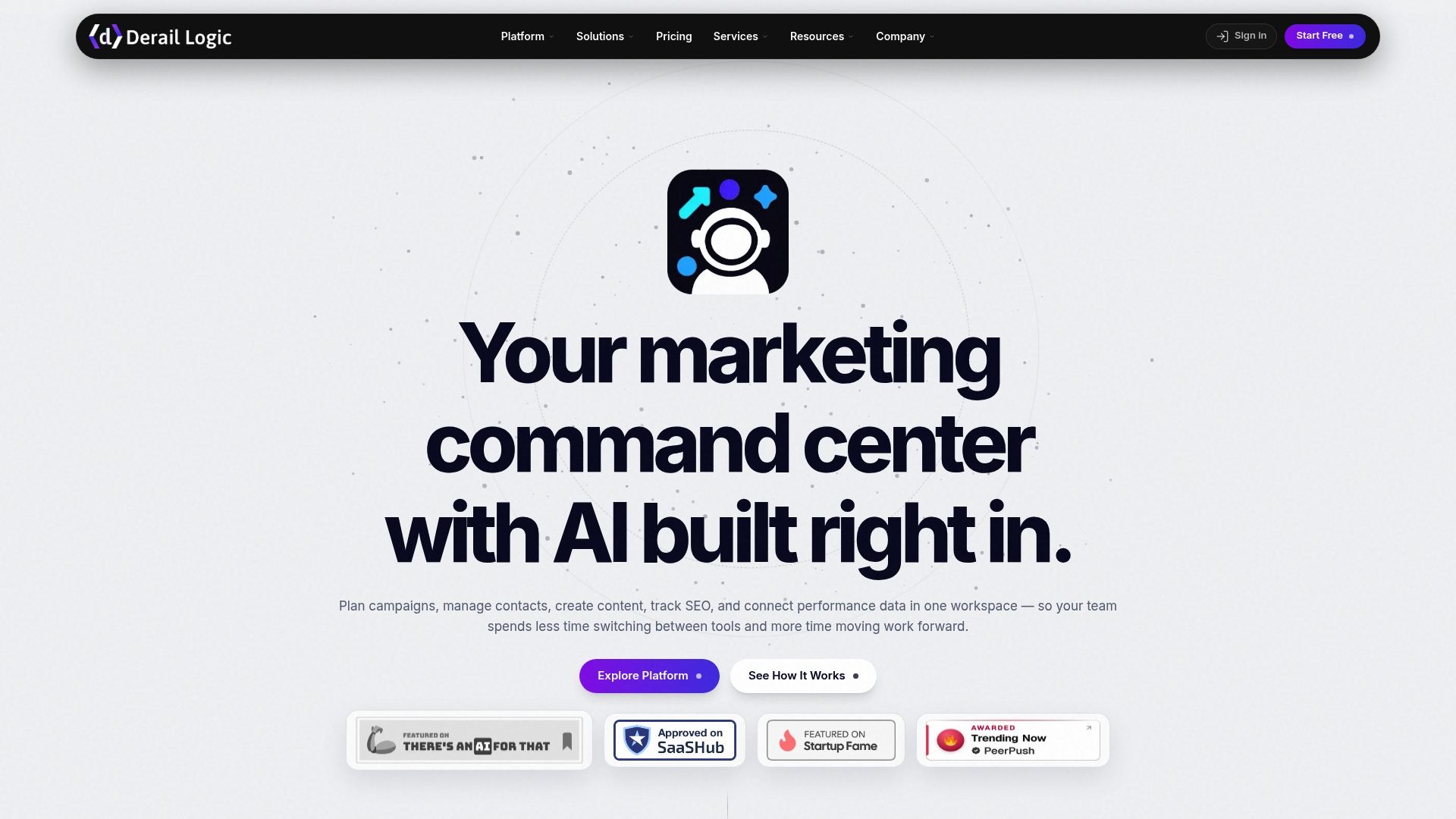
Derail Logic’s MartechAI platform is built for marketing teams that need to run campaigns as a connected, repeatable system rather than a collection of disconnected tasks. The marketing automation services cover end-to-end campaign orchestration, from brief to retrospective, with automation that keeps lifecycle programs running between manual campaigns. The platform connects Campaign Studio, CRM, email, analytics, and project management in one workspace, so your team spends less time moving data and more time acting on it. If you want to see how a unified command center changes the way your team operates, explore MartechAI’s features or request a demo directly from the site.
FAQ
What is campaign lifecycle management in simple terms?
Campaign lifecycle management is the process of guiding a marketing campaign through every phase, from strategy and planning to launch and post-campaign analysis, using a repeatable, structured workflow.
How many stages does the campaign management process have?
The standard campaign management process has seven stages: planning strategy, writing the brief, setting up tracking, asset build and QA, launch, real-time monitoring and optimization, and reporting with a retrospective.
What is the difference between campaign management and lifecycle marketing?
Campaign management is an operational process for executing individual campaigns. Lifecycle marketing is a customer-centric strategy that moves buyers through awareness, consideration, acquisition, retention, and loyalty stages over time. The two frameworks work best when integrated.
Why does tracking need to happen before asset creation?
Tracking infrastructure, including UTM parameters, pixels, and attribution rules, must be in place before launch so every campaign interaction is measurable from day one. Setting up tracking after assets go live creates permanent gaps in campaign analytics.
What is RFM modeling in lifecycle marketing?
RFM modeling segments customers by Recency, Frequency, and Monetary value to identify behavioral patterns. Lifecycle marketing programs use RFM data to trigger the right campaign at the right time based on what a customer has actually done, not a fixed schedule.