



What does a complete e-commerce content marketing SEO workflow look like?
The most effective e-commerce content marketing SEO workflow is a connected system, not a checklist. It links keyword research, content creation, technical SEO, publishing standards, and distribution into a repeatable loop that compounds organic visibility over time. Teams that treat these as separate tasks end up with fragmented output and inconsistent results. Teams that connect them see traffic build steadily, month after month.
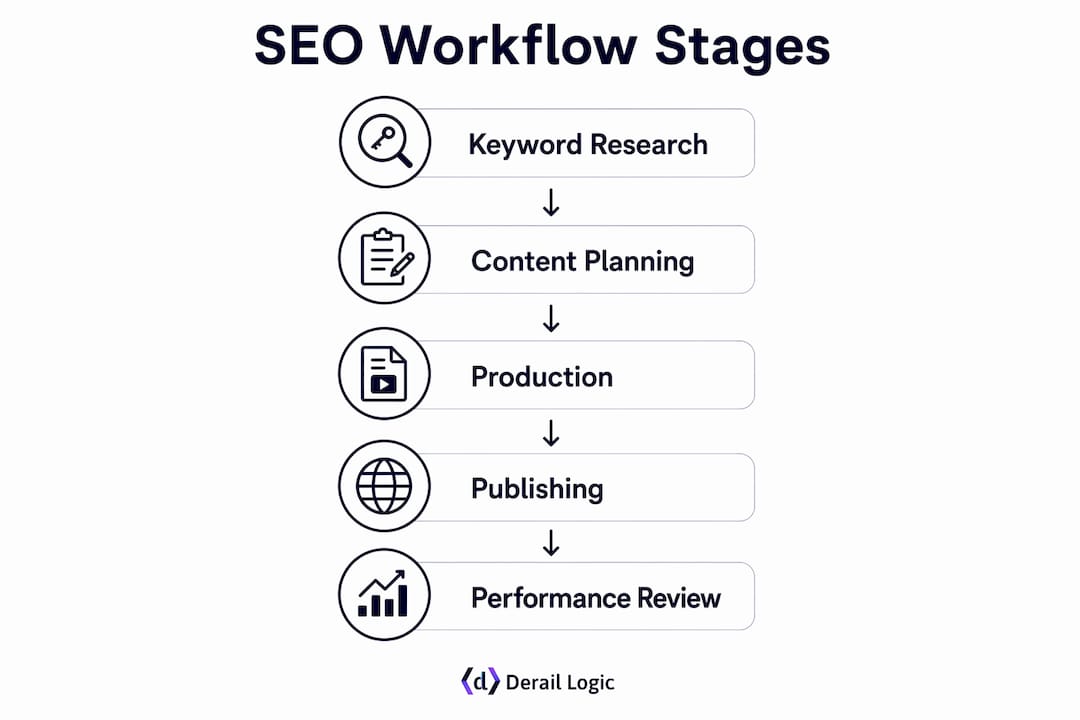
At its core, the workflow runs through five phases:
- Keyword research and intent mapping: Identify buyer-intent queries at every funnel stage, from awareness to decision.
- Content planning and briefing: Assign each query to a content type, set a target angle, and define the internal linking destination.
- Production and editorial QA: Write, review, and optimize before publishing, not after.
- Publishing with technical standards: Apply URL, metadata, heading, and schema markup rules consistently at the point of publication.
- Measurement and refresh cycles: Track organic revenue contribution and update content on a structured schedule.
Automation enters at every phase. AI tools can generate keyword clusters, draft content briefs, flag on-page SEO gaps, and trigger refresh alerts when rankings slip. Without automation, the workflow depends entirely on human bandwidth, which means it breaks the moment a team gets busy.
Pro Tip: Build your workflow documentation before you build your content calendar. A team that agrees on the process first publishes consistently; a team that agrees on topics first usually stalls within six weeks.

Table of Contents
- How to build a strategic SEO content marketing framework for e-commerce
- How AI and automation tools change SEO content production
- Why technical SEO and analytics must be built into the workflow, not added later
- How to distribute SEO content and adapt to emerging trends
- How MartechAI supports e-commerce SEO content marketing
- How to research and plan SEO content for e-commerce
- How to set up and optimize your SEO content workflow
- Step-by-step workflow phases from keyword research to content update cycles
- How to prioritize e-commerce SEO content tasks by impact and resources
- How to write SEO-friendly product descriptions and category pages
- Best practices for optimizing images and videos in e-commerce SEO content
- How to run ongoing content audits and refresh cycles to protect rankings
- MartechAI gives your content workflow a connected operating layer
- Key Takeaways
- FAQ
How to build a strategic SEO content marketing framework for e-commerce
Strategy comes before production. Publishing without a framework is how stores end up with a blog full of posts that never move a buyer toward a purchase.
The framework starts with a clear map of buyer intent across three stages: discovery, evaluation, and decision. Each stage needs its own content type and its own SEO goal.
| Buyer Stage | Content Type | SEO Goal | Example Query |
|---|---|---|---|
| Discovery | How-to guides, educational posts | Topical authority, brand awareness | “how to choose a standing desk” |
| Evaluation | Buying guides, comparison articles | High-intent traffic, internal linking | “standing desk vs regular desk” |
| Decision | Product pages, FAQ pages, reviews | Transactional ranking, conversion | “buy adjustable standing desk” |
Content clusters organize this framework in practice. A cluster groups one pillar page (a broad, authoritative guide) with several supporting pages targeting related long-tail queries. The pillar links out to the supporting pages; the supporting pages link back. This structure signals topical depth to search engines and guides buyers through a natural commercial route toward your product pages.
Prioritization within the framework should follow revenue impact, not raw search volume. A query with 400 monthly searches from buyers actively comparing products is worth more than a query with 4,000 searches from people who will never buy. Buyer intent and revenue potential should drive your content calendar, not vanity metrics.
- Focus cluster topics on your highest-margin product categories first.
- Map each supporting page to a specific product or category page it should link to.
- Avoid creating content on “interesting topics” that lack validated search demand behind them.
How AI and automation tools change SEO content production
Manual SEO content workflows have a ceiling. A small team can produce a limited number of quality pieces per month, and quality tends to drop when volume pressure increases. AI and automation tools raise that ceiling without sacrificing consistency.
At the keyword research phase, tools like Semrush and Ahrefs surface long-tail query clusters faster than manual research. Most search keywords carry low monthly volume individually, but long-tail SEO captures broader relevant traffic in aggregate. AI-assisted clustering groups these queries into logical content topics automatically.
At the briefing and drafting phase, AI tools generate structured content briefs from target queries, including recommended headings, internal link targets, and competitor gap analysis. This cuts brief creation time significantly and gives writers a clear starting point rather than a blank page.
At the QA and publishing phase, automated checks flag missing metadata, broken internal links, duplicate title tags, and missing schema markup before content goes live. This is where consistency problems typically hide in manual workflows.
Automation in SEO content workflows does not replace editorial judgment. It removes the repetitive, error-prone tasks that drain team capacity, so writers and strategists can focus on the work that actually requires human thinking: angle selection, depth of expertise, and genuine product knowledge.
Pro Tip: Integrate your AI content tools with your CMS so that SEO checks run automatically on save, not as a separate pre-publish step. Friction in the QA process is the most common reason standards slip.
MartechAI’s Content Studio connects content creation, SEO intelligence, and publishing into one workflow, reducing the tool-switching that creates invisible waste in most e-commerce content operations.
Why technical SEO and analytics must be built into the workflow, not added later
Technical SEO is not a one-time setup task. It is a set of ongoing standards that every piece of content must meet at publication and maintain over time. Treating it as a separate workstream from content production is one of the most common sources of ranking underperformance.
The non-negotiable technical standards for e-commerce content include:
- URL structure: Descriptive, keyword-aligned, and consistent across content types and category hierarchies.
- Title tags and meta descriptions: Unique per page, within character limits, and written for click-through rate, not just keyword inclusion.
- Heading hierarchy: H1 reserved for the primary topic, H2s for major subtopics, H3s for supporting detail.
- Schema markup: Product schema on product pages, Article schema on blog content, FAQ schema where applicable.
- Internal linking: Every content page links to at least one relevant product or category page. Technical SEO standards for URLs, metadata, and structured data directly improve indexing and ranking.
On the analytics side, the metrics that matter for e-commerce content are not pageviews. They are organic revenue, keyword ranking movement, click-through rate from search, and assisted conversions. Content performs best when measured by revenue influence, not surface-level engagement signals.
Assisted conversions deserve particular attention. Content pages often touch buyers early in their research without receiving last-click credit. A buying guide that introduces a shopper to your brand and routes them to a product page three sessions later contributed to that sale, even if the analytics default view does not show it.
How to distribute SEO content and adapt to emerging trends
Publishing is the start of distribution, not the end. A piece of content that earns a ranking takes weeks or months. Distribution through owned channels gets it in front of buyers immediately while it builds organic traction.
Practical distribution channels for e-commerce content:
- Email sequences: Route new buying guides and comparison articles to your subscriber list. Email delivers a significant return on investment when tied to content that matches buyer intent.
- Social and short-form video: More than 60% of product discovery now happens on social platforms. Short clips and behind-the-scenes content introduce buyers to your brand before they search.
- Internal linking from existing pages: New content earns authority faster when established pages link to it.
- User-generated content (UGC): Customer reviews, photos, and videos on product pages build trust at the decision stage and contribute to long-tail keyword coverage organically.
Emerging trends reshaping e-commerce content distribution include AI-driven personalization, voice search optimization, and Google’s AI Overviews. For AI Overviews specifically, leading with a direct answer at the top of each piece and using clear subheadings and FAQ sections increases the likelihood of being cited. Thin “what is” posts are increasingly answered inside the search results page itself; content that wins now carries first-hand testing, original data, and a specific point of view.

How MartechAI supports e-commerce SEO content marketing
MartechAI, the platform behind Derail Logic, is built to address the fragmentation that breaks most e-commerce content workflows. Marketing teams typically operate across disconnected tools: a content calendar in one place, a CRM in another, analytics in a third. The coordination overhead becomes the bottleneck.
MartechAI connects these operations into a single workflow with several capabilities directly relevant to e-commerce SEO content:
- Visual campaign studio: Plan and manage content campaigns with a unified calendar that connects to CRM data and publishing workflows.
- Intelligent CRM: Align content targeting with actual customer segments and purchase behavior, not assumed personas.
- Content Studio with SEO intelligence: Create blog and social content with built-in SEO guidance, reducing the gap between content strategy and execution.
- Deep analytics dashboard: Track organic performance, assisted conversions, and campaign ROI in one view rather than stitching together reports from multiple platforms.
- AI-driven insights: Surface content opportunities and performance gaps proactively, before rankings slip.
The real cost of disconnected marketing tools is not the subscription fees. It is the hours spent moving data between systems, the decisions made on incomplete information, and the content that never gets refreshed because no one has a clear view of what is decaying.
For e-commerce teams managing large product catalogs and seasonal content cycles, MartechAI’s e-commerce solutions provide the operational structure that keeps content workflows running at scale.
How to research and plan SEO content for e-commerce
Start with your best-selling product categories and work backward. Ask what questions a first-time buyer in each category would ask before feeling confident enough to purchase. Each of those questions is a potential content topic with real search demand.
Use keyword tools to validate demand before committing to production. Look for long-tail keyword opportunities with clear purchase intent rather than broad head terms with high competition and mixed intent. A query like “best memory foam mattress for side sleepers under $800” tells you exactly who is searching and how close they are to buying.
Map every validated topic to a buyer stage, a content type, and a target product or category page before writing begins. This mapping is the planning artifact that keeps production aligned with business goals. Without it, writers default to what is interesting to them rather than what buyers are actually searching for.
How to set up and optimize your SEO content workflow
A functional SEO content workflow has four operational layers: planning, production, publishing, and performance review. Each layer needs defined owners, tools, and handoff points.
Planning layer: Keyword research, topic prioritization, content brief creation. Output is a brief per piece with target query, angle, word count range, internal link targets, and competitor reference pages.
Production layer: Writing, editing, image sourcing, and SEO QA. The QA step checks title tag, meta description, heading structure, internal links, and image alt text before the piece moves to publishing.
Publishing layer: CMS upload, schema markup application, URL confirmation, and scheduling. Standards applied here should be documented so any team member can execute them consistently.
Performance review layer: Monthly ranking checks, quarterly content audits, and triggered refresh alerts when a page drops below a defined ranking threshold. Building a content calendar aligned to SEO priorities keeps the review layer from becoming reactive.
Step-by-step workflow phases from keyword research to content update cycles
- Keyword research: Cluster queries by intent and buyer stage. Prioritize long-tail queries with purchase intent over high-volume informational terms you cannot realistically rank for yet.
- Topic prioritization: Score topics by revenue potential, ranking difficulty, and alignment with current inventory. High-margin categories with winnable queries go first.
- Content briefing: Assign each topic a brief covering target query, content type, angle, word count, internal link targets, and competitor gaps to address.
- Production and editorial review: Write to the brief, review for accuracy and depth, and run SEO QA before publishing.
- Publishing with standards: Apply URL, metadata, schema, and internal linking standards at publication. No exceptions.
- Distribution: Route published content through email, social, and internal links from related pages within 48 hours of going live.
- Performance monitoring: Track keyword rankings, organic traffic, and assisted conversions monthly. Flag pages that drop more than five positions for review.
- Content refresh cycles: Update flagged pages with new data, expanded sections, and refreshed internal links. Consistent publishing of quality content targeting validated keywords outperforms high-volume, low-quality output by a significant margin, often resulting in much higher traffic per post.
How to prioritize e-commerce SEO content tasks by impact and resources
Not every content task deserves equal attention. A prioritization framework prevents teams from spending production capacity on low-impact work.
Score each potential content task across three dimensions: revenue potential (how directly does this topic connect to a high-margin product?), ranking difficulty (can this page realistically rank in the next 90 days?), and resource cost (how much production time does this require?). High revenue potential, moderate difficulty, and low resource cost is the ideal combination.
In practice, this means product category buying guides and comparison articles typically rank highest. They target buyers close to a purchase decision, link naturally to product pages, and tend to earn backlinks that lift domain authority. Generic educational posts that sit far from any purchase decision rank lowest, regardless of search volume.
Treat your content backlog as a living priority list, not a fixed queue. Inventory changes, seasonal demand shifts, and ranking movements should all trigger re-prioritization. A page that was low priority in January may become urgent in October if it targets a seasonal product category.
How to write SEO-friendly product descriptions and category pages
Product descriptions and category pages are the highest-converting content on any e-commerce site. Most stores treat them as an afterthought, which shows in thin copy that sends shoppers back to Google.
A strong product description answers three questions: what does this product do, who is it for, and why is it better than the alternatives? It uses the primary keyword naturally in the first sentence, incorporates long-tail variants in the body, and includes specific details (materials, dimensions, use cases) that both buyers and search engines need.
Category pages need an introductory paragraph that targets the category’s primary keyword and explains what the buyer will find. This paragraph is often the only text on the page, which is a missed opportunity. Add a short FAQ section addressing common buyer questions, internal links to top-selling products, and a clear heading structure. E-E-A-T signals matter here too: demonstrate genuine product expertise rather than surface-level keyword coverage.
Best practices for optimizing images and videos in e-commerce SEO content
Images and videos carry SEO weight that most e-commerce teams leave on the table. Every product image should have a descriptive alt text that includes the primary keyword where it fits naturally. File names should be descriptive (“red-running-shoes-womens-size-8.jpg”) rather than generic (“IMG_4521.jpg”). Compress images to reduce page load time without visible quality loss; slow pages hurt both rankings and conversion rates.
For video content, host product demos and tutorials on YouTube and embed them on relevant product and content pages. YouTube is the second-largest search engine, and a well-optimized video can drive traffic from both platforms simultaneously. Include a transcript on the page to give search engines indexable text from the video’s content.
Schema markup for images (ImageObject) and videos (VideoObject) helps search engines understand and surface your visual content in rich results. This is a technical step that most competitors skip, which makes it a genuine differentiator for stores that implement it consistently.
How to run ongoing content audits and refresh cycles to protect rankings
Content decay is one of the most common sources of organic traffic loss, and most teams do not notice it until rankings have already dropped significantly. A structured audit and refresh process prevents this.
Run a content audit quarterly. Pull organic traffic and ranking data for every content page. Flag any page that has lost more than 20% of its organic traffic year-over-year or dropped out of the top 10 for its primary keyword. These pages are candidates for refresh, not deletion.
A refresh typically involves updating statistics and examples, expanding thin sections, improving internal links to reflect current product catalog changes, and re-optimizing the title tag and meta description for current search behavior. Treat SEO content as an operating asset with a lifecycle tied to inventory shifts and category maturity. A buying guide for a discontinued product category needs to be redirected or repurposed, not left to decay. Google consistently rewards pages that are demonstrably kept current over static pages that have not been updated in years.
MartechAI gives your content workflow a connected operating layer
Most e-commerce content teams are not short on ideas. They are short on the connected infrastructure that turns ideas into consistent, measurable output. Derail Logic’s MartechAI platform addresses exactly that gap.
Where other tools handle one piece of the workflow, MartechAI unifies the planning, execution, and measurement layers into a single operating environment. Your content calendar connects to your CRM. Your SEO intelligence connects to your publishing workflow. Your analytics feed back into your content prioritization. The result is a workflow where nothing falls through the cracks because everything is visible in one place.
For e-commerce teams managing seasonal campaigns, large product catalogs, and ongoing content refresh cycles, that operational clarity is the difference between a content program that compounds and one that stalls. Marketing automation through MartechAI removes the manual coordination overhead so your team can focus on the content decisions that actually require expertise.
Start with a demo at Derail Logic to see how MartechAI maps to your current workflow and where it closes the gaps.
Key Takeaways
A connected e-commerce content marketing SEO workflow, linking keyword research, content production, technical standards, and refresh cycles, is the single most reliable driver of compounding organic growth.
| Point | Details |
|---|---|
| Prioritize buyer intent over volume | Focus on long-tail queries with purchase intent; they drive more qualified traffic than high-volume head terms. |
| Build content clusters, not isolated posts | Group pillar pages with supporting content and link them to product pages to signal topical depth. |
| Automate QA and refresh triggers | Use automation to flag on-page SEO gaps at publication and ranking drops before they become traffic losses. |
| Measure by revenue contribution | Track organic revenue and assisted conversions, not pageviews, to understand content’s real commercial value. |
| MartechAI unifies the workflow | Derail Logic’s MartechAI connects content planning, SEO intelligence, and analytics into one operating layer for e-commerce teams. |
FAQ
What is content marketing for e-commerce SEO?
Content marketing for e-commerce SEO means creating buying guides, comparison articles, product descriptions, and how-to content that targets buyer-intent queries, builds topical authority, and routes organic traffic toward product and category pages.
How do you prioritize SEO content tasks for an e-commerce store?
Score each content task by revenue potential, ranking difficulty, and production cost. Buying guides and comparison articles targeting high-margin product categories with winnable keywords consistently deliver the strongest return.
How often should e-commerce content be refreshed?
Run a content audit quarterly and refresh any page that has lost more than 20% of its organic traffic year-over-year or dropped out of the top 10 for its primary keyword. Google rewards pages kept demonstrably current over static ones.
What analytics metrics matter most for e-commerce content performance?
Track organic revenue, keyword ranking movement, click-through rate from search, and assisted conversions. Pageviews and social shares are not reliable indicators of commercial impact.
How does MartechAI support an e-commerce SEO content workflow?
MartechAI connects content planning, SEO intelligence, CRM data, and analytics into a single workflow, reducing the tool-switching and coordination overhead that causes most e-commerce content programs to stall.