



The fastest way to unify disconnected marketing workflows is to consolidate your tools into a single orchestration layer, and MartechAI from Derail Logic is built exactly for that. Start today with a one-hour audit: list every tool your team touches in a campaign cycle, identify where data leaves one platform and gets re-entered manually in another, and flag those handoffs as your first integration targets. Teams that close even two or three of those gaps typically recover hours of coordination time per week and gain attribution data they can actually trust.
Table of Contents
- What does a disconnected marketing workflow actually cost you?
- Which integration model fits your team’s scale and risk tolerance?
- How do you build a practical implementation roadmap?
- What does a reliable unified marketing architecture look like?
- What governance and security controls do connected workflows require?
- How do you measure whether unification is actually working?
- What does a realistic timeline and budget look like?
- Why agentic AI changes the unification equation
- The hidden cost of content debt in disconnected stacks
- Key Takeaways
- The part most unification guides skip
- MartechAI gives you a connected workspace, not another tool to manage
- FAQ
What does a disconnected marketing workflow actually cost you?
Fragmentation is not just an inconvenience. It is invisible waste that compounds with every campaign.
Common operational symptoms include:
- Manual CSV exports to move audience data between your CRM and ad platforms
- Duplicate audience builds in separate tools that drift out of sync
- Inconsistent KPI definitions across teams (marketing calls it “leads,” sales calls it “MQLs,” finance calls it neither)
- Report reconciliation cycles that take days instead of hours
- Brand assets living in three different folders with no single source of truth
The numbers are stark. A significant majority of marketing teams still use spreadsheets to manage campaign data across multiple tools, and Gartner’s CMO Spend Survey data cited by AI Digital shows martech consumes a meaningful share of marketing budgets while leadership skepticism about ROI continues to grow.
Consider a realistic scenario: a campaign brief originates in a project management tool, creative assets are built in a design platform, copy is approved over email, the audience is built in the ad platform, results land in a separate analytics dashboard, and the CRM never gets updated with campaign touchpoints. Attribution breaks at step four. Pacing decisions are made on stale data. The post-campaign report takes three days to assemble. That is not a tool problem. It is an architecture problem.
Which integration model fits your team’s scale and risk tolerance?
Three models cover most situations, and the right choice depends on volume, sync direction, and how much custom logic your workflows require.
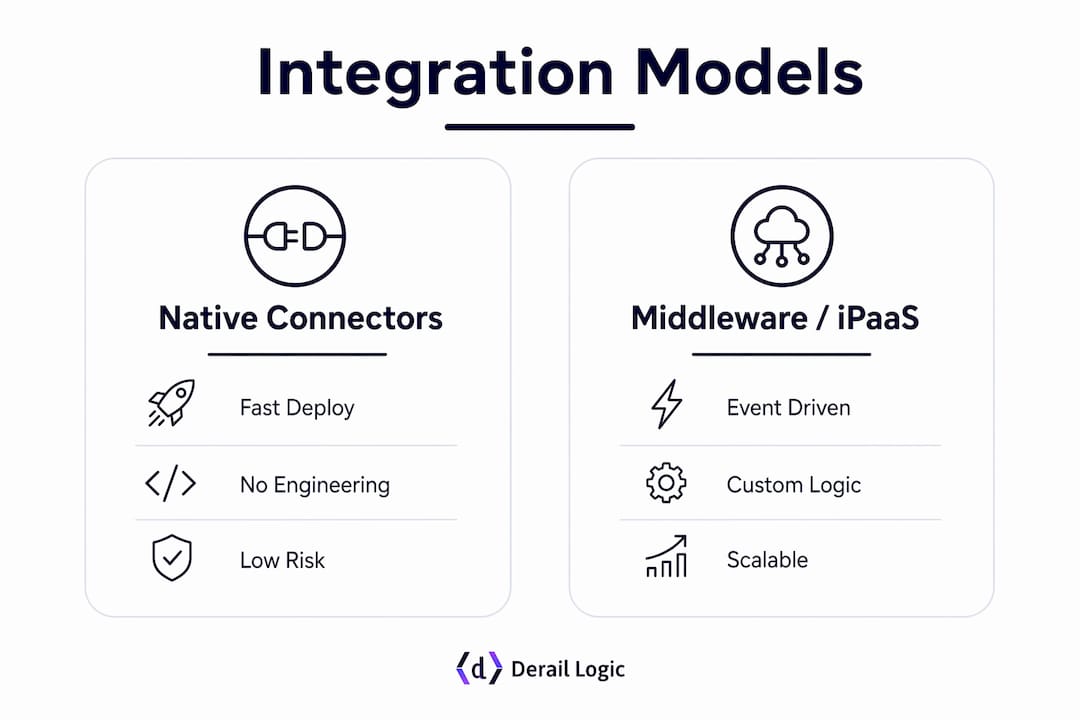
Packaged connectors (native integrations) are the right starting point. They are fast to deploy, require no engineering, and cover the most common tool pairs. Use them whenever they exist for your stack.
Middleware / iPaaS platforms (event-driven orchestration layers) fill the gap when native connectors are unavailable or when you need low-to-moderate-volume, multi-step workflows with conditional logic. They add a maintenance layer but give you flexibility without custom code.
Custom API integrations deliver the highest reliability and control for high-volume, bi-directional syncs that require conflict resolution and SLA guarantees. Empirium’s practitioner guidance is clear: reserve custom code for business-critical flows only, because the ongoing maintenance cost is real.
A quick decision checklist:
- Native connector available? Use it first, always.
- Low-to-medium event volume, no conflict resolution needed? Middleware fits.
- High volume, bi-directional sync, custom objects, SLA requirements? Custom API.
- Unclear? Start with middleware and migrate to custom only when you hit a ceiling.
Pro Tip: When evaluating total cost of ownership, add monitoring, error handling, and re-run logic to your estimate. A middleware solution that costs $500/month in licensing can easily cost $3,000/month in engineering time if the error queue is not managed. Build that into your business case before you commit.
How do you build a practical implementation roadmap?
A phased approach reduces risk and produces early wins that build internal momentum.
- Audit (2 weeks): Map every tool in your stack, document data flows, and identify manual handoffs. Produce a single-page diagram showing where data originates, where it lands, and where it gets re-entered.
- Prioritize quick wins: Rank handoffs by frequency and time cost. The highest-frequency, lowest-complexity gaps are your pilot candidates.
- Design target architecture: Sketch the connected state. Identify the integration model for each connection point before writing a line of code or configuring a connector.
- Pilot one workflow (4–8 weeks): Choose a contained, measurable workflow. The brief → create → approve → schedule → report cycle is a strong pilot because it touches every team and produces clear before/after data.
- Iterate and scale (3–9 months): Expand to adjacent workflows using the patterns and governance rules established in the pilot.
Pilot success criteria to define upfront: cycle time for the chosen workflow, number of manual handoffs eliminated, and a measurable output metric (campaign launch time, report assembly time, or attribution completeness).
Pro Tip: Document every workflow as a plain-English SOP before you automate it. If you can write the steps clearly enough for a new hire to follow, that workflow is a prime candidate for agentic AI automation. Skipping this step is the single most common reason automation projects stall after the pilot.
What does a reliable unified marketing architecture look like?
Most integration failures are architectural, not tool-specific. A functional stack has four layers working together.
Identity-resolved data layer: A central store where customer and prospect records are deduplicated and resolved across systems. Without this, every downstream tool works from a different version of the truth.

Orchestration and workflow engine: The layer that sequences tasks, carries context between steps, and handles errors. This is where agentic AI lives when you are ready for it. Agentic AI pipelines can sequence research, copy, design, approval, and publishing with context carried between agents, replacing multi-tool manual chains entirely.
Activation connectors: Read/write connections to your CRM, ad platforms, email platform, and CMS. Use event-driven hooks where possible. Canonical schemas (a shared data model all connectors write to) prevent the field-mapping chaos that breaks pipelines at scale.
Analytics and reporting layer: A centralized delivery layer that pulls from the data store rather than from individual platforms. Funnel’s ETSD model (extract, transform, store, deliver) recommends preserving raw data and transforming on read, so future business questions can be answered without rebuilding pipelines.
Monitoring points to instrument from day one: error queues, replay logs, SLA breach alerts, and data freshness timestamps.
What governance and security controls do connected workflows require?
Connecting systems expands your attack surface. These controls are non-negotiable for U.S. marketing organizations handling PII.
Security checklist:
- Apply least-privilege access to every integration: each connector should read or write only the fields it needs.
- Use scoped API tokens, not admin credentials, for all integrations.
- Rotate credentials on a defined schedule (quarterly at minimum).
- Encrypt data at rest and in transit for all pipelines touching PII.
- Maintain audit trails for every automated write action, especially in your CRM and email platform.
Compliance notes for U.S. teams: Consent records must be stored and accessible. If your workflows touch California residents, CCPA requirements apply to automated data flows, not just manual ones. Segment your environments: dev, staging, and production should never share live PII. Change approval gates (even a simple Slack-based approval for production deploys) prevent accidental overwrites that are expensive to reverse.
How do you measure whether unification is actually working?
Track before-and-after metrics from the moment the pilot launches. Without a baseline, you cannot prove value to finance or leadership.

| Metric | Before (baseline) | After target | Notes |
|---|---|---|---|
| Campaign cycle time | Measure in days | Reduce significantly | Time from brief to launch |
| Ops time per campaign | Hours per week | Reduce significantly | Manual handoffs eliminated |
| Attribution completeness | % of conversions attributed | Improve significantly | Requires event instrumentation |
| Conversion rate | Current platform rate | Notable improvement possible | Per HubSpot benchmarks under correct implementation |
Measurement tips that actually matter:
- Agree on tag standards before the pilot launches. Retroactive tagging is painful and often incomplete.
- Run incrementality tests rather than relying on platform-level attribution, which double-counts.
- Set a shared reporting cadence with finance (monthly is standard; weekly during the pilot).
- Use a centralized dashboard that pulls from your data layer, not from individual platform exports.
An AI-driven content workflow can cut research time by 60%, which is a useful benchmark when estimating ops-time savings in your pre/post measurement plan.
What does a realistic timeline and budget look like?
Phase timeline:
- Audit and prioritization: 2 weeks
- Architecture design and vendor selection: 2–3 weeks
- Pilot build and launch: 4–8 weeks
- Pilot measurement and iteration: 4 weeks
- Scale to full stack: 3–9 months
Roles you will need:
- Marketing ops lead (0.5–1 FTE): owns the workflow design and SOP documentation
- Data engineer (0.25–0.5 FTE): builds and maintains integration pipelines
- Product owner or project manager (0.25 FTE): coordinates stakeholders and tracks milestones
- Vendor or agency support: fills gaps in engineering capacity during the pilot
Primary cost drivers:
- Volume and frequency of data syncs (higher volume = higher infrastructure cost)
- Number of custom objects requiring field mapping
- SLA requirements for near-real-time syncs
- Monitoring, alerting, and maintenance overhead post-launch
- Change management and training time (often underestimated)
Why agentic AI changes the unification equation
That shift is what makes agentic AI orchestration different from traditional automation. Rather than connecting two tools, you are sequencing specialized agents that carry context across an entire campaign pipeline: brief → research → draft → design → approval → publish. Each agent hands off to the next without a human acting as the connector.
MartechAI from Derail Logic maps directly to this model. Its visual campaign studio gives marketing leaders a single workspace to plan and sequence campaigns. The intelligent CRM connects contact data to campaign activity without manual exports. Deep analytics pull from a centralized data layer rather than individual platform dashboards. The Autopilot feature surfaces opportunities proactively, and the AI Engine generates content and insights from your actual business data, not generic templates.
A practical pilot scope: run one campaign end-to-end through MartechAI’s connected workspace. Measure cycle time, handoffs eliminated, and attribution completeness against your baseline. That data is your business case for scaling.
The hidden cost of content debt in disconnected stacks
Content debt accumulates quietly. When your CMS, email platform, and social scheduler are not connected, the same asset gets uploaded, renamed, and reformatted in three places. Version control breaks. Approvals happen over email. The “final” file is rarely final. Over a quarter, this adds up to hours of rework per campaign and a growing library of outdated assets that no one trusts.
Connecting your content management system to your campaign orchestration layer solves this at the source. Assets are approved once, stored centrally, and pulled into each activation channel from a single record. That is not a minor efficiency gain. It is the difference between a team that ships confidently and one that spends Friday afternoons hunting for the right logo file.
Key Takeaways
Unifying disconnected marketing workflows requires a phased approach: audit your stack first, pilot one contained workflow, then scale using the governance and architecture patterns established in the pilot.
| Point | Details |
|---|---|
| Audit before you automate | Map every tool and manual handoff before selecting an integration model or platform. |
| Match integration model to volume | Use native connectors first, middleware for event-driven flows, custom APIs only for high-volume critical syncs. |
| Measure from day one | Set a baseline for cycle time, ops hours, and attribution completeness before the pilot launches. |
| Document SOPs for AI readiness | Plain-English workflow documentation is the prerequisite for agentic AI automation, not an afterthought. |
| Derail Logic as your pilot platform | MartechAI connects campaign studio, CRM, analytics, and AI Engine in one workspace — a contained pilot reveals ROI in 4–8 weeks. |
The part most unification guides skip
The hardest part of connecting disparate marketing tools is not the technology. It is the politics. Every tool in your stack has an owner, and every owner has a reason their tool is the source of truth. The audit phase surfaces these tensions before they become blockers, which is why it deserves two full weeks rather than a half-day workshop.
What I would prioritize in the first 30 days: one shared KPI definition document, one integration that eliminates the most painful manual handoff, and one weekly sync where marketing and sales review the same dashboard. Those three rituals create more alignment than any platform migration.
Practical advice you can copy into your kickoff plan:
- Stakeholder ritual: A 30-minute weekly review of shared KPIs with marketing, sales, and finance present. Consistency matters more than the agenda.
- Pilot guardrail: Limit the pilot to one workflow, one team, and one measurement period. Scope creep is the most common reason pilots fail to produce clean data.
- Reporting cadence: Monthly for leadership, weekly during the pilot. Automate the report assembly from day one so the process itself demonstrates the value of integration.
MartechAI gives you a connected workspace, not another tool to manage
Most marketing teams do not need more tools. They need fewer, better-connected ones. MartechAI from Derail Logic replaces the spreadsheet-and-email coordination layer with a single workspace where campaigns are planned, executed, and measured without manual handoffs. The visual campaign studio, intelligent CRM, AI Engine, and Autopilot feature work together from day one, so your pilot produces real before/after data rather than a proof of concept that never scales.
The pilot scope is simple: pick one campaign workflow, run it through MartechAI’s connected workspace for four to eight weeks, and measure cycle time and attribution completeness against your baseline. That is enough data to make a confident scaling decision.
Start your MartechAI pilot and see what your workflows look like when the human glue is replaced by a system that actually holds.
Useful sources
- Integrated Marketing Systems: Connect Data, Channels & Performance — AI Digital’s overview of how connected systems reduce reconciliation time and improve accountability; useful for framing the business case.
- Integrating multiple marketing platforms: A complete 2026 guide — InfluenceFlow’s practitioner guide covering integration patterns, conversion benchmarks, and spreadsheet dependency data.
- The Modern Marketing Operations Stack: A Reference Architecture — Empirium’s five-layer stack model and integration decision criteria; the most useful technical reference for architecture and model selection.
- Everything you need to know about marketing data integration — Funnel’s ETSD model for preserving raw data and transforming on read; essential for teams designing a central data layer.
- Agentic AI workflow orchestration for marketing teams — Simplified’s breakdown of agentic pipelines and how SOP documentation enables end-to-end automation.
- MartechAI blog — Implementation guidance, case studies, and perspective on tool sprawl and automation readiness from Derail Logic.
FAQ
What does it mean to unify disconnected marketing workflows?
Unifying disconnected marketing workflows means connecting your tools, data, and processes into a single operational environment so campaigns move from brief to report without manual handoffs or data re-entry. An integrated marketing system reduces time between event and analysis from days to hours.
How long does a marketing workflow unification project take?
A focused audit takes two weeks, a pilot runs four to eight weeks, and scaling to the full stack typically takes three to nine months depending on stack complexity and available engineering resources.
Which integration model should most marketing teams start with?
Start with native connectors wherever they exist, then use middleware for event-driven, low-volume flows. Reserve custom API integrations for high-volume, bi-directional syncs that require conflict resolution and SLA guarantees.
How do you measure the ROI of connected marketing workflows?
Track campaign cycle time, ops hours per campaign, attribution completeness, and conversion rate before and after the pilot. Connected platforms can yield between 25% and 40% higher conversion rates when correctly implemented, according to HubSpot benchmarks.
Can MartechAI replace multiple point solutions in one pilot?
Yes. MartechAI from Derail Logic connects campaign planning, CRM, email, analytics, and AI-driven content generation in one workspace, making it practical to consolidate several point solutions within a single four-to-eight-week pilot.