



Integration debt in marketing is the accumulated cost and operational friction caused by incomplete, brittle, or undocumented connections between your marketing systems. Right now, run a one-hour “connection inventory”: list every active integration, who owns it, and when it last failed. Then pause any new tool onboarding until you have a documented data map for each existing connection. Those two steps alone will surface more risk than most teams expect.
Table of Contents
- What Is Integration Debt in Marketing — and Why Does It Cost You Now?
- How Do You Recognize Integration Debt in Your Stack?
- What Causes Integration Debt to Build Up?
- How to Audit and Measure Integration Debt
- How to Prioritize Fixes and Build a Remediation Roadmap
- Which Architectural Patterns Actually Reduce Integration Debt?
- How AI Adoption Exposes Integration Debt
- How a Unified Platform Reduced Integration Debt: A MartechAI Example
- One-Page Checklist and Scoring Rubric You Can Use This Week
- What Does Remediation Actually Cost and How Long Does It Take?
- How Integration Debt Damages Cross-Channel Marketing and Customer Experience
- Which Tools Help You Identify and Manage Integration Debt?
- Key Takeaways
- The Part Most Teams Get Wrong
- How MartechAI by Derail Logic Addresses Integration Debt Directly
- Useful Sources
- FAQ
What Is Integration Debt in Marketing — and Why Does It Cost You Now?
Integration debt is not the same as technical debt. Technical debt lives inside a codebase. Integration debt lives between systems, in the handoffs, sync jobs, and data pipelines that tie your CRM to your analytics platform, your ad platform to your attribution tool, your email system to your CDP. Because it spans departments and vendors, no single team owns it, which is exactly why it compounds.
The business cost is direct. Slower campaign launches, inconsistent attribution, and lost speed-to-insight are the most common symptoms. 66% of marketers cannot measure their martech’s impact due to integration challenges, making it the primary bottleneck, not tool count.
Data quality is the AI readiness problem hiding in plain sight. Marketing leaders report that AI initiatives consistently underperform when fed fragmented “Frankenstack” data environments. AI acceleration is making this visible faster than most teams anticipated.
Only A minority of marketing organizations report fully unified advertising and marketing technologies. Clean, timely, unified data is not optional for AI. It is the prerequisite. Understanding how AI depends on connected data is the first step toward treating integration work as a strategic priority rather than a maintenance task.
How Do You Recognize Integration Debt in Your Stack?
The signs are operational before they become financial. Watch for these:
- Duplicate contact records across your CRM and email platform
- Conflicting conversion numbers between your ad platform and analytics dashboard
- Manual CSV exports as a regular part of any campaign workflow
- Launch processes that require more than two people to coordinate data handoffs
- A core tool that would take months to replace because everything else depends on it
That last point is a reliable indicator of high debt. Replacing a core system that has become a hidden dependency hub is a months-long project, not a weeks-long one.
KPIs to track integration health:
| Metric | What to Measure | Alarm Threshold |
|---|---|---|
| Sync lag | Time between source update and destination update | More than 4 hours for campaign-critical data |
| Integration error rate | Failed sync jobs as % of total | More than 5% in any 7-day window |
| Manual work rate | % of workflows requiring a human data step | More than 6% |
| Duplicate record rate | Duplicate contacts as % of total CRM records | More than 3% |
| Time-to-launch | Days from campaign brief to live | Trending upward quarter over quarter |

What Causes Integration Debt to Build Up?
Most integration debt is not the result of bad decisions. It is the result of fast ones.
- Ad hoc point-to-point connections built to meet a deadline rather than a pattern. Each one works in isolation; together they become a web nobody can fully map.
- No documented data contracts. When “customer” means something different in your CRM than in your analytics platform, every downstream report is suspect.
- Ownership gaps. Marketing owns the tools. Engineering owns the infrastructure. Nobody owns the space between them.
- Agency SOWs focused on campaign outcomes, not pipeline integrity. Agency-managed stacks accumulate debt silently because Statements of Work rarely include middleware maintenance as a deliverable. When the campaign ends, the brittle integration stays.
Point-solution sprawl and tactical integrations are the primary structural drivers. Governance is the most overlooked fix.
How to Audit and Measure Integration Debt
A structured audit turns invisible debt into a prioritized backlog. Run it in this order:
- Inventory every integration. List source system, destination system, owner, sync frequency, and last known failure date.
- Map data flows. Trace how a contact record, a campaign event, or a revenue figure moves from origin to reporting.
- Identify owners. If no one can name the owner, flag it as unowned debt.
- Capture failure modes. Pull error logs from the past 90 days for each integration.
- Score business criticality. Rate each integration: does a failure block revenue, delay reporting, or cause no immediate harm?
Sample integration inventory table:
| Source | Destination | Owner | Sync Frequency | Last Failure | Business Criticality |
|---|---|---|---|---|---|
| CRM | Email platform | Marketing ops | Hourly | — | High |
| Ad platform | Analytics | Unowned | Daily | 3 days ago | High |
| E-commerce | CDP | Engineering | Real-time | — | Medium |
| Webinar tool | CRM | Unowned | Manual | Unknown | Low |
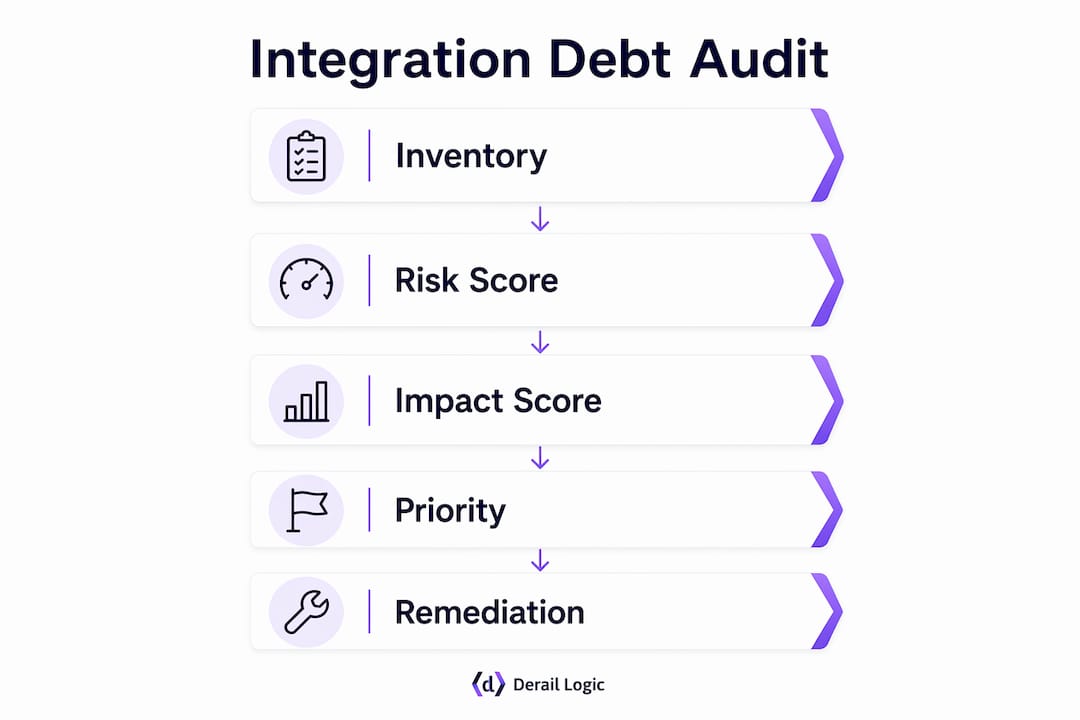
Score each integration using a simple Risk × Impact formula: rate risk (likelihood of failure) 1–3 and impact (business harm if it fails) 1–3. Multiply for a priority score of 1–9. Anything scoring 6 or above goes into the immediate remediation queue.
Pro Tip: Store your connection map in a shared, version-controlled document, not a personal spreadsheet. Without a retrievable audit trail, the map becomes stale within weeks and the next person to audit starts from zero.
Without a monthly measurement loop for data quality and stack utilization, integration debt re-accumulates within six to twelve months.
How to Prioritize Fixes and Build a Remediation Roadmap
Not every broken integration deserves the same urgency. A triage matrix helps you allocate effort honestly.
- High risk + high impact (score 7–9): Refactor now. These are your revenue-blocking, attribution-breaking connections.
- Medium risk or impact (score 4–6): Patch with a documented workaround and schedule a proper fix within one quarter.
- Low risk + low impact (score 1–3): Monitor. Log them, assign an owner, and revisit quarterly.
Roadmap milestones follow a natural sequence. Quick wins (stop-gap fixes and owner assignments) take days to weeks. Standardizing data contracts and replacing unowned point-to-point connections takes weeks to three months. Re-architecting the integration layer is a three- to nine-month project, sometimes longer for large stacks.
Stakeholder roles matter as much as the technical work. Marketing ops drives the audit and owns the connection map. Engineering handles re-architecture. Data governance sets the canonical definitions. Agency partners and vendors need to be contractually accountable for pipeline integrity, not just campaign outcomes.
Which Architectural Patterns Actually Reduce Integration Debt?
The pattern you choose depends on the scale of the problem and the team’s capacity.
- iPaaS (integration platform as a service): Tools like MuleSoft, Boomi, or Zapier for simpler stacks centralize connection management and reduce point-to-point sprawl. Best when you have many tools and limited engineering bandwidth.
- Event-driven integrations: Systems publish events (a contact updated, a form submitted) and subscribers consume them. Decoupled by design, which means one system’s failure does not cascade.
- Canonical data models: Define a single authoritative schema for “contact,” “campaign,” and “revenue event” across all systems. Every integration maps to that model, not to each other.
- API façade / abstraction layer: A thin layer that translates between your internal data model and each vendor’s API. Changing a vendor means updating one translation, not rebuilding every downstream connection.
- Master data management (MDM): For organizations with serious identity resolution problems across CRM, CDP, and ad platforms, MDM creates a single authoritative record.
Pro Tip: Start with the two or three integrations that scored highest in your audit, not the ones that are easiest to fix. Early wins on critical paths build stakeholder confidence and reduce the most immediate risk.
How AI Adoption Exposes Integration Debt
AI does not hide bad integrations. It amplifies them.
“The only way to know when customers jump from ad experiences to other marketing channels is through data, and that’s why unifying data is driving marketers closer to martech-ad tech convergence.” — eMarketer / Zeta Global research
Fewer than one-third of marketers actively apply AI across both paid and owned channels, and fragmented data is a primary reason. An AI model trained on stale, duplicated, or mismatched inputs produces unreliable outputs, and those outputs get acted on by your campaigns. The role of AI in marketing is expanding fast, but its value is directly proportional to the quality of the data it consumes.
Governance steps that protect AI initiatives:
- Assign a named data owner for each critical integration
- Document connection maps and update them after every tool change
- Set data quality SLAs (for example, sync lag under four hours for campaign-critical data)
- Run monthly integration health checks against your KPI thresholds
Fixing integration debt is not a prerequisite for buying AI tools. It is a prerequisite for those tools performing reliably.
How a Unified Platform Reduced Integration Debt: A MartechAI Example
A mid-size US-based marketing team running separate tools for campaign planning, CRM, email, and analytics faced a common pattern: attribution numbers disagreed across platforms, launches required four-person coordination calls, and replacing their email platform had been “on the roadmap” for eighteen months because of undocumented dependencies.
After moving to MartechAI’s unified platform and completing a connection mapping exercise:
- Before: Three separate sync jobs, two unowned, with no documented failure alerting
- After: Single connection map with named owners for every data flow
- Before: Campaign launch required manual CSV handoffs between three tools
- After: Orchestrated from one workspace, reducing launch coordination from days to hours
- Before: Attribution discrepancies of 15–30% between ad platform and CRM reports
- After: Consistent attribution from a single data layer feeding all reports
The marketing teams solution at Derail Logic is built specifically for this kind of consolidation, with US-based teams as the primary use case.
One-Page Checklist and Scoring Rubric You Can Use This Week
Run this as a 60–90 minute team workshop. Assign one person to document, one to facilitate.
- List every tool in your stack and every known connection between them.
- For each connection, name the owner (a person, not a team).
- Record sync frequency and last known failure date.
- Pull error logs from the past 90 days.
- Rate each integration: Risk (1 = unlikely to fail, 3 = fails regularly) × Impact (1 = no business harm, 3 = blocks revenue or reporting).
- Flag any integration with no named owner as priority regardless of score.
- Sort by priority score and assign the top five to owners with a fix deadline.
Sample scoring rubric:
| Integration | Risk (1–3) | Impact (1–3) | Priority Score | Action |
|---|---|---|---|---|
| CRM → Email | 2 | 3 | 6 | Patch this quarter |
| Ad platform → Analytics | 3 | 3 | 9 | Refactor now |
| Webinar → CRM (manual) | 1 | 2 | 2 | Monitor |
| CDP → Personalization | 2 | 2 | 4 | Patch next quarter |
What Does Remediation Actually Cost and How Long Does It Take?
Set realistic expectations before you take this to leadership.
- Quick wins (stop-gap fixes, owner assignments, error alerting): days to two weeks, primarily person-hours from marketing ops and engineering.
- Medium projects (standardizing data contracts, replacing unowned point-to-point connections): four to twelve weeks, may require external consulting or iPaaS licensing.
- Re-architecture (event-driven layer, MDM, full abstraction): three to nine months or more, with significant engineering and QA investment.
Primary cost drivers:
| Cost Factor | Notes |
|---|---|
| Internal person-hours | Marketing ops, engineering, data governance |
| External consulting | Integration architects, agency retainers |
| iPaaS or ETL licensing | Varies by tool and data volume |
| Testing and QA | Often underestimated; budget 20–30% of build time |
| Documentation and training | Ongoing; not a one-time cost |
The hidden cost is opportunity cost. Every week a high-priority integration stays broken is a week your attribution is wrong and your AI tools are working from bad inputs.
How Integration Debt Damages Cross-Channel Marketing and Customer Experience
When your systems do not share a consistent view of a customer, your campaigns cannot either. A contact who converts on paid search may still receive a retargeting ad the next day because the CRM and ad platform are not in sync. A customer who contacts support gets a follow-up email based on data that is 48 hours stale.
56% of marketing leaders describe their organization’s customer experience as only “somewhat consistent” because some systems or teams are not yet integrated. That inconsistency is not a brand problem. It is a data pipeline problem. Cross-channel orchestration requires a unified consumer view, and that view only exists when integrations are healthy, documented, and owned.
The analytics and ROI impact of closing integration gaps is measurable: organizations that complete integration report better attribution, improved targeting, and faster campaign cycles.
Which Tools Help You Identify and Manage Integration Debt?
No single tool solves integration debt, but several categories address specific parts of the problem.
Discovery and monitoring: Platforms like Datadog, Monte Carlo, and Fivetran’s observability features surface sync failures, data drift, and pipeline anomalies before they affect campaigns.
iPaaS and middleware: MuleSoft, Boomi, Workato, and Zapier (for lighter stacks) centralize connection management and provide audit logs that feed your connection map.
CDPs: Segment, mParticle, and Tealium act as a canonical data layer, reducing the number of point-to-point connections by routing customer data through a single hub.
Unified marketing platforms: Tools that combine CRM, campaign orchestration, and analytics in one workspace, like MartechAI from Derail Logic, reduce integration debt structurally by eliminating connections that would otherwise need to be built and maintained.
Spreadsheet-based audits remain the starting point for most teams. A shared Google Sheet or Notion database tracking source, destination, owner, sync frequency, and last failure is more useful than no system at all, and it costs nothing to start.
Key Takeaways
Integration debt is the primary bottleneck in most marketing stacks, and fixing it is a prerequisite for reliable AI performance, consistent attribution, and faster campaign execution.
| Point | Details |
|---|---|
| Start with a connection inventory | List every integration, its owner, and its last failure date in a 60-minute team session. |
| Score by risk × impact | Multiply risk (1–3) by impact (1–3) to produce a priority score; refactor anything scoring 6 or above immediately. |
| Assign named owners | Any integration without a named human owner is unmanaged debt regardless of its technical state. |
| Monthly health checks prevent re-accumulation | Without a regular review cadence, integration debt returns within six to twelve months as tools and business rules change. |
| Derail Logic’s MartechAI reduces debt structurally | A unified platform with visual connection maps and a single data layer eliminates categories of point-to-point connections entirely. |
The Part Most Teams Get Wrong
Most marketing teams treat integration debt as an engineering problem and wait for engineering to fix it. That framing is why it never gets fixed.
The real issue is ownership. Engineering can refactor a connection, but they cannot decide which data model is canonical for “customer” across your CRM, CDP, and ad platform. Marketing ops can document the connection map, but they cannot enforce data quality SLAs without a governance agreement that includes vendors and agency partners. The work sits in the gap between functions, and nobody has a budget line for “the gap.”
The teams that make real progress do one thing differently: they treat the integration layer as a product, with a named owner, a backlog, and a regular review cadence. Not a project that ends, but an ongoing operational discipline. That shift in framing is what separates teams that fix integration debt from teams that just talk about it.
How MartechAI by Derail Logic Addresses Integration Debt Directly
Fragmented stacks cost marketing teams real time and real attribution accuracy. MartechAI by Derail Logic was built to eliminate that friction by connecting your CRM, campaign studio, analytics, and content tools in a single workspace, with visual connection maps that make data ownership visible and AI-driven data quality alerts that catch sync issues before they affect your reports.
For US-based marketing teams ready to move from audit to action, MartechAI offers a practical path: fewer manual handoffs, consistent attribution across channels, and an AI engine that works from clean, unified data rather than a patchwork of brittle connections. The marketing automation service is the right starting point if you want a guided integration review and a clear remediation plan. Book a demo or request an integration audit at derail-logic.com.
Useful Sources
- Technology Integration Debt: The Real Bottleneck in Your Marketing Stack — Nomad Marketing
- When Integration Debt Replaces Technical Debt — The Big Pixel
- The Integration Debt Reckoning Is Coming for Agency Owners — Ingenia
- Integration Debt Is the New Tech Debt — NLTD
- While Marketers Champion Tech Stack Convergence, They’re Struggling to Make It Happen — eMarketer / Zeta Global
- Is the Data Integration Gap Eroding Your Martech ROI? — Advertising Week
- What Is Integration Debt in Enterprises? — Team Computers
- Derail Logic Blog: AI Won’t Fix Marketing Tool Sprawl
- Derail Logic: Marketing Teams Solutions
FAQ
What is integration debt in marketing?
Integration debt is the accumulated cost and friction from incomplete, brittle, or undocumented connections between marketing tools. It compounds over time and becomes the primary bottleneck for attribution, campaign speed, and AI readiness.
How do you measure integration debt?
Track sync lag, integration error rate, manual work rate, duplicate record rate, and time-to-launch. Score each integration by risk × impact (both rated 1–3) to produce a priority score for your remediation backlog.
How long does it take to fix integration debt?
Quick wins take days to two weeks. Standardizing data contracts and replacing unowned connections takes four to twelve weeks. Re-architecting the integration layer is a three-to-nine-month project depending on stack complexity.
Why does integration debt get worse when you add AI tools?
AI models require consistent, timely, unified data to perform reliably. Fragmented integrations feed AI tools stale or mismatched inputs, which produces unreliable outputs that get acted on by your campaigns.
How does Derail Logic help reduce integration debt?
MartechAI by Derail Logic connects CRM, campaign orchestration, and analytics in a single workspace with visual connection maps and AI-driven data quality alerts, reducing the point-to-point connections that create and sustain integration debt.