



Conversion tracking measures the actions that matter to your business, links them back to the specific ads or campaigns that drove them, and feeds that signal into reporting and automated bidding. Without it, you’re spending budget on guesswork. Three things must be in place before any of that works:
- Conversion action definition: what counts as a conversion (purchase, form fill, call, app install) and what value it carries
- Tracking signal: the tag, pixel, or server-side event that fires when the action happens and sends identifiers back to the platform
- Attribution and counting rules: how credit is assigned across touchpoints and whether multiple conversions per click are counted
Get those three right, and your campaign data becomes a reliable input for Smart Bidding, budget allocation, and creative decisions. Miss one, and automated bidding underperforms because the platform is optimizing against incomplete or incorrect signals.
Pro Tip: Before touching any campaign settings, audit your existing conversion actions. Duplicate or misconfigured actions are the most common reason Smart Bidding targets the wrong outcome.
Table of Contents
- How does conversion tracking actually work under the hood?
- What conversion types and surfaces can you track?
- How do you set up and validate conversion tracking?
- How do attribution models and counting settings affect your numbers?
- How do you use conversion data to actually optimize campaigns?
- How do you integrate conversion tracking into a unified marketing stack?
- Key Takeaways
- The part most teams get wrong about conversion tracking
- Derail Logic MartechAI closes the gap between tracking and decisions
- FAQ
- Selected sources and further reading
How does conversion tracking actually work under the hood?
The signal chain from ad click to reported conversion has several links, and any one of them can break silently.
Client-side flow is the standard path most teams start with:
- A user clicks your ad. The platform appends a click identifier to the destination URL — Google uses a GCLID (Google Click Identifier), Meta uses
fbclid, and other platforms have their own equivalents. - The landing page loads your tag or pixel (via Google Tag, Google Tag Manager, or a platform-specific pixel). A site-wide tag and Conversion Linker store the GCLID in a first-party cookie so it survives navigation to other pages.
- When the user completes the target action (reaches a thank-you page, submits a form, makes a purchase), an event snippet fires. It sends the event name, a
transaction_idorevent_id, and optionally a conversion value back to the platform. - The platform matches the event to the original click using the stored GCLID or cookie and records a conversion.
Server-side flow runs in parallel. Instead of relying on the browser, your server or CRM sends the conversion event directly to the platform’s API (Google’s Conversions API, Meta’s Conversions API, or a server-to-server postback for affiliate networks). Server-to-server postbacks are often the most reliable method for partner and affiliate networks because they bypass browser restrictions entirely.
The practical minimum today is a dual setup: client-side tag plus server-side API. Browser restrictions like Safari’s Intelligent Tracking Prevention (ITP) and ad blockers can silently drop client-side events. A server-side layer captures what the browser misses, and a shared
event_idortransaction_idlets the platform deduplicate events that arrive through both channels. Dual setups maximize coverage and resilience in ways that a pixel-only implementation simply cannot match.
Common break points in the chain: the GCLID is stripped by a redirect or a URL-rewriting plugin, the Conversion Linker tag is missing so the cookie never sets, the thank-you page fires on page load rather than on form submission, or cross-domain navigation loses the cookie entirely. Each of these has a specific fix — Conversion Linker for GCLID preservation, cross-domain linker configuration for multi-domain flows, and server-side capture for browser-blocked events.
What conversion types and surfaces can you track?
Google Ads supports conversion actions across four main surfaces: website, app, phone calls, and offline imports. Most other ad platforms follow a similar structure.
| Conversion type | Typical implementation | Key parameter to capture |
|---|---|---|
| Website purchase | Thank-you page event snippet or server-side API | transaction_id, value, currency |
| Lead / form fill | Thank-you page snippet or form-submit event | event_id for deduplication |
| Phone call | Call forwarding number or call extension | Call duration threshold |
| App install / in-app event | SDK (Firebase, Adjust, AppsFlyer) | app_instance_id |
| Offline conversion | CRM or POS import via GCLID or hashed PII | GCLID or hashed email/phone |
| Store visit | Platform-modeled (Google Ads only) | No direct tag required |
A few implementation notes worth keeping in mind:
- Offline imports: CRM or POS systems can upload conversion data using the GCLID captured at form submission or hashed PII, attributing closed deals back to the original ad click. This is the most underused capability in B2B campaign measurement.
How do you set up and validate conversion tracking?
A clean setup follows this sequence:
- Implement the tag and parameters. Place the global site tag on every page. Add event snippets on conversion pages, passing
transaction_id,value, andcurrencywhere applicable. Enhanced conversions capture hashed first-party data (email, phone, name) at conversion time to improve match quality. - Set primary vs. secondary conversions. Primary conversions feed Smart Bidding. Secondary conversions appear in reports but don’t influence bids. Getting this distinction right is what separates clean bidding signals from noisy ones.
Pro Tip: Don’t wait for conversions to appear organically during testing. Use the “Test” function in Google Tag Manager or manually trigger the conversion event in a staging environment, then check the platform diagnostics within 30 minutes.
How do attribution models and counting settings affect your numbers?
Attribution determines which touchpoint gets credit. Counting determines how many conversions a single click can generate. Both settings change the CPA and ROAS figures you see, and they change what Smart Bidding optimizes for.
| Attribution model | What it credits | Best fit |
|---|---|---|
| Last-click | Final ad interaction before conversion | Simple funnels, direct response |
| First-click | First ad interaction | Awareness-focused measurement |
| Linear | Equal credit across all touchpoints | Long consideration cycles |
| Time decay | More credit to recent touchpoints | Short sales cycles |
| Position-based | Credits first and last touchpoints, with partial credit to middle interactions | Balanced brand + DR campaigns |
| Data-driven | ML-weighted based on actual paths | High-volume accounts |
Data-driven attribution produces the most accurate credit distribution, but it requires sufficient conversion volume to train the model. Below platform thresholds, it falls back to last-click, which can quietly skew your bidding signals without any warning in the UI.
Key counting and attribution decisions to get right:
- Switch from last-click to data-driven when your account generates enough conversions to qualify. The bidding improvement is real.
- Use “One” counting for leads to avoid inflating CPA with repeat form submissions from the same user.
- Check your attribution window. A 30-day window is standard for most campaigns, but a 7-day window may be more appropriate for short-cycle products. Changing the window retroactively shifts historical numbers.
How do you use conversion data to actually optimize campaigns?
Measurement only earns its keep when it changes decisions. Three high-value optimizations follow directly from clean conversion data:
- Shift budget to higher-value campaigns. Sort campaigns by conversion value, not just conversion count. A campaign generating fewer but higher-value conversions often deserves more budget than a high-volume, low-value one. Aligning your marketing and sales view makes this comparison possible when offline revenue is in the picture.
- Switch bidding targets from clicks to conversion value. Once you have at least 30–50 conversions per month per campaign, Target ROAS or Maximize Conversion Value outperforms manual CPC. The signal quality your tracking provides is what makes that switch safe.
- Test creatives against primary conversions, not CTR. An ad with a lower click-through rate but a higher conversion rate is the better ad. Use conversion rate and cost per conversion as the primary creative evaluation metrics, not engagement proxies. For practical CRO experiments, conversion rate optimization guidance can help structure your testing approach.
Before acting on any shift in conversion numbers, verify three things: tag status hasn’t changed, attribution window hasn’t been modified, and conversion values are consistent across platforms. A sudden CPA improvement is sometimes a tracking regression, not a real performance gain.
How do you integrate conversion tracking into a unified marketing stack?
Conversion data scattered across platforms creates blind spots. A unified stack connects ad platform events, CRM outcomes, and analytics into one consistent schema.
Integration checklist:
- Link Google Ads to GA4 and import GA4 goals as conversion actions to reduce tag duplication.
- Configure server-side event forwarding from your CRM so closed deals and qualified leads flow back as offline conversions using the GCLID captured at form submission.
- Map all events to a canonical schema: consistent
event_name,transaction_id,value, andcurrencyacross every platform and channel. - Enable anomaly detection on conversion event volume. A tag regression caught within hours costs far less than one discovered during a monthly report review.
Derail Logic’s MartechAI platform connects campaign studio, CRM events, analytics, and server-side event forwarding into a single workflow. Campaign managers get a centralized place to map conversion events, monitor match quality, and confirm that offline CRM data is flowing back to ad platforms without manual exports. For enterprise teams managing complex attribution and long sales cycles, that unified view removes the “invisible waste” of misattributed spend.
Pro Tip: Use AI-powered anomaly detection to catch tag regressions and match quality drops before they distort a full reporting period.
Key Takeaways
Conversion tracking works when the signal chain from ad click to reported event is complete, deduplicated, and matched to the right attribution model for your funnel.
| Point | Details |
|---|---|
| Three core components | Every setup needs a defined conversion action, a firing tracking signal, and clear attribution/counting rules. |
| Dual tracking is the standard | Client-side tags plus a server-side API upload together recover the conversions browser restrictions would otherwise drop. |
| Attribution model choice matters | Data-driven attribution improves bidding accuracy at sufficient volume; below threshold, last-click quietly skews your signals. |
| Privacy features are not optional | Enhanced conversions and Consent Mode are now baseline requirements for accurate measurement under modern browser restrictions. |
| Derail Logic MartechAI | Centralizes campaign, CRM, and server-side event data so conversion signals stay clean, testable, and connected to real business outcomes. |
The part most teams get wrong about conversion tracking
Conversion tracking is treated as a setup task. You configure it once, confirm the tag fires, and move on. That’s the mistake.
The real discipline is maintenance. Attribution windows drift. Tags break silently after a site redesign. A developer adds a redirect that strips the GCLID. Enhanced conversions get disabled during a consent management platform update. None of these failures announce themselves in the campaign UI. They show up weeks later as a CPA that looks better than it should, or a Smart Bidding strategy that stops performing after a period of apparent improvement.

The teams that get the most out of conversion data treat it like a live system, not a completed project. They check tag status weekly, monitor event match quality scores, and verify that server-side uploads are arriving with the right identifiers. They also resist the temptation to add more conversion actions than the account can support. A campaign optimizing against five primary conversions with thin volume on each is worse off than one with two well-defined, high-volume actions.
The trade-off between data volume and signal clarity is real. More conversion types give you richer funnel visibility, but they dilute the bidding signal if volume is spread too thin. Pick your primary conversions deliberately, treat secondary conversions as diagnostic tools, and revisit that decision every quarter as campaign scale changes.
Derail Logic MartechAI closes the gap between tracking and decisions
Campaign teams often have the tracking configured but lack a single place to see whether it’s working, what it’s telling them, and what to do next. Derail Logic’s MartechAI platform gives you that unified view: a visual campaign studio connected to a CRM, real-time analytics dashboards, and server-side event forwarding that keeps your conversion data clean across channels.
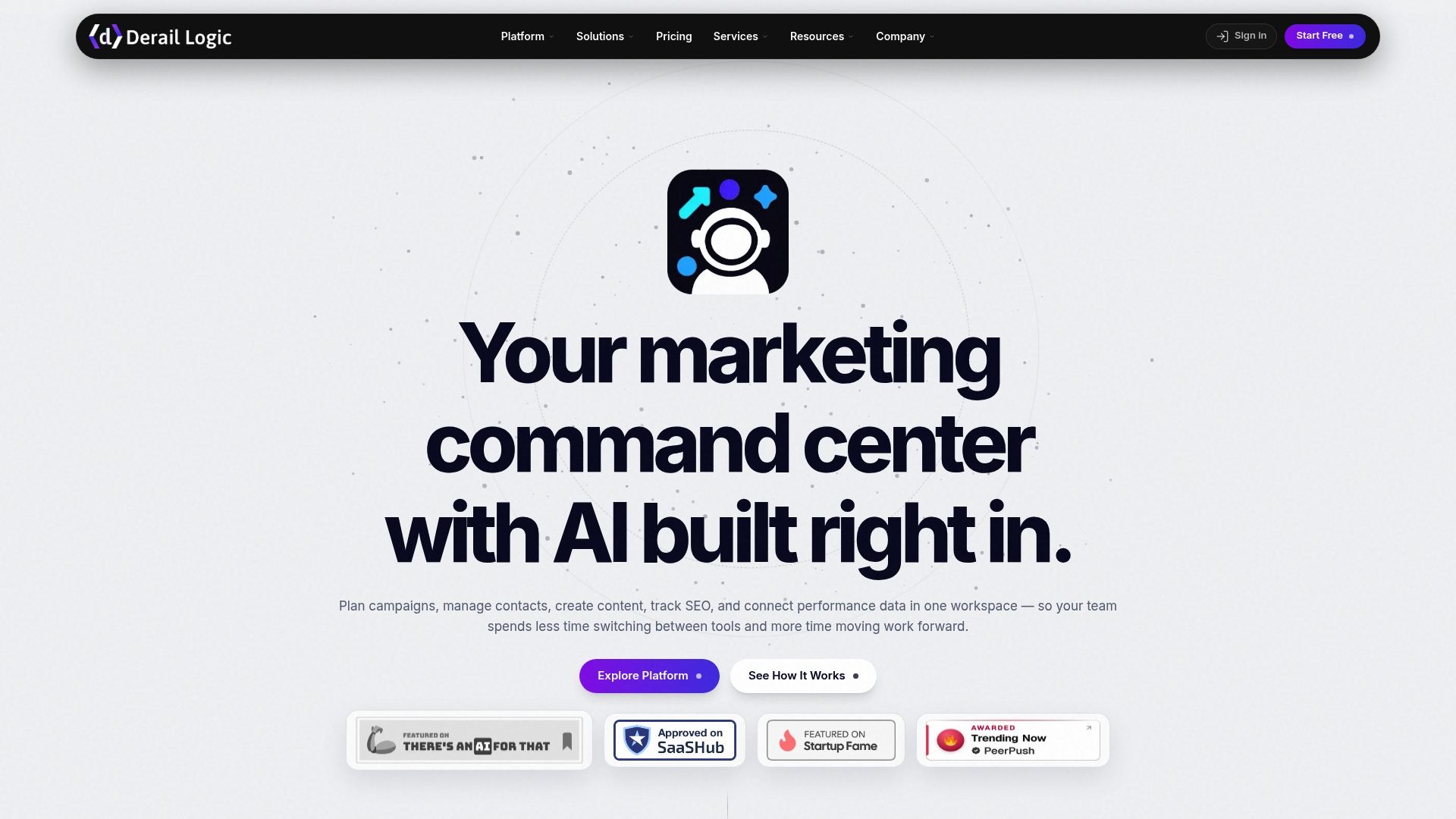
The platform handles offline conversion imports from your CRM, maps events to a canonical schema across ad platforms, and surfaces anomalies before they distort a reporting period. For campaign managers who need measurement that actually feeds decisions, not just fills a dashboard, it’s a direct path from tracking setup to optimization.
Start a free trial of MartechAI and connect your conversion data to the campaigns that depend on it. Other integrations and workflows exist, and teams should choose the setup that fits their stack.
FAQ
What is conversion tracking in digital marketing?
Conversion tracking records when a user completes a defined action after interacting with an ad, then links that action back to the campaign, ad group, or keyword that drove it. It’s the foundation of ROI measurement and automated bidding.
How does the GCLID work in Google Ads conversion tracking?
Google appends a GCLID (Google Click Identifier) to the landing page URL when a user clicks an ad. A site-wide tag stores it in a first-party cookie, and when a conversion event fires, the platform uses that stored GCLID to match the conversion back to the original click.
What is the difference between primary and secondary conversions?
Primary conversions feed Smart Bidding and appear in the “Conversions” column. Secondary conversions are tracked for reporting only and don’t influence automated bids. Keeping a few high-quality primary conversions per campaign produces cleaner bidding signals than including every tracked action.
Why do my conversion numbers differ between Google Ads and GA4?
Attribution model differences, conversion window settings, and cross-domain tracking gaps are the most common causes. Google Ads uses ad-click attribution by default; GA4 uses session-based attribution. Linking both platforms and aligning attribution windows reduces but rarely eliminates the discrepancy.
How do enhanced conversions improve tracking accuracy?
Enhanced conversions hash first-party customer data (email, phone, name) at conversion time and send it to Google alongside the standard event. Google matches the hash against signed-in user data to recover conversions that cookies or browser restrictions would otherwise miss, improving both match quality and attribution accuracy.
Selected sources and further reading
These platform docs and implementation guides cover the technical steps in detail:
- How to Set Up Google Ads Conversion Tracking in 5 Steps | WordStream
- About conversion measurement — Google Ads Help
- Conversion Tracking: The Complete Guide for Marketers — Wonster Analytics
- Conversion Tracking Complete Guide 2026: Accurate Measurement
- Conversion tracking: why it’s important and how to properly set it up | Forbes
- Introduction To Conversion Tracking Methods — Everflow Helpdesk