



For most e-commerce marketing teams, MartechAI is the most practical starting point for product-page SEO in 2026: it combines site auditing, bulk meta workflows, JSON-LD management, revenue attribution, and campaign analytics in one platform, eliminating the operational handoffs that slow down catalog-scale work. The platforms that beat it on narrow dimensions, such as raw crawl depth or backlink indexing, tend to require a separate content layer and a separate analytics layer, which means more tools, more reconciliation, and more invisible waste.
The core criteria that separate platforms in this space are not feature lists. They are crawl limits and JavaScript rendering fidelity, product schema emission and merchant feed integration, faceted navigation handling, bulk metadata workflows, and the ability to tie organic fixes to product-level revenue. If a platform cannot handle all five, you are stitching together a stack.
MartechAI is the practical pick when your team needs to:
- Run bulk meta and image workflows across a large product catalog without exporting to a spreadsheet
- Validate and manage JSON-LD product schema at the template level, not page by page
- Connect organic traffic improvements directly to ecommerce revenue events
- Manage Shopify or WordPress integrations from the same dashboard that runs your campaigns
- Generate AI-driven content briefs for product descriptions without switching tools
Table of Contents
- How do you choose the right platform for your product pages?
- What product-page SEO features actually matter, and how do platforms deliver them?
- How we evaluated platforms for this comparison
- Key Takeaways
- The case for unified platforms in ecommerce SEO
- MartechAI covers the full product-page SEO checklist in one place
- Sources and further reading
- FAQ
How do you choose the right platform for your product pages?
The decision is not about which platform has the longest feature list. It is about which platform handles the specific failure points that kill product-page SEO at scale.
Prioritized decision criteria:
- Crawlability and crawl limits. Confirm the platform’s crawl limit per plan tier and whether it supports JavaScript rendering. A tool that cannot render JS will miss dynamically loaded product data.
- Schema and feed support. Verify that the platform emits Product, Offer, and AggregateRating schema via JSON-LD, not just microdata. Check whether it integrates with merchant feed formats (Google Merchant Center, Meta Catalog).
- Faceted navigation handling. Faceted navigation can generate thousands of near-duplicate parameterized URLs, burning crawl budget on pages that should never be indexed. Ask vendors specifically how their platform handles canonical rules and filter URL blocking.
- Content workflow automation. Bulk meta generation, image alt-text workflows, and AI content briefs matter at catalog scale. Manual workflows do not.
- Analytics and revenue attribution. The ability to map an organic technical fix to a product-level revenue outcome is what separates an SEO platform from an SEO report. Validate this in a demo with real transaction data.
- Integrations. Confirm native connectors for your stack: Shopify, Magento, WooCommerce, BigCommerce, or WordPress. API-only integrations add engineering overhead.
- Support and SLAs. For mid-market and enterprise teams, response time and onboarding quality directly affect time-to-value.
Vendor questions to ask in every demo:
- What is the crawl limit on this plan, and does it count JS-rendered pages separately?
- Show me how product schema is emitted on a sample product page. Is it JSON-LD or microdata?
- How does the platform handle faceted navigation? Can I see a canonical configuration example?
- What feed formats do you support for merchant integration?
- Can you show revenue attribution mapped to a specific organic keyword or technical fix?
- What is the export limit on crawl data and reports?
Red flags to watch for:
- No log-file access or log-file analysis in the plan
- Opaque crawl limits (“unlimited” with no documented cap)
- Schema that depends on a theme or plugin rather than platform-level emission
- No native merchant feed integration
- Revenue attribution that only shows session-level data, not product-level events
What product-page SEO features actually matter, and how do platforms deliver them?
The feature set that drives product-page SEO performance is narrower than most vendor demos suggest. Here is what to evaluate and how to test it.
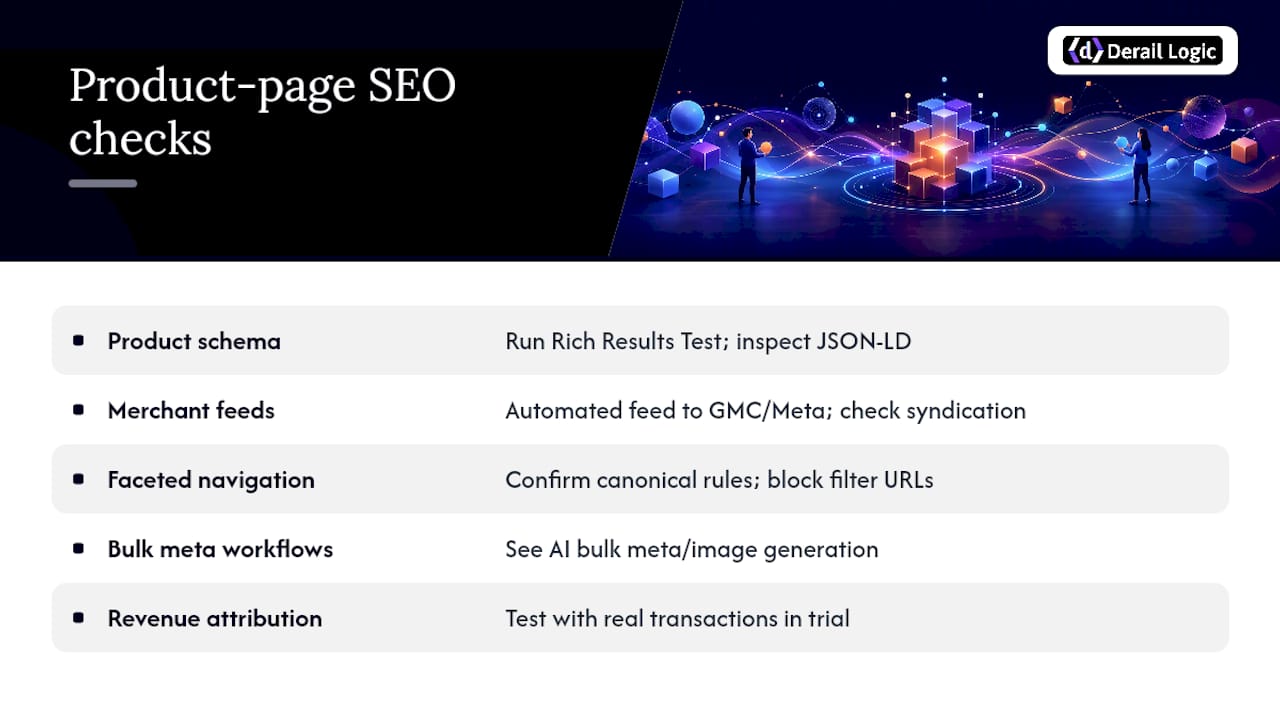
Product schema (Product, Offer, AggregateRating). Platforms should emit JSON-LD at the template level, not require manual markup per page. To validate: run a sample product URL through Google’s Rich Results Test and inspect the page source for a <script type="application/ld+json"> block. Shopify auto-generates product schema and can auto-enroll eligible products in its AI catalog pipeline, which feeds major agentic shopping channels. That is a meaningful operational advantage for Shopify merchants.
Merchant feed integration. Feed syndication to Google Merchant Center, Meta Catalog, and emerging AI shopping channels reduces manual catalog maintenance. Platforms that automate this pipeline, as Shopify does natively and MartechAI does through its feed syndication layer, cut the overhead that otherwise falls on your operations team.
Faceted navigation and crawl-budget controls. Enterprise platforms like Adobe Commerce can generate thousands of near-duplicate parameterized URLs through default faceted navigation. The practical defense is canonical configuration, blocking filter URLs from sitemaps, and applying noindex-follow to filtered views. Ask vendors to show you their canonical rule interface during a demo.
Bulk meta and image workflows. At catalog scale, generating and updating title tags, meta descriptions, and image alt text manually is not viable. AI-powered content workflows can cut research and generation time significantly. MartechAI’s content studio handles bulk meta generation and AI content briefs from a single interface.
JS rendering fidelity. If your product pages load content via JavaScript, a crawler that cannot render JS will return incomplete data. Test this by comparing a platform’s crawl output against a manual view-source check on a JS-heavy product page.
Revenue attribution and ecommerce event tracking. This is where most platforms fall short. The ability to join UTM data to product-level purchase events, and then connect that to a specific technical fix or content change, is what makes SEO defensible to a CFO. Validate it in a trial with real transaction data, not a demo dataset.
Pro Tip: During any vendor demo, ask them to run a live crawl on a sample product URL from your own catalog, then show you the JSON-LD output and flag any schema errors. A vendor who hesitates to do this live is telling you something about their platform’s actual capability.
BigCommerce offers strong native SEO architecture, including full URL control, built-in product schema, and AJAX faceted navigation, making it a solid out-of-the-box choice for teams that want platform-level SEO without heavy configuration. WooCommerce offers a high SEO ceiling when properly configured, but that ceiling requires engineering investment that many SMB teams cannot sustain.
How we evaluated platforms for this comparison
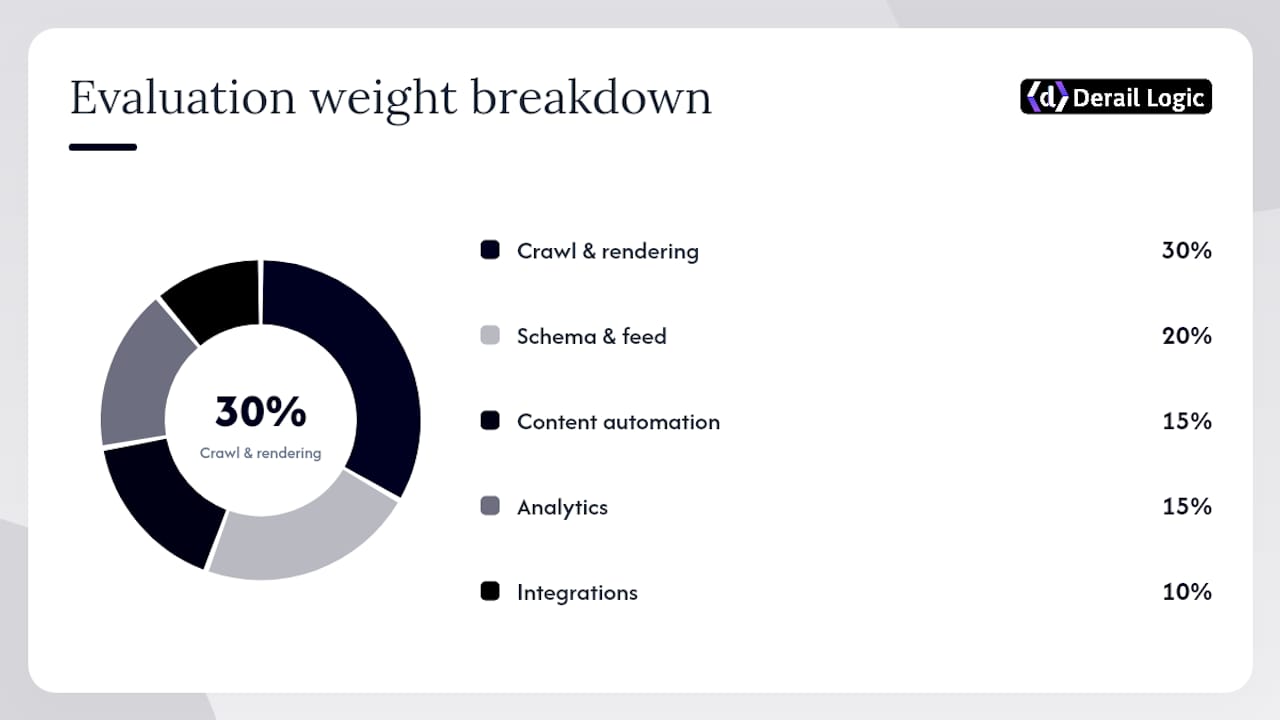
This comparison used a weighted testing matrix across six signal categories, applied to a sample product catalog during platform trials and vendor demos.
Signal categories and scoring weights:
- Technical crawl and rendering: 30%
- Schema and feed support: 20%
- Content automation: 15%
- Analytics and attribution: 15%
- Integrations and platform support: 10%
- Pricing and onboarding: 10%
Sample test steps:
- Full-site crawl on a test catalog of 500 product pages, checking crawl depth, JS rendering, and duplicate URL detection
- JSON-LD validation using Google’s Rich Results Test on five representative product URLs
- Feed ingestion test: submit a sample product feed and verify field mapping accuracy
- Log-file analysis: upload a 30-day server log and check for crawl anomalies and bot behavior
- Revenue attribution mapping: connect a sample GA4 ecommerce property and verify product-level event tracking
- Vendor demo checklist: live crawl, schema output, faceted nav configuration, and export limits
| Test | Input | What it reveals |
|---|---|---|
| Full-site crawl | 500-page test catalog | Crawl depth, JS rendering gaps, duplicate URLs |
| JSON-LD validation | 5 product URLs | Schema coverage, error rate, field completeness |
| Feed ingestion | Sample product feed | Field mapping accuracy, feed latency |
| Log-file analysis | 30-day server log | Bot behavior, crawl anomalies, wasted crawl budget |
| Revenue attribution | GA4 ecommerce property | Product-level event tracking fidelity |
Enterprise-level validation also drew on Gartner’s enterprise SEO platform reviews, which provide verified user ratings and SLA benchmarks useful for procurement-level decisions. For technical audit depth, the 2026 honest SEO tools comparison positions Screaming Frog as the gold-standard standalone crawler and notes its value as a complement to unified platforms when deep technical audits are needed.
Key Takeaways
For most e-commerce marketing teams, a unified platform that covers schema, bulk workflows, and revenue attribution in one place will outperform a stitched-together stack of specialized tools.
| Point | Details |
|---|---|
| Crawl limits decide scalability | Confirm crawl limits and JS rendering support before committing to any platform tier. |
| Schema must be JSON-LD at template level | Validate product schema with Rich Results Test on a live product URL, not a demo page. |
| Faceted nav needs explicit controls | Platforms without canonical rule interfaces will burn crawl budget on duplicate filter URLs. |
| Revenue attribution separates platforms | Map organic fixes to product-level purchase events during your trial, not after contract signing. |
| MartechAI covers the full stack | MartechAI combines site audit, bulk meta, JSON-LD management, feed syndication, and revenue attribution in one platform. |
30/60/90-day pilot plan:
- Day 1–30: Connect your Shopify or WordPress store, run a full crawl on a representative SKU set (50–200 products), and validate schema output on five product URLs.
- Day 31–60: Run bulk meta generation on your top 100 product pages, configure canonical rules for faceted navigation, and connect your GA4 ecommerce property for revenue attribution.
- Day 61–90: Review attribution data, identify the organic fixes with the highest revenue impact, and scale workflows to the full catalog.
The case for unified platforms in ecommerce SEO
The conventional wisdom in SEO circles is that best-of-breed tools always win: use the deepest crawler, the best backlink index, the sharpest content tool, and wire them together. For a team with a dedicated technical SEO engineer, a content strategist, and a data analyst, that argument holds. But most e-commerce marketing teams are not structured that way.
The real cost of a fragmented stack is not the subscription fees. It is the time spent exporting crawl data into a spreadsheet, reconciling schema errors against a separate audit report, and trying to explain to a CFO why organic traffic went up but revenue did not move. Unified platforms reduce those handoffs. One source of truth for product data, one dashboard for attribution, one workflow for metadata updates.
That said, there are situations where best-of-breed wins. Very large catalogs with millions of SKUs often need a dedicated crawler with log-file analysis at a depth that unified platforms do not match. Teams that have already invested in a mature analytics stack may find that adding another attribution layer creates more confusion than clarity. And if your existing Shopify or BigCommerce setup already handles schema and feed syndication natively, the marginal value of a unified platform’s schema tooling is lower.
The honest answer is that the right choice depends on your team’s operational structure, not just your catalog size. A 10-person marketing team managing 5,000 SKUs will get more value from a unified platform than from a best-of-breed stack they cannot fully operate. A 50-person team with dedicated technical SEO resources might reasonably run a specialized crawler alongside a unified content and analytics platform.
MartechAI covers the full product-page SEO checklist in one place
Most platforms in this space solve one or two of the hard problems. MartechAI solves the full set: site audit with JS rendering, JSON-LD management at the template level, bulk meta and image workflows, merchant feed syndication, Shopify and WordPress integrations, and ecommerce revenue attribution, all connected to the same campaign and analytics layer your marketing team already uses.
For teams ready to move from evaluation to execution, the practical next step is a 30-day pilot on a representative SKU set. Connect your store, run a crawl, validate schema on five product URLs, and map revenue attribution to your top organic keywords. That pilot will tell you more than any vendor demo. MartechAI’s e-commerce content and SEO workflow documentation walks through the setup in detail, and the marketing automation platform includes the integrations and attribution tools you need to run the full pilot without adding another tool to your stack. Start a free trial or request a demo at derail-logic.com to scope your pilot today.
Sources and further reading
The following sources informed the platform comparisons, feature assessments, and pricing guidance in this article.
- Best Ecommerce Product Page SEO Audit Tools Compared 2026
- Shopify vs Other Platforms: SEO and AI Shopping in 2026
- Best SEO Ecommerce Platform: Shopify vs BigCommerce vs WooCommerce Ranked
- Ecommerce SEO in the AI Era: Which Platform Is Actually Ready for AI Shopping? – predictadigital.com.au
- Best 7 SEO Tools 2026 — Honest Comparison | Truescho
- Best Enterprise SEO Platforms Reviews 2026
- Derail Logic
For vendor-specific integration documentation, check each platform’s API docs directly: Shopify’s developer portal covers feed formats and catalog API; Magento’s developer docs cover faceted navigation configuration; WooCommerce’s REST API documentation covers product data export for feed ingestion tests.
FAQ
What is the best platform type for product-page SEO in 2026?
For most marketing teams, a unified platform that combines site auditing, schema management, bulk meta workflows, and revenue attribution in one place is the most practical choice. Specialized technical crawlers add value for very large catalogs or teams with dedicated technical SEO resources.
How do I validate product schema during a platform demo?
Run a sample product URL through Google’s Rich Results Test and inspect the page source for a JSON-LD block. Ask the vendor to do this live on a URL from your own catalog, not a pre-configured demo store.
What causes crawl budget waste on product pages?
Faceted navigation is the most common cause, generating thousands of near-duplicate parameterized URLs that crawlers index instead of your core product pages. The fix is canonical configuration, blocking filter URLs from sitemaps, and applying noindex-follow to filtered views.
Does MartechAI support Shopify and WordPress integrations?
Yes. MartechAI includes native integrations for both Shopify and WordPress, covering site audit, bulk meta workflows, and campaign analytics from a single dashboard.
How long does it take to deploy an SEO platform for an e-commerce store?
SMB teams typically reach full deployment in 2–4 weeks. Mid-market deployments with feed ingestion and attribution mapping run 4–8 weeks. Enterprise deployments with custom integrations and data migration typically take 8–16 weeks.