



Retainer-based marketing management is a recurring contractual agreement where a client pays a fixed, predictable fee, typically billed monthly or quarterly, to secure ongoing access to an agency’s marketing team, expertise, and services. The industry term you’ll see in contracts is “marketing retainer,” and it covers both strategy and execution, not just one or the other. The core appeal is straightforward: predictable costs, continuous momentum, and a team that already knows your business.
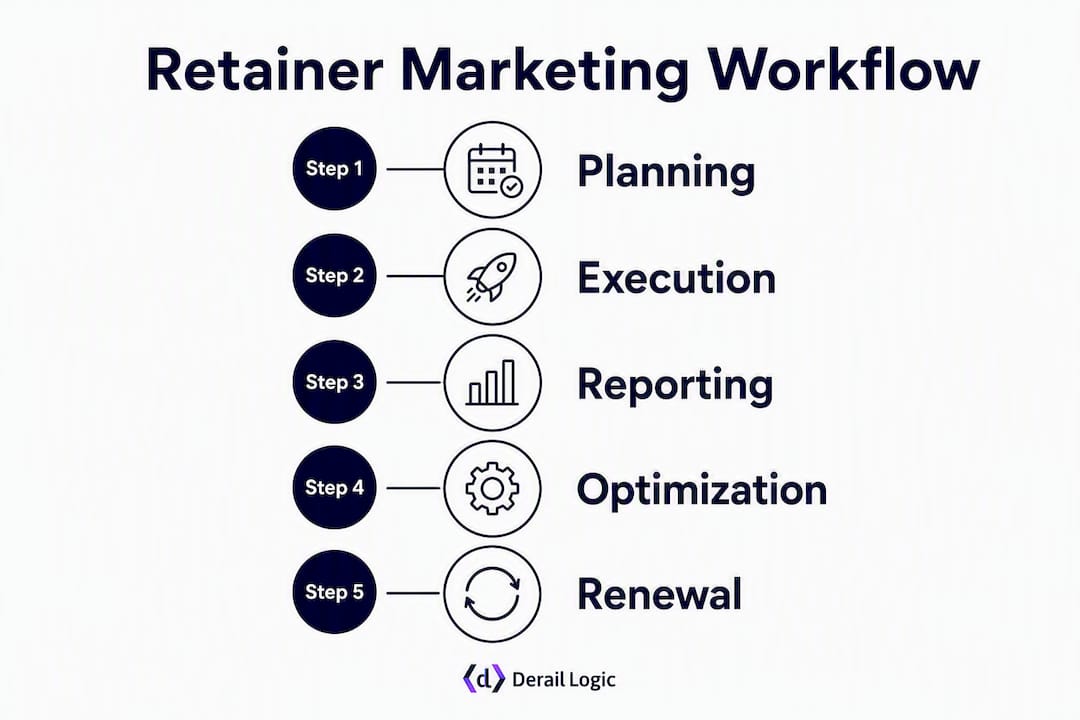
Table of Contents
- What does retainer-based marketing management look like in practice?
- What are the main types of marketing retainers?
- How does a retainer engagement work month to month?
- Retainer vs. hourly vs. project-based billing: which model fits?
- What are the real benefits of retainer-based marketing management?
- How do you price a marketing retainer?
- What contract clauses does every retainer agreement need?
- What are the most common retainer pitfalls, and how do you fix them?
- When should you choose a retainer, and when shouldn’t you?
- How does a unified platform support retainer management?
- Key Takeaways
- The case for treating retainers as infrastructure, not overhead
- Derail Logic makes retainer management less painful
- Useful sources
- FAQ
What does retainer-based marketing management look like in practice?
The model takes a few different shapes depending on what a client actually needs. Some retainers give you dedicated access to a named team, others deliver a fixed set of outputs each month, and others simply prepay a block of agency hours you draw down as needed.

A typical monthly retainer for a B2B tech company might include deliverables such as several long-form blog posts, paid media campaigns, regular social scheduling, and analytics reports, all for a fixed fee invoiced monthly. The agency allocates specific staff hours to that client, tracks utilization internally, and holds a standing 30-minute check-in every other week. No surprises on the invoice, no re-briefing the team from scratch every quarter.
Common services bundled under retainer-based management include:
- SEO and content: keyword research, blog production, on-page optimization, and link building
- Paid media: campaign setup, budget pacing, A/B testing, and performance reporting
- Social media: scheduling, community management, and creative asset production
- Email marketing: list segmentation, campaign builds, and deliverability monitoring
- Analytics and reporting: dashboard maintenance, KPI tracking, and monthly performance summaries
- Strategy: quarterly planning, competitive analysis, and channel recommendations
The billing cadence matters operationally. Monthly fixed fees are most common because they align with most marketing planning cycles and make cash flow predictable for both sides.

What are the main types of marketing retainers?
Retainer structures generally fall into four categories, and each one creates a different balance of predictability, flexibility, and accountability.
Hours/capacity retainers prepay a set number of agency hours per month. The client draws from that pool for whatever work comes up.
- Pros: flexible, good for clients with variable or unpredictable needs
- Cons: hard to forecast output; unused hours often don’t roll over; scope can drift without discipline
Deliverable/output retainers specify exactly what gets produced each month: four blog posts, eight social graphics, one email campaign.
- Pros: clear expectations, easy to measure, simple to invoice
- Cons: less flexible when priorities shift; quality can suffer if quantity targets dominate
Value- or KPI-linked retainers tie some or all of the fee to agreed outcomes, such as a target number of marketing-qualified leads (MQLs), a traffic threshold, or a conversion lift. Many agencies now adopt KPI-linked models to increase accountability and reduce buyer risk.
- Pros: aligns agency incentives with client goals; transparent performance measurement
- Cons: requires clean attribution data; fees can become unpredictable if KPIs are volatile
Hybrid retainers combine a fixed base fee covering core deliverables with a performance bonus tied to specific KPIs. This is increasingly common because it protects the agency’s floor revenue while giving clients a share of the upside.
- Pros: balances stability with incentive alignment
- Cons: more complex contracts; requires clear KPI definitions upfront
Pro Tip: Before choosing a retainer type, map your internal reporting capabilities. A KPI-linked model only works if you can actually measure the KPIs you’re tying fees to. If your attribution is messy, start with a deliverable-based structure and layer in performance bonuses once the data is clean.
How does a retainer engagement work month to month?
Knowing the model is one thing. Running it without friction is another. Here’s how a well-structured retainer typically operates from kickoff through steady-state delivery.
Onboarding and knowledge transfer
- Discovery session: agency interviews key stakeholders, reviews existing analytics, and audits current channels.
- Access and documentation: client shares CRM access, ad account credentials, brand guidelines, and historical campaign data.
- Initial audit: agency produces a baseline assessment covering SEO health, paid media performance, and content gaps.
- Scope confirmation: both parties sign off on the deliverable list, hour caps, and KPIs before any production begins.
Monthly workflow
| Phase | Typical timing | Who leads |
|---|---|---|
| Planning and prioritization | Days 1–3 | Agency strategy lead |
| Content and creative production | Days 4–— | Agency production team |
| Client review and approvals | Days —–20 | Client marketing manager |
| QA, publishing, and distribution | Days —–— | Agency operations |
| Reporting and next-month planning | Days —–30 | Agency + client together |
Reporting cadence
A solid monthly report covers five things: KPI performance vs. targets, channel-level highlights, budget pacing, utilization (hours delivered vs. estimated), and recommended priorities for the next cycle. Keep it to one page or one dashboard view. The goal is a decision-ready summary, not a data dump.
Retainer clients typically receive priority scheduling, which means urgent requests get handled faster than they would for project-based clients. Define “urgent” in the contract, though. A reasonable SLA is a 4-hour acknowledgment and a 24-hour action plan for priority requests.
Retainer vs. hourly vs. project-based billing: which model fits?
| Dimension | Retainer | Hourly | Project-based |
|---|---|---|---|
| Pricing / predictability | Fixed monthly or quarterly fee; fully predictable | Variable; depends on hours logged | Fixed per project; predictable per engagement |
| Best for (use case) | Ongoing channels: SEO, content, paid media, social | Ad hoc support, overflow capacity, undefined scope | One-off builds: website, rebrand, campaign launch |
| Flexibility / scope changes | Moderate; change-control process required | High; pivot anytime | Low; changes require contract amendments |
| Accountability / KPI alignment | Strong when KPIs are defined upfront | Weak; effort is tracked, not outcomes | Moderate; tied to project deliverables |
| Billing cadence / invoicing | Monthly or quarterly invoice; easy to budget | Weekly or monthly based on timesheets | Milestone-based or on completion |
| Risk allocation / agency incentives | Agency incentivized to build long-term value | Agency incentivized to log more hours | Agency incentivized to close scope fast |
The retainer model outperforms the others when marketing work is continuous and compounds over time, like SEO or content. Hourly billing suits overflow or exploratory work where scope is genuinely unknown. Project billing fits discrete, bounded deliverables with a clear end date.
Rule of thumb: if you need the same agency team working on your marketing every month for more than three months, a retainer almost always costs less and delivers more than repeated project engagements.
What are the real benefits of retainer-based marketing management?
The advantages split cleanly between what clients gain and what agencies gain, and understanding both sides helps you negotiate a better deal.
For clients
- Predictable budgeting: one fixed line item replaces unpredictable project invoices and scope-change fees.
- Institutional knowledge: the agency learns your brand, audience, and competitive context over time. That knowledge compounds. Re-briefing a new vendor every quarter is expensive, even when it’s invisible.
- Faster turnarounds: a team already familiar with your brand guidelines and approval process moves faster than one starting cold.
- Priority access: retainer clients typically receive VIP scheduling, which matters when a campaign needs to launch quickly.
- Compounding results: channels like SEO and content marketing build on prior work. Continuity produces results that project-based engagements rarely achieve.
For agencies
- Predictable revenue: recurring income allows better staffing decisions and reduces the feast-or-famine cycle.
- Deeper planning: knowing a client’s goals 12 months out enables proactive strategy rather than reactive execution.
- Higher lifetime client value: retainers shift the relationship from vendor to strategic partner, which increases both retention and referral rates.
- Better work: teams that know a client deeply produce better creative and smarter strategy than teams parachuting in for a single project.
This relationship-driven engagement model is why retainers tend to produce stronger long-term outcomes than transactional arrangements. The agency has skin in the game beyond the next invoice.
How do you price a marketing retainer?
Three pricing approaches dominate the market, and most agencies use a blend of all three to arrive at a defensible number.
The three approaches
Cost-plus pricing starts with the agency’s internal cost (hours × fully-loaded hourly rate) and adds a target margin. Transparent and easy to audit, but it can undervalue strategic work.
Deliverable-based pricing sets a price per output type (e.g., $X per blog post, $Y per campaign) and bundles them into a monthly package. Works well when scope is stable and outputs are easy to count.
Value/KPI-linked pricing anchors the fee to the business outcome the client cares about, such as a percentage of ad spend managed or a fee per MQL generated. Requires clean measurement infrastructure.
Step-by-step pricing method
- List every deliverable the retainer covers and assign an estimated hour count to each.
- Calculate fully-loaded cost: multiply total hours by the blended hourly rate (salary + benefits + overhead).
- Apply your target margin: most agencies target a gross margin on retainer work.
- Sanity-check against value: if the fee is less than what the client would pay a mid-level in-house hire for the same output, you’re probably underpriced.
- Set a monthly hour cap and define what happens when the client requests work beyond it (change-control pricing).
Example: 40 hours/month × $85 fully-loaded rate = $3,400 cost. At a 50% margin, the retainer price is $6,800/month. Add a $150/hour overage rate for requests beyond the cap.
Pro Tip: Track utilization monthly: hours delivered vs. hours estimated. If you’re consistently delivering 110% of estimated hours without additional revenue, your scope definition is broken. Set a utilization alert at 90% so you can flag scope creep before it erodes margin.
Defining scope with explicit deliverable quantities, revision rounds, and monthly hour caps is the single most important step in protecting retainer profitability.
One proven tactic: lead with a fixed-fee pilot project to prove value before proposing a retainer. A short pilot period with a discount can reduce the client’s perceived risk and give both parties a chance to test the working relationship before committing to a longer term.
What contract clauses does every retainer agreement need?
A retainer without a solid contract is just a handshake with a monthly invoice. These clauses protect both parties.
- Scope definition: a precise list of deliverables, channels covered, and what is explicitly excluded. Vague language like “ongoing marketing support” is the root cause of most retainer disputes.
- Deliverable specifications: quantity, quality standards (word count, image resolution, revision rounds), and format for each output type.
- Monthly hour cap: the maximum hours included in the fee, with a defined overage rate.
- Change-control procedure: how out-of-scope requests are identified, priced, and approved before work begins.
- Billing cadence and payment terms: invoice date, due date, and late-payment terms.
- Termination and notice period: typically 30–90 days written notice; specify whether the notice period is billable.
- IP and ownership: who owns the creative assets, copy, and data produced under the retainer.
- Confidentiality: mutual NDA language covering client data, strategy, and competitive information.
- SLA and priority terms: defined response times for standard and urgent requests.
- Renewal and price-review terms: annual price adjustment mechanism (e.g., CPI-linked or fixed percentage) and renewal notification window.
For scope creep specifically, the most effective language is a written change-order requirement: any request outside the defined scope triggers a written estimate and approval before work starts. No approval, no work. This one clause eliminates most scope disputes before they start.
KPI definitions belong in the contract too, especially for value-linked retainers. Specify the measurement methodology, the data source, and who is responsible for reporting.
What are the most common retainer pitfalls, and how do you fix them?
Even well-structured retainers run into problems. Here are the five most frequent, with practical fixes.
- Vague scope: the agency does “whatever comes up” each month, making it impossible to measure value or control costs. Fix: rewrite the scope as a deliverable list with quantities and revision limits before the next billing cycle.
- Underutilization: the client isn’t sending enough work, so the agency delivers less than the retainer value. Fix: monthly utilization reports showing hours delivered vs. contracted; a quarterly scope review to right-size the engagement.
- Mismatched expectations: the client expects strategy; the agency delivers execution. Fix: define the ratio of strategic vs. tactical work in the contract and revisit it at the 90-day mark.
- Insufficient reporting: the client can’t tell if the retainer is working. Fix: a standardized monthly report template covering KPIs, budget pacing, and next-month priorities, delivered on a fixed date.
- Measurement disputes: both parties disagree on whether KPIs were hit. Fix: agree on the data source and measurement methodology in writing before the retainer starts.
Warning signs a retainer needs renegotiation: the agency is consistently over-delivering without additional compensation; the client is consistently sending fewer requests than the scope assumes; KPIs haven’t been reviewed in more than six months; or either party dreads the monthly check-in call.
When should you choose a retainer, and when shouldn’t you?
Run through this checklist before committing to either side of the decision.
A retainer is the right choice when:
- You have consistent, recurring marketing needs across at least two channels.
- The channels you’re investing in compound over time (SEO, content, email list growth).
- You need a team that understands your brand deeply, not one re-briefed every engagement.
- You want priority access and faster turnarounds during peak periods.
- You’re planning 6+ months of continuous marketing activity.
- You need strategic input, not just task execution.
A project or hourly model is better when:
- The work is a one-off build: a website redesign, a brand identity, a single campaign launch.
- Your scope is undefined or you’re evaluating a new vendor relationship.
- The engagement is seasonal and won’t extend beyond 8–10 weeks.
- Budget is highly variable month to month and you can’t commit to a fixed fee.
Scoring rule: if you checked three or more items in the “retainer is right” list, a retainer will almost certainly deliver better value than repeated project engagements. Fewer than three, start with a fixed-scope pilot.
How does a unified platform support retainer management?
Running a retainer well requires more than good intentions. It requires systems that keep everyone aligned on scope, progress, and results without constant manual coordination. This is where a platform like Derail Logic’s MartechAI makes a measurable difference for agencies managing multiple retainer clients.
The features that matter most for retainer operations:
- Shared campaign calendar: all planned deliverables, deadlines, and approvals visible to both agency and client in one place.
- Task boards linked to deliverables: each retainer deliverable becomes a tracked task, so utilization is visible in real time rather than reconstructed from timesheets at month-end.
- Centralized analytics dashboards: KPI data from paid media, SEO, email, and social pulled into one view, eliminating the manual data-gathering that consumes hours before every monthly report.
- Automated reporting: scheduled report generation means the monthly summary goes out on time without someone spending half a day building it in a spreadsheet.
- Collaboration tools: comments, approvals, and revision requests happen inside the platform, not scattered across email threads and Slack channels.
The onboarding phase is where most retainers lose time. MartechAI’s project management and task boards let agencies build a repeatable onboarding template, so a new retainer client is up and running in days rather than weeks. Utilization tracking is built in, which means the 90% utilization alert described in the pricing section above is a dashboard notification, not a manual calculation.
Key Takeaways
A retainer-based marketing management agreement delivers the most value when scope is defined precisely, KPIs are agreed upfront, and utilization is tracked monthly.
| Point | Details |
|---|---|
| Define scope precisely | Vague retainers are the primary cause of margin erosion; specify deliverables, quantities, and revision rounds in the contract. |
| Match retainer type to your data | Use deliverable-based retainers when attribution is messy; layer in KPI-linked fees once measurement is clean. |
| Price with a utilization floor | Estimate hours, apply fully-loaded costs, target 40% margin, and set a 90% utilization alert as an early warning. |
| Start with a pilot | A 3-month pilot at a 10% discount reduces client risk and validates the working relationship before a long-term commitment. |
| Use Derail Logic to run the workflow | MartechAI’s task boards, campaign calendar, and automated reporting reduce retainer admin overhead and keep utilization visible in real time. |
The case for treating retainers as infrastructure, not overhead
The conventional framing of a marketing retainer is a cost to justify. The more useful frame is infrastructure. A retainer is the operating system for your marketing function: it keeps the team running, the data flowing, and the strategy connected to execution month after month.
What most articles understate is how much of the retainer’s value is invisible. The agency that already knows your brand doesn’t just save onboarding time. It catches the strategic mistake before it ships, flags the competitive move you missed, and connects last quarter’s content investment to this quarter’s pipeline. That institutional knowledge doesn’t show up on a deliverable list, but it’s often the most valuable thing the retainer buys.
The practical priority for both clients and agencies: start with a short pilot, define deliverables precisely, and review scope quarterly. Retainers that drift into vague “ongoing support” arrangements almost always disappoint both sides. The ones that work treat scope definition as a living document, not a one-time negotiation.
Derail Logic makes retainer management less painful
Managing a retainer without the right infrastructure means your team spends hours every month chasing approvals, reconciling data from disconnected tools, and manually building reports that should generate themselves. Derail Logic’s MartechAI platform addresses exactly those friction points.
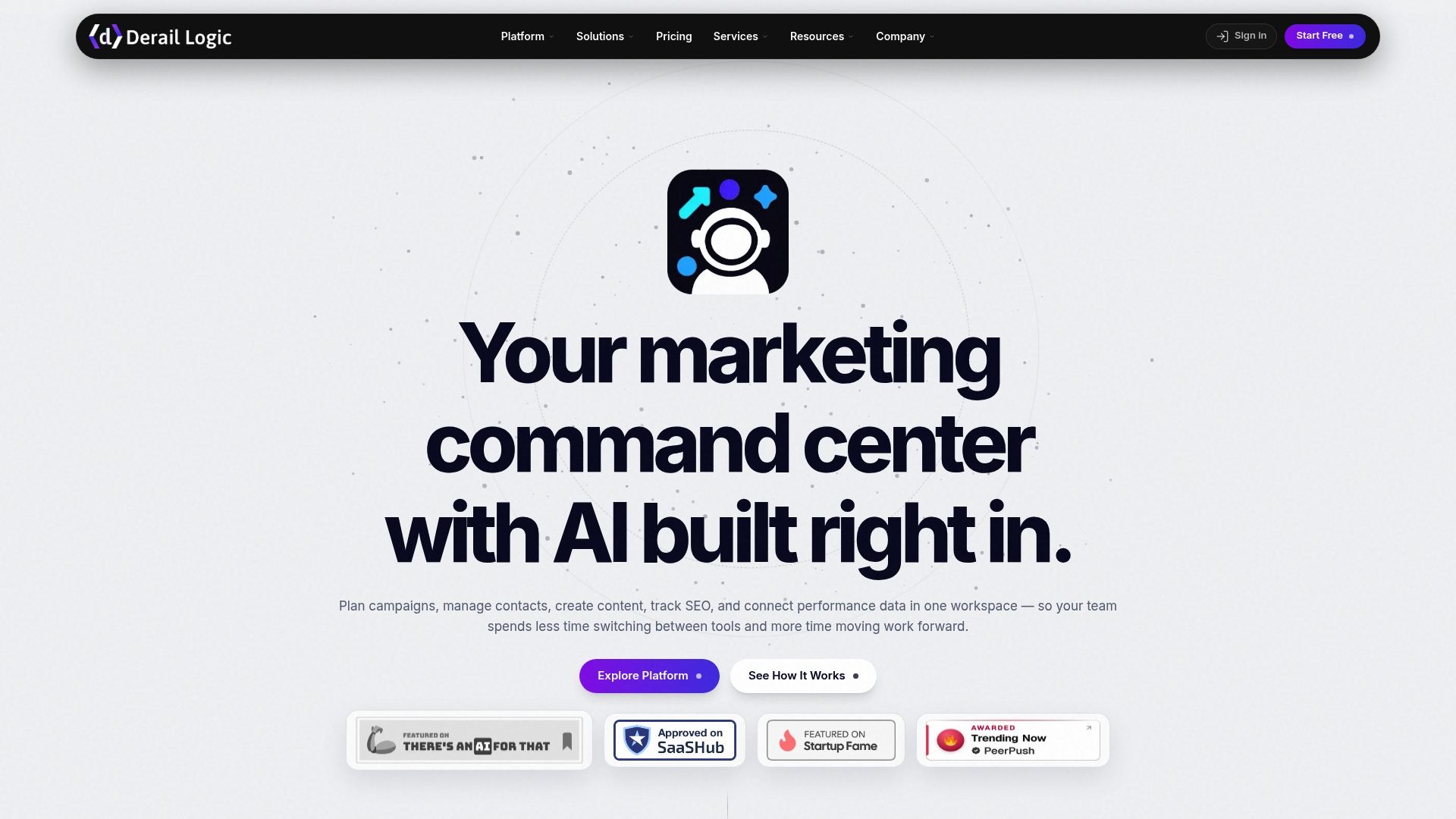
The platform connects your campaign calendar, task boards, CRM, and analytics into one workflow, so utilization tracking is automatic, monthly reports are scheduled, and every deliverable has a clear owner and deadline. For agencies running multiple retainer clients, that means managing more clients without multiplying complexity. For in-house teams evaluating whether to bring a retainer agency on board, it means you’ll have the visibility to hold them accountable from day one.
Marketing automation handles the repetitive coordination work so your team focuses on strategy and output, not admin. Start a free trial or request a demo to see how MartechAI fits your retainer workflow.
Useful sources
- Marketing Retainers: What Are They and How Do They Work? — NetSuite
- What Is a Marketing Retainer and How Can It Benefit Your Business? — DC Business Toolkit
- Marketing Performance Benchmarks: KPI Examples for Teams — Derail Logic
FAQ
What does “retainer-based” mean in marketing?
Retainer-based means a client pays a fixed recurring fee, usually monthly, to secure ongoing access to an agency’s team and services rather than hiring them project by project. The fee covers a defined scope of work delivered continuously over the contract period.
What does a marketing retainer typically include?
A marketing retainer usually covers a defined mix of services, such as SEO, content production, paid media management, social scheduling, and monthly reporting, all specified in the contract with quantities and revision limits.
Is a retainer the same as a salary?
No. A retainer is a contractual fee paid to an external agency or freelancer for ongoing services; it is not an employment arrangement. The agency remains an independent contractor, and the client does not pay payroll taxes, benefits, or employment overhead on a retainer.
When is a retainer better than a project engagement?
A retainer outperforms project billing when marketing work is continuous and compounds over time, such as SEO or content, and when you need a team with deep brand knowledge rather than one re-briefed for each engagement. If you checked three or more items on the “retainer is right” checklist above, a retainer is likely the stronger choice.
How do you prevent scope creep in a retainer agreement?
The most effective tactic is a written change-order requirement: any request outside the defined scope triggers a written estimate and explicit approval before work begins. Pair that with monthly utilization reporting to catch overruns early.