



A single risky word almost never sends a legitimate email to spam. Sender reputation, authentication, and engagement history decide inbox placement far more than vocabulary does. Before you edit another subject line, check your SPF, DKIM, and DMARC records, run a seed-list placement test, and review your subject formatting. This guide covers the word categories that still carry weight, why old “spam word” lists mislead marketers, a pre-send checklist, tool recommendations, and where Derail Logic fits into the fix.
TL;DR:
- Urgency phrases like “act now” or “expires today” are still flagged, but replacing them with specific dates can reduce risk.
- Financial claims such as “free money” or “double your income” carry high filter weight, especially if they resemble scams or lack specific details.
- Subject lines are more scrutinized than body content, so stacking risky words in headlines significantly increases the likelihood of filtering.
- Modern spam filters rely on a rule-scoring system rather than blacklists, where multiple signals including reputation and authentication weigh more than isolated words.
- Prioritizing authentication fixes and list hygiene reduces deliverability issues more than focusing solely on avoiding spam words.
Table of Contents
- Which Email Spam Words Still Trigger Filters in 2026?
- Why Are Fixed Spam-Word Lists Outdated?
- Pre-Send Checklist: What to Fix Before Every Campaign
- What Tools Actually Check for Spam Words?
- How Derail Logic Handles Spam-Risk Checks for You
- What Actually Deserves Your Editing Time
- Try MartechAI’s Email Builder Before Your Next Send
- Sources
- FAQ
Which Email Spam Words Still Trigger Filters in 2026?
Filters weigh categories, not individual words in isolation. Modern spam engines cluster risk around a handful of regulated or heavily abused topics, and those categories are worth knowing cold because they still carry disproportionate scoring weight even in machine-learning systems.
Urgency and pressure language tops the list. Phrases like “act now,” “urgent response required,” and “expires today” read as classic scam patterns because legitimate senders rarely need to manufacture panic. A safer alternative states a real, specific date: “Offer ends March 14” carries the same urgency without the alarm-bell phrasing.
Financial and money-related terms come next. “Free money,” “cash bonus,” “double your income,” and “no fees ever” sit near the top of most filter dictionaries because they mirror advance-fee fraud templates almost word for word. Naming a specific dollar figure, a program name, or a plan tier (“Save $40 on the Growth plan”) reads as commercial, not predatory.
Health, pharma, and other regulated terms carry heavy weight because they’re tied to real abuse: unlicensed pharmacies, weight-loss scams, and miracle-cure schemes have trained filters to treat this category with suspicion by default. If you sell in this space, lean on specific product names and regulatory language rather than vague promises like “lose 30 pounds fast.”
Other categories worth watching:
- Clickbait and overpromise phrasing: “You won’t believe,” “guaranteed results,” “once in a lifetime”
- Adult or explicit content language: even mild innuendo in B2C campaigns can trip filters trained on adult-content spam
- Crypto and get-rich-quick terminology: “double your bitcoin,” “guaranteed returns,” “financial freedom”
- Aggressive direct-sales CTAs: “buy now,” “click here immediately,” stacked in the same line
Subject lines carry more weight than body copy because filters treat them as the highest-signal real estate in the message. A subject line stacking three risky words (“URGENT: Free Cash Offer Expires!!!”) compounds risk in a way that a single word in a long paragraph never does.
Pro Tip: Read your subject line out loud. If it sounds like something you’d forward to your spam folder without opening, rewrite it before you touch anything else in the email.
Why Are Fixed Spam-Word Lists Outdated?
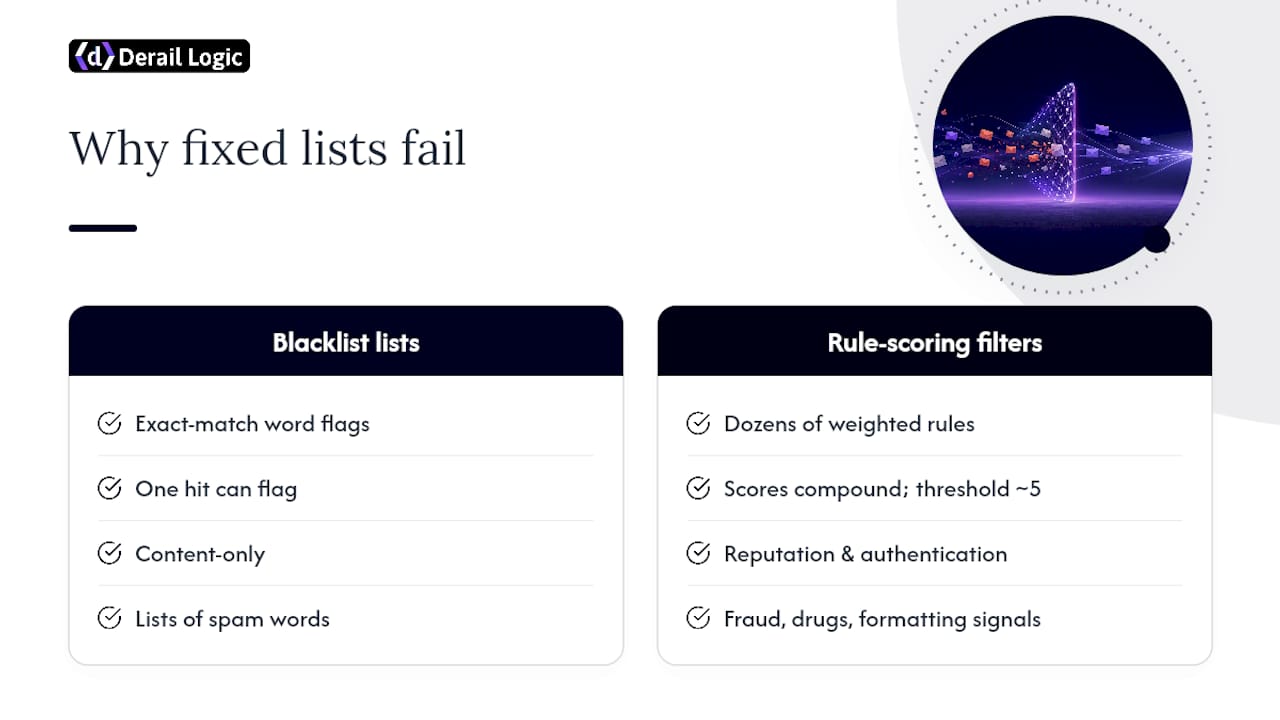
The “avoid these 100 words” lists that circulate online treat spam classification like a blacklist lookup. That’s not how modern filtering works, and it hasn’t been for years.
SpamAssassin, one of the most widely deployed open-source filtering engines, illustrates the actual mechanism. It uses a configurable rule-scoring system: dozens of rules each contribute a small score, and administrators set a required threshold, defaulting to 5.0, before a message gets flagged. A single risky phrase might add 0.5 points. It takes a pile of compounding signals, poor authentication, and a bad sending history to cross that line.
Sender reputation and authentication explain most of the variance in inbox placement. Content features account for a minority of the decision, and they matter mainly when reputation is already weak.
That framing, drawn from current analysis of what 2026 filters actually evaluate, matches what rule-scoring engines have shown for years: word-level signals still matter, but they cluster around regulated categories, financial fraud, prescription drugs, crypto scams, and around formatting patterns like excessive capitalization and punctuation density. Isolated vocabulary outside those clusters rarely moves the needle on its own.
Pre-Send Checklist: What to Fix Before Every Campaign
Work through these in order. Authentication and hygiene fix more deliverability problems than word choice ever will.
- Confirm authentication. Verify SPF, DKIM, and DMARC are all correctly configured, then monitor results in Google Postmaster Tools. Gmail’s sender guidelines treat authentication as a primary driver of inbox placement, above almost everything else.
- Clean your list. Remove hard bounces, suppress addresses that haven’t opened anything in six months or more, and cap blast size for new or recovering domains.
- Edit the subject line. Limit capital letters, cut exclamation points to zero or one, and drop stacked urgency phrases.
- Check the body. Balance text-to-image ratio, avoid URL shorteners, and make sure link text matches the actual destination.
- Test before you blast. Send to a seed list across major providers, check placement, and watch your complaint rate.
Pro Tip: Keep your reported spam rate under 0.1%, and never let it approach Gmail’s 0.3% threshold — bulk senders that cross it can lose eligibility for delivery mitigation entirely.
What Tools Actually Check for Spam Words?
Three tool types cover most needs: subject-only analyzers that scan headlines in isolation, full-message scanners that check both subject and body against rule sets, and mailbox placement testers that show where a real send actually lands across providers.
- Free checkers like Mailmeteor’s spam checker scan for suspicious words and formatting issues in seconds.
- Tools such as Folderly’s spam words checker flag risky phrases but often overcount legacy trigger words that no longer carry much real weight.
- Treat a high flag count as a prompt to review, not a mandate to rewrite everything the tool underlines.
- Pair any word-level checker with an actual placement test before trusting the score.
How Derail Logic Handles Spam-Risk Checks for You
Running this checklist manually on every campaign gets tedious fast, especially for small teams juggling calendars, CRM data, and analytics at once. Derail Logic’s email builder includes AI-driven compatibility checking with automatic fixes, catching formatting issues before they become deliverability problems.
- Visual editor flags common formatting risks (image-heavy layouts, broken link structures) as you build
- Built-in compatibility auto-fix corrects rendering issues across major inbox providers
- The CAN-SPAM compliance guide walks through unsubscribe and sender-identification requirements that also factor into spam scoring
- Campaign QA runs inside the same workflow you already use for planning and analytics
What Actually Deserves Your Editing Time
Fix infrastructure first: authentication, list hygiene, sender reputation. Test copy changes only after those fundamentals are solid, and keep your sender voice consistent. A sudden shift in tone reads as a context mismatch to both filters and subscribers.
— Zachary
Try MartechAI’s Email Builder Before Your Next Send
Derail Logic gives marketing teams one place to catch compatibility issues, run compliance checks, and fix formatting before a campaign goes out, instead of juggling a spam checker, a CAN-SPAM checklist, and a separate email builder across three different tabs. The email builder applies auto-fixes for rendering and compatibility problems as you build, and the CAN-SPAM audit guide walks through the sender-identification and unsubscribe rules that also affect spam scoring.

Plans start with a free tier and scale up through various paid plans; current prices are available on the pricing page. Start on the Free plan, build your next campaign inside the visual editor, and run the compatibility check before you schedule your send.
Sources
- Mail::SpamAssassin configuration documentation
- Email sender guidelines – Gmail Help
- Senderreputation
FAQ
What Are Examples of Spam Emails?
Classic examples include fake prize notifications, unsolicited pharmacy offers, phishing messages disguised as account alerts, and unrequested cryptocurrency investment pitches. They typically combine urgent language, financial promises, and mismatched or shortened links, the exact pattern filters are trained to catch.
What Words Should I Avoid in Email Spam Filtering?
No single word guarantees a spam folder landing, but categories like urgency phrases (“act now,” “limited time”), unqualified financial claims (“free money,” “guaranteed returns”), and unregulated health claims carry the highest risk. Stacking several of these in one subject line, as described in SenderReputation.org’s 2026 analysis, compounds the risk far more than any one term does alone.
What Are 100 Useful Email Phrases?
There’s no single official list, since useful phrasing depends entirely on your industry, audience, and offer. A safer approach than copying a generic list is replacing vague urgency and financial claims with specific dates, exact figures, and named products or plans, the same edits recommended throughout this guide.
What Are Some Common Spam Words I Can Copy and Paste?
Skip copy-pasting from recycled 100 or 600-word lists; most are outdated and full of low-risk terms flagged out of context. Focus instead on rewriting the high-risk categories covered above, urgency, unqualified financial promises, and unregulated health claims, in language specific to your actual offer.