



CAN-SPAM permits commercial email, but it forbids deceptive headers, requires ad disclosure, demands a valid postal address, and mandates a one-step opt-out honored within 10 business days. The Federal Trade Commission enforces the law and can assess substantial civil penalties per email. Before your next send, verify two things right now: your unsubscribe link works, and your footer lists a real postal address.
TL;DR:
- Sending emails without verifying that unsubscribe links and postal addresses are accurate and functional risks hefty penalties and compliance violations.
- Treat any email with promotional content above the fold as commercial, even if it contains transactional elements, to avoid misclassification.
- Maintaining a centralized, up-to-date suppression list, logging all opt-ins and opt-outs, and incorporating these into templates help prevent common violations.
- Automating compliance processes with connected workflows reduces manual errors, streamlines audits, and supports better inbox placement while lowering operational risk.
Table of Contents
- What Does CAN-SPAM Compliance Actually Require?
- Is Your Email Commercial or Transactional Under CAN-SPAM?
- What Must Appear in Every Commercial Email?
- How Do You Manage Opt-Outs and Vendor Risk?
- Who Enforces CAN-SPAM and What Are the Penalties?
- What Compliance Mistakes Cause the Most Violations?
- Does CAN-SPAM Cover Texts, GDPR, or State Privacy Laws?
- How Do You Fix CAN-SPAM Gaps This Week?
- Why Compliance Is a Deliverability Strategy, Not Just a Legal One
- Reduce the Manual Work Behind CAN-SPAM Compliance
- Sources
- FAQ
What Does CAN-SPAM Compliance Actually Require?
Run through this checklist before your next campaign goes out. These seven items form the backbone of every CAN-SPAM audit, and skipping even one puts you at risk.
- Honest headers. From, To, and routing information must accurately identify the sender.
- Accurate subject lines. No teasing a discount that doesn’t exist or disguising an ad as a personal note.
- Clear ad identification. If the message is an advertisement, say so.
- Valid postal address. A real street address, USPS-registered PO box, or registered private mailbox.
- One-step opt-out. No login walls, no surveys, no extra steps.
- 30-day link life. The opt-out mechanism has to keep working for at least a month after you send.
- 10-business-day honor window. Once someone opts out, you must stop mailing them within that window, per FTC guidance.
Test every template on desktop, mobile, and webmail clients like Gmail and Outlook before launch. Purely transactional messages, such as receipts or shipping updates, are exempt from most of these rules. If your email contains sexually oriented material, the Adult Labeling Rule requires “SEXUALLY-EXPLICIT:” at the start of the subject line.
Is Your Email Commercial or Transactional Under CAN-SPAM?
The law draws a line between commercial messages and transactional or relationship messages, and that line determines which rules apply. 16 C.F.R. §316.3 sets out the “primary purpose” test: regulators look at what the subject line promises and what the top of the message shows before any scrolling happens.
A shipping confirmation that also pitches a 20% off coupon above the fold can flip from transactional to commercial in the eyes of the law. So can a password reset email that leads with a product announcement. 15 U.S.C. §7702 defines commercial electronic mail as any message whose primary purpose is advertising or promoting a product or service.
Mixed-purpose emails are the most common trap here. If promotional content dominates the subject line or the visible top of the body, treat the whole message as commercial and apply the full checklist. When you’re unsure, default to commercial. The cost of over-complying is a slightly longer footer. The cost of under-complying starts at thousands of dollars per email.
What Must Appear in Every Commercial Email?
Each statutory requirement solves a specific problem, and understanding the “why” makes implementation easier across your email platform and templates.
Truthful headers and routing means your From name, domain, and reply-to path must match reality. Spoofing a domain you don’t control, or routing replies through a dead mailbox, counts as a materially misleading header under 15 U.S.C. §§7701–7713.
Deceptive subject lines get flagged when the promise in the subject doesn’t match the content. A quick internal test: would a reasonable recipient feel misled after opening it? If yes, rewrite it.
Ad disclosure doesn’t require a giant banner. A simple line like “This is an advertisement” near the top or in the footer satisfies the requirement, as long as it’s clear and conspicuous.
Postal address formats accepted under the law include a current street address, a USPS-registered PO box, or a private mailbox registered with a commercial mail receiving agency, according to FTC compliance guidance.
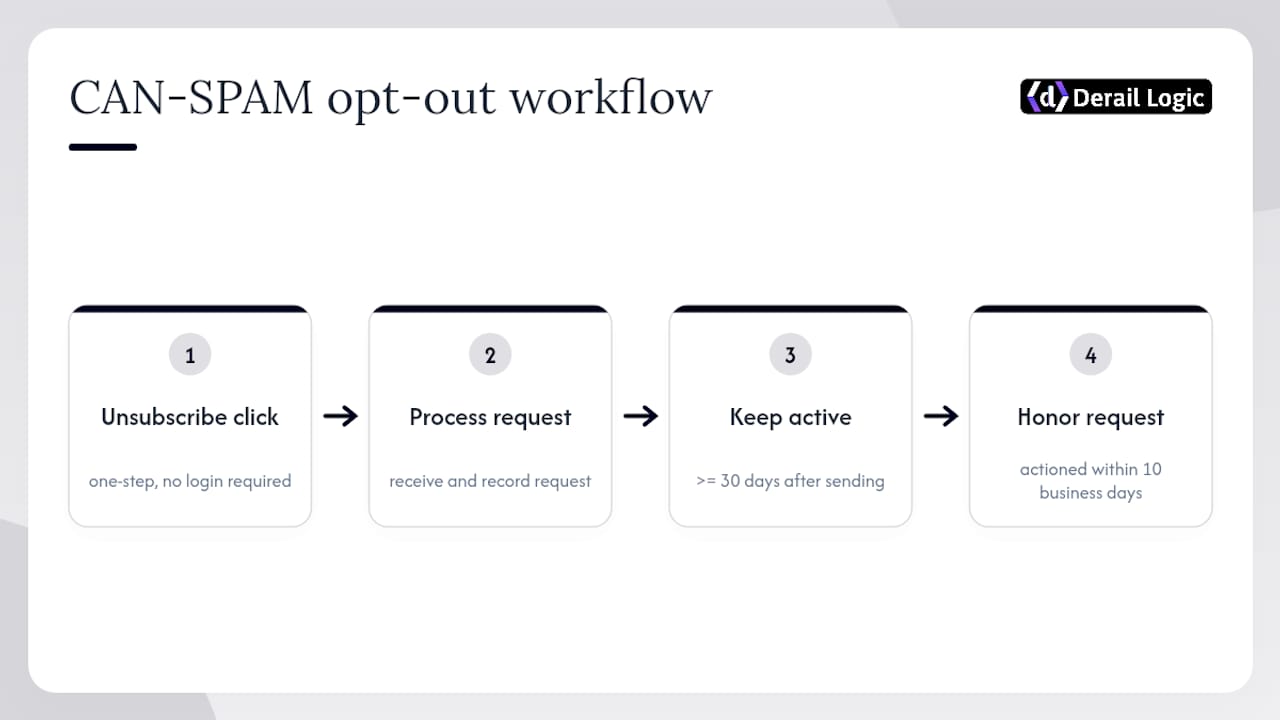
One-step opt-out and timing rules require the mechanism to work without a login, stay active for at least 30 days after sending, and get honored within 10 business days of the request.
Pro Tip: Build your unsubscribe link and postal address into a locked template footer that content creators can’t accidentally delete or edit. Most violations start as a copy-paste error, not a policy failure.
How Do You Manage Opt-Outs and Vendor Risk?
A suppression list only works if it’s centralized, current, and scrubbed before every send. Build one master list that every campaign, every platform, and every vendor checks against, no exceptions.
- Schedule an automatic suppression scrub immediately before each send, not once a week.
- Require vendor contracts to state explicitly that they’ll honor your suppression list.
- Reserve audit rights in vendor agreements so you can verify compliance, not just assume it.
- Add indemnity clauses covering CAN-SPAM violations caused by a vendor’s list or send practices.
- Log the timestamp and source of every opt-in and opt-out for audit evidence.
You cannot contract away liability. Advertisers who “procure” a third-party mailing can be treated as senders and held responsible even when the vendor sent the actual email, per FTC guidance.
Pro Tip: Keep an immutable, timestamped log of every suppression action. If the FTC ever asks how a complainant ended up on your list after opting out, “we can’t find that record” is the worst possible answer.
Who Enforces CAN-SPAM and What Are the Penalties?
The FTC is the primary enforcer, but state attorneys general, certain sector regulators, and internet service providers can also bring action against violators.
As of 2026, the FTC can assess civil penalties of up to $53,088 per individual email found in violation. A single campaign sent to 10,000 people with a broken opt-out link isn’t one violation. It’s potentially 10,000.
Aggravated violations, like harvesting addresses or using automated scripts to register accounts, can trigger criminal charges. There’s no private right of action for ordinary recipients under CAN-SPAM, so most enforcement pressure comes from regulators rather than lawsuits, which makes proactive audits more valuable than reactive legal defense.
What Compliance Mistakes Cause the Most Violations?
Most CAN-SPAM problems trace back to a handful of repeat offenders. Fix these first.
- Broken or hidden unsubscribe flows. Test every opt-out link on every send, on every device, before launch.
- Purchased lists without suppression checks. Never mail a bought or rented list without running it against your suppression file first.
- Misclassified mixed messages. Treat any email with promotional content above the fold as commercial, regardless of intent.
- Weak vendor oversight. Missing postal addresses and login-gated unsubscribes are common failure points practitioners flag repeatedly in compliance audits.
Prioritize fixes by risk. Opt-out failures and misleading headers draw the most enforcement attention and carry the highest per-email exposure, so patch those before worrying about smaller formatting issues.
Does CAN-SPAM Cover Texts, GDPR, or State Privacy Laws?
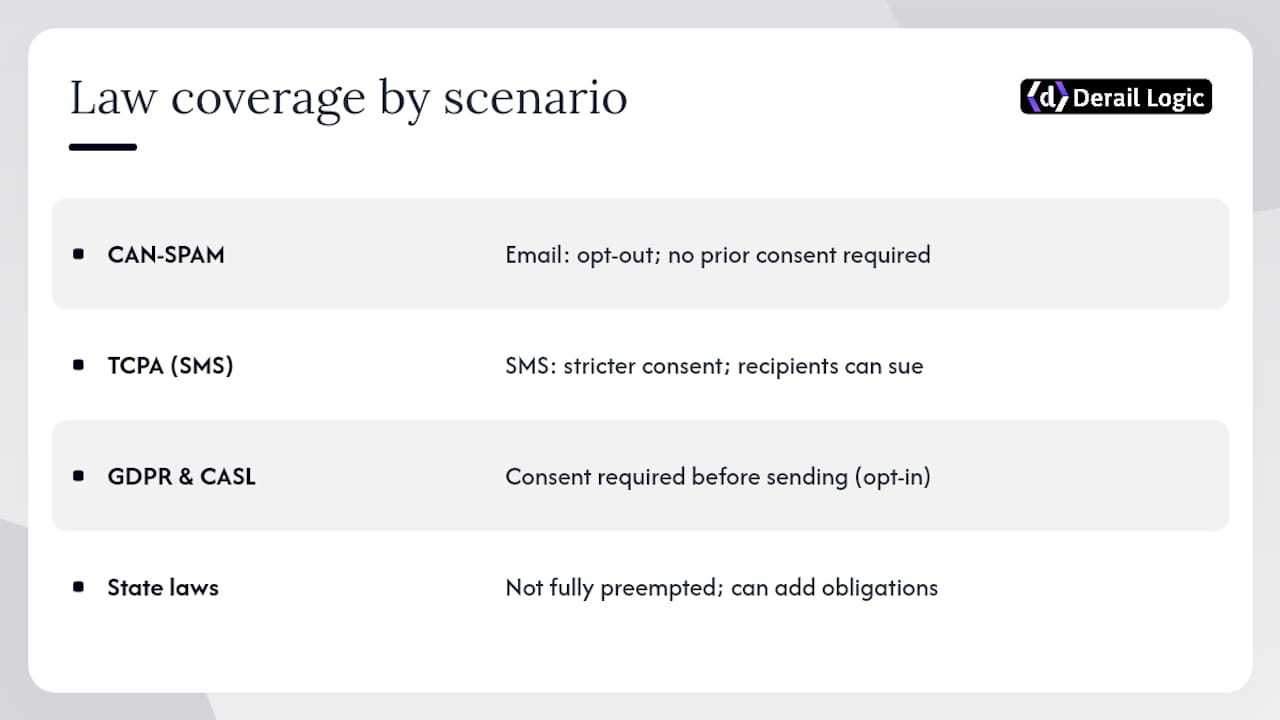
CAN-SPAM governs email, not text messages. The Federal Communications Commission coordinates with the FTC on wireless and mobile messaging, but SMS falls under the Telephone Consumer Protection Act, which requires stricter prior consent and allows recipients to sue directly.
If your list includes international recipients, remember that CAN-SPAM runs on an opt-out model. There’s no federal requirement to get permission before the first email. GDPR and Canada’s CASL work the opposite way, requiring consent before you send anything. When your list crosses borders, default to the strictest standard that applies to any given recipient.
CAN-SPAM preempts most state laws specifically regulating commercial email, but it doesn’t preempt state laws addressing fraud or deception. Broader state privacy statutes, like those covering data collection and consumer rights, can still layer additional obligations on top. Segment your lists by jurisdiction and build conservative defaults rather than gambling on the lowest common denominator.
How Do You Fix CAN-SPAM Gaps This Week?
You don’t need a quarter-long project to get your email program in shape; follow this Marketing Automation Checklist: Step-by-Step Guide for SMBs to close most of the exposure efficiently. Four steps, done in sequence, close most of the exposure.
- Audit and patch. Run the checklist above against your last three campaigns. Fix any broken opt-out link or missing postal address today.
- Centralize suppression. Build one master suppression list and scrub every upcoming send against it before it leaves the platform.
- Update templates. Lock down headers, ad disclosure language, and postal address in your master templates, then document exactly what changed and when.
- Lock down vendor contracts. Add suppression-honoring clauses, audit rights, and indemnity language, then schedule a quarterly compliance review on your calendar.
Pro Tip: Treat step four as recurring, not one-time. Vendor relationships and email platforms change quietly over a year. A quarterly 30-minute check catches drift before it becomes a violation.
Why Compliance Is a Deliverability Strategy, Not Just a Legal One
Here’s what gets missed in most compliance conversations: the same habits that keep you legal also keep you out of the spam folder. Clean suppression lists, honest subject lines, and functioning opt-outs all reduce spam complaints, and complaint rates directly affect inbox placement. Compliance and deliverability aren’t two separate projects. A platform that ties suppression logic, template controls, and audit trails to the same workflow, the way MartechAI’s automation tools do, treats them as one problem because they are one problem.
— Zachary
Reduce the Manual Work Behind CAN-SPAM Compliance
Derail Logic is the alternative to running suppression lists and unsubscribe tracking across a stack of disconnected spreadsheets and platforms. Instead of manually cross-checking every send against a suppression file, MartechAI’s connected workflow keeps your CRM, email tool, and campaign calendar tied to the same data, so a suppressed contact stays suppressed everywhere at once.

That matters most when your team is small and your list is growing. MartechAI’s intelligent CRM and template controls help you keep ad disclosures and postal addresses locked into every send, while deep analytics flag deliverability issues before they turn into complaint spikes. If you’re managing email compliance manually today, compare your current process against the Core plan at $69 per month, and see whether a connected workflow closes the gaps a checklist alone can’t catch. Growth teams juggling multiple senders or vendors can also review the Growth and Agency tiers for expanded seats and workspace capacity.
Sources
- CAN-SPAM Act: A Compliance Guide for Business | Federal Trade Commission
- PART 316—CAN-SPAM Rule | eCFR
- CAN-SPAM Act of 2003 (Public Law text) | govinfo
FAQ
Why should you never delete spam email complaints or opt-out requests?
Deleting a spam complaint or opt-out request destroys the audit trail regulators expect you to produce if your compliance is ever questioned. Keep timestamped records of every opt-out and complaint instead, since that documentation is your best defense in an FTC inquiry.
What compliance requirements are part of the CAN-SPAM Act?
CAN-SPAM requires honest headers, accurate subject lines, clear ad disclosure, a valid postal address, a one-step opt-out that stays active for 30 days, and honoring opt-out requests within 10 business days, according to FTC guidance.
Who enforces the CAN-SPAM Act?
The FTC is the primary enforcer, with state attorneys general, certain sector regulators, and internet service providers also able to take action. Criminal charges are possible for aggravated violations like address harvesting.
How do you file a CAN-SPAM complaint with the FTC?
Complaints about unwanted or deceptive commercial email can be submitted directly through the FTC’s complaint system at reportfraud.ftc.gov. There’s no private right of action for individual recipients, so enforcement runs through regulators rather than personal lawsuits.
Can a tool like MartechAI help with CAN-SPAM compliance tasks?
MartechAI’s connected workflow ties suppression list management, unsubscribe handling, and template controls to one system, which reduces the manual cross-checking that causes most compliance gaps. It doesn’t replace legal review, but it does cut down the operational risk of a missed opt-out or an outdated postal address.