



Run a keyword-gap report against a small set of true rivals to get a ranked list of attainable keywords worth testing in your next planning cycle. That’s the entire job in one sentence. The first task is mechanical: export the gap report with position and search volume for each competitor, then filter for terms you can realistically rank for within a normal planning cycle.
TL;DR:
- Focusing on competitors in organic and paid search, rather than topical or brand rivals, ensures more accurate gap analysis and actionable keywords.
- Filtering for keywords ranked in the top 10 with monthly volumes between 101 and 1,000 and difficulty labeled “possible” maximizes chances of successful ranking within one planning cycle.
- Running consolidated exports that include position, volume, difficulty, CPC, and traffic estimates helps prioritize high-value, attainable keywords for content or paid testing.
- Validating candidate keywords through short-term paid ads before building new pages improves decision accuracy and prevents resource waste on low-convertible terms.
- Continuous tracking of rank movements, new keywords, and CPC shifts is essential for maintaining a current competitive edge and refining keyword targets over time.
Table of Contents
- What Competitor Keyword Analysis Actually Involves
- Which Reports Reveal Competitor Keywords, Organic and Paid
- How to Filter Competitor Keywords Down to the Ones Worth Chasing
- Turning Prioritized Keywords Into Content and PPC Tests
- How to Track Competitor Keyword Movement Over Time
- How Derail Logic Supports a Repeatable Competitor Keyword Workflow
- What Practitioners Get Wrong About Competitor Keyword Analysis
- Put Competitor Keyword Analysis on Autopilot With Derail Logic
- Sources
- FAQ
What Competitor Keyword Analysis Actually Involves
Competitor keyword analysis is the process of identifying which search terms your rivals rank for (organically or through paid ads) so you can find gaps in your own coverage and prioritize what to build next. It’s a specific discipline within competitor SEO analysis, distinct from backlink audits or content audits, because it starts and ends with a term list you can act on.
The mechanics matter more than the definition. You’re not just curious about what competitors rank for. You’re hunting for terms where a rival ranks and you don’t, where the difficulty is manageable, and where the volume justifies the work. Marketers who treat this as a research exercise instead of an execution filter usually end up with spreadsheets nobody opens twice.
Picking the right rivals before you pull any data
Not every competitor deserves a seat in your gap report. Three categories exist, and mixing them up wastes hours:
- SEO competitors rank for the same organic terms you target, regardless of what they actually sell.
- PPC competitors bid on the same paid terms, which sometimes includes companies with no organic overlap at all.
- Topical competitors publish content adjacent to your niche without competing for your core commercial terms.
Include all three types only when your goal is broad market mapping. For a working gap report, stick to direct SEO and PPC rivals. Signals that confirm a true rival include shared positions across a batch of your priority terms, overlapping top pages when you check a competitor’s site with a site: search, and similar landing pages behind their paid ads. Run a quick site: query and a top-pages snapshot before committing anyone to your rival list.
Cap the list at three to five competitors for a gap report. One dominant brand in the mix, especially a category giant with disproportionate domain authority, will flood your report with keywords that are genuinely out of reach and skew your prioritization toward terms you can’t win this year.
Which Reports Reveal Competitor Keywords, Organic and Paid
Every major platform, including Ahrefs, SEMrush, SpyFu, and Moz, exposes the same core report types even though the interfaces differ. Knowing which report answers which question saves you from clicking through five tabs to find one column.
Run these in order:
- Organic keywords report shows every term a domain ranks for, with position, volume, and estimated traffic attached.
- Paid keywords or advertising research report surfaces terms a competitor is actively bidding on, often with CPC and ad copy history.
- Keyword gap or content-gap report compares your domain against multiple rivals at once and flags terms they rank for that you don’t.
- Top pages report tells you which specific URLs are pulling the traffic, which matters when you’re deciding whether to build a new page or expand one that already exists.
- New keywords or trending report flags terms a competitor has started ranking for recently, a strong early signal of a content or product push.
For the export itself, pull keyword, position, search volume, difficulty score, CPC, traffic estimate, and ranking URL into one CSV. That field list gives you everything needed to score and prioritize without going back for a second pull. Ad-history reports matter more than organic-only exports when you’re validating commercial intent. Ahrefs’ guidance on competitor keyword research treats paid terms as a distinct signal worth checking separately from organic rankings, because a term a rival pays to rank for is a term someone has already confirmed converts.
Pro Tip: Run the site-level organic report first, strip out every branded and navigational term, then export. Branded noise from a competitor’s own name inflates the file and buries the terms you actually came for.
How to Filter Competitor Keywords Down to the Ones Worth Chasing
Raw exports are useless until they’re cleaned. Start with de-duplication, strip branded terms (yours and theirs), and normalize plural, singular, and near-identical variants that would otherwise create three rows for one real keyword. Then cluster by parent topic. A dozen keyword variants around “email deliverability” belong on one well-built page, not spread across ten thin ones, a point that shows up consistently in content-gap methodology from Moz.
From there, apply a scoring pass:
- De-dupe and normalize the list so each row represents one distinct search intent.
- Cluster by parent topic and assign each cluster to an existing page or a new one.
- Apply attainability filters, then score what’s left by volume, difficulty, and business value.
That third step is where most teams either win or waste a quarter. Backlinko’s attainable-keyword framework recommends filtering for terms where a competitor ranks in the top 10, monthly search volume sits between 101 and 1,000, and keyword difficulty is labeled “possible” rather than “hard.” Terms outside that band either lack enough demand to matter or require backlink volume you’re not going to build in a single sprint.
Attainable-gap filter: competitor in the top 10, volume between 101 and 1,000, difficulty marked “possible.” Keywords passing all three filters convert into real content briefs far more often than high-volume terms that look impressive in a slide deck but sit permanently out of reach.
Score what survives by combining scaled volume, inverse difficulty, and a business-value weight (does this term sit near a page that converts?). Prioritize shared gaps, terms multiple rivals rank for that you don’t, since several rivals ranking for the same term is a stronger demand signal than one competitor’s outlier ranking.
Turning Prioritized Keywords Into Content and PPC Tests
Every surviving keyword needs one decision: build a new page or expand one you already have. Map each cluster to its closest existing URL first; a new page is the fallback, not the default.
Before committing editorial time, treat competitor paid terms as a fast validation layer. A small-budget ad test against a term a rival bids on tells you whether the intent converts before you spend a week writing for it, a practice Ahrefs recommends specifically for separating traffic-only terms from revenue terms.
- Build a landing page with one clear conversion action, matched UTM parameters, and a headline that mirrors the tested keyword.
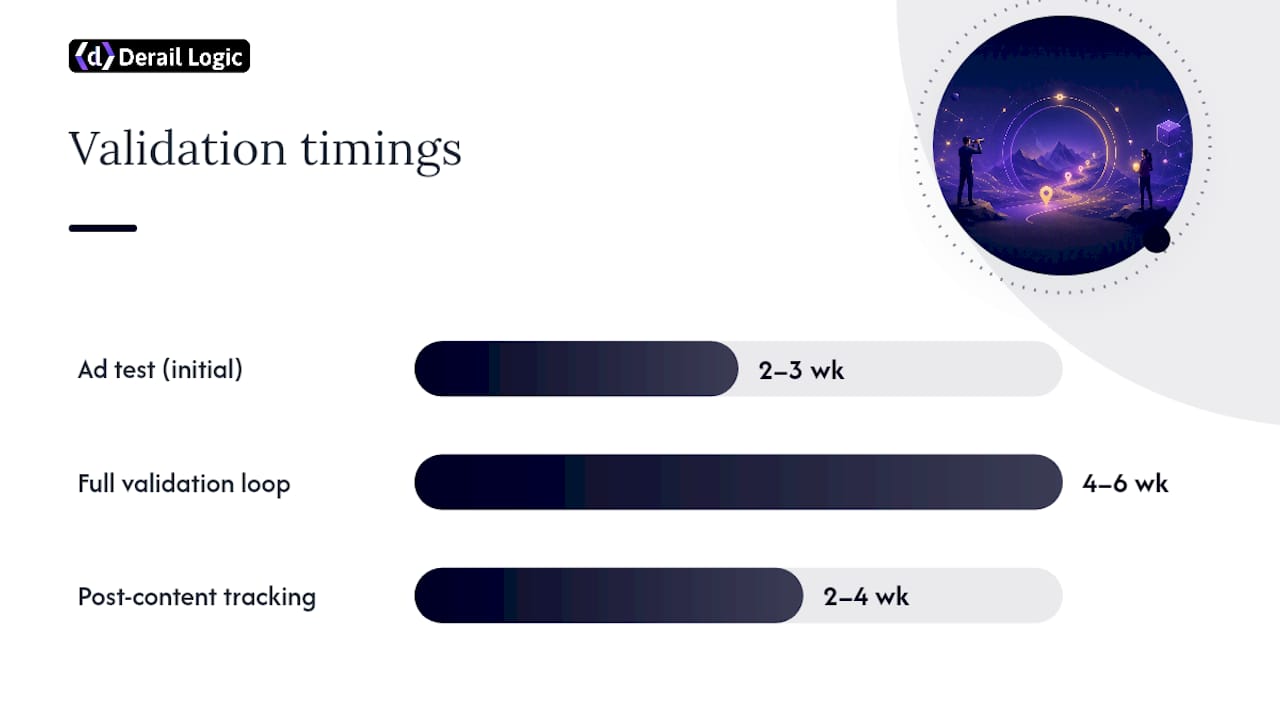
- Run the ad for two to three weeks at a modest budget before judging results.
- Compare click-through and conversion rate against your existing pages before deciding to scale the term into full content.
Pro Tip: Run a four-to-six-week validation loop: two weeks of paid testing, followed by content production and two to four weeks of tracking. That cadence keeps competitor keyword research tied to measurable outcomes instead of a permanent backlog.
How to Track Competitor Keyword Movement Over Time
Competitor keyword tracking isn’t a one-time export. Rivals shift rankings, launch new pages, and adjust ad spend constantly, and a report from three months ago tells you nothing about what’s happening now.
Watch four signals: position deltas on shared terms, traffic estimate changes on their top pages, brand-new ranking pages, and CPC shifts in their paid terms. Set alerts for “new keywords” and “competitor position change” reports, which most tracking platforms support natively, and review them weekly during active campaigns. For steady, low-change categories, a monthly or quarterly gap re-run is usually enough, a cadence echoed in step-by-step competitive analysis guidance from SE Ranking.
How Derail Logic Supports a Repeatable Competitor Keyword Workflow
Most of this workflow lives in disconnected exports: one tool for organic keywords, another for paid research, a spreadsheet for clustering, and a fourth tool for tracking. Derail Logic’s competitor monitoring and keyword tracking features sit inside the same workspace as the campaign studio and content tools, so a keyword that clears your attainability filter moves straight into a content brief or campaign test without a CSV changing hands.
That said, a dedicated backlink-analysis platform still earns its keep for deep link-gap research. Derail Logic’s strength is closing the loop between discovery and action, not replacing every specialist report you might need for edge cases.
What Practitioners Get Wrong About Competitor Keyword Analysis
The most common mistake is chasing branded terms that were never winnable, followed closely by ignoring intent and piling effort into high-volume keywords with no conversion history behind them. Expect measurable ranking movement in 60 to 90 days on attainable terms, not overnight wins. If your domain lacks basic technical health or backlinks, fix that before chasing anything labeled “hard.”
— Zachary
Put Competitor Keyword Analysis on Autopilot With Derail Logic
Derail Logic replaces the tool-chaining most teams default to: one platform for competitor monitoring, keyword tracking, and the campaign studio that turns a validated keyword into a live test, instead of juggling exports across four separate logins.
Once a gap report surfaces an attainable keyword, Derail Logic’s content studio turns it into a brief without a separate handoff, and the campaign studio lets you run the paid validation test in the same workspace where you’ll track the result. This isn’t a mandatory replacement for every specialist tool you use, just a faster path from keyword to launched test. Plans include a free tier and several paid options; current prices are on the pricing page. Check current plans and pricing and start a workspace today.
Sources
- How to Find Competitors’ Keywords to Boost Your SEO
- How to Find and Use Competitor Keywords
- How to Conduct a Competitor Keyword Analysis
FAQ
What Is Competitor Keyword Analysis?
Competitor keyword analysis is the process of identifying which organic and paid search terms your rivals rank for, then using that list to find gaps in your own keyword coverage. It typically starts with a gap report run against three to five direct rivals and ends with a filtered, prioritized list of terms to target.
What Is an Example of a Competitor Keyword?
If a rival ranks in the top 10 for “email deliverability checklist” with monthly search volume between 101 and 1,000 and you don’t rank for it at all, that’s a competitor keyword worth testing. It fits the attainable-gap criteria of top-10 competitor position, moderate volume, and manageable difficulty.
What Are the Four Types of Competitor Analysis?
Marketers generally break competitor analysis into SEO (organic ranking overlap), PPC (paid keyword overlap), content or topical analysis (subject matter overlap without direct commercial competition), and backlink analysis (link profile comparison). Competitor keyword research usually draws from the first two categories.
How Do You Do a Competitor Analysis in SEO?
Start by confirming true rivals through shared SERP positions and overlapping top pages, then pull organic and paid keyword reports for each one. Clean the exports, cluster by parent topic, apply attainability filters, and map surviving keywords to new or existing pages, a workflow Derail Logic’s keyword tracking tools can help operationalize once the initial list is built.