



A customer relationship is the ongoing connection between an organization and its customers, built through every interaction across the full lifecycle from first contact to renewal and advocacy. Managed well, it produces measurably better outcomes: higher retention, greater customer lifetime value (CLV), and organic advocacy that reduces acquisition cost. Frameworks like Net Promoter Score (NPS) and CLV exist precisely to quantify this connection, and platforms like Derail Logic’s MartechAI are built to operationalize it at scale.
Key Takeaways
Strong customer relationships are built on unified data, consistent cross-channel experiences, and proactive action on behavioral signals, measured through CLV, churn rate, NPS, and CES.
| Point | Details |
|---|---|
| Definition and scope | A customer relationship is the cumulative bond formed across every lifecycle touchpoint, managed cross-functionally. |
| Core principles | Trust, personalization, consistency, low effort, and relational intelligence are the foundations of durable relationships. |
| Lifecycle design | Each stage from acquisition to win-back needs a defined activity, a named owner, and a primary KPI. |
| Metrics to watch | Track CLV and churn together for revenue health; pair NPS and CSAT with CES to confirm behavioral loyalty. |
| First action | Unify your customer data before personalizing or automating; fragmented data produces fragmented experiences. |
Table of Contents
- What does “customer relationship” actually mean?
- What are the primary goals of managing customer relationships?
- What principles make customer relationships effective?
- What are the main types of CRM and what do modern tools do?
- What happens at each stage of the customer relationship lifecycle?
- How do you build and manage customer relationships effectively?
- Which metrics tell you how healthy your customer relationships are?
- What are the most common challenges in managing customer relationships?
- How is “customer relationship” different from customer service, CX, and CRM software?
- Real-world examples of customer relationship practices
- How CRM, marketing automation, and AI work together
- What most practitioners get wrong about customer relationships
- Sources
- FAQ
What does “customer relationship” actually mean?
Customer relationship management (CRM) is formally defined as the strategic process organizations use to manage, analyze, and improve interactions with customers across every touchpoint. But the underlying concept, the customer relationship itself, is broader: it is the cumulative emotional and transactional bond a buyer forms with a brand over time.
That bond spans every department. Sales owns the initial deal. Onboarding and customer success own early activation. Support handles friction. Marketing sustains awareness and relevance. Product shapes the experience. No single team owns the relationship; every team contributes to it.
Where the concept applies and where it does not:
- Applies to ongoing accounts, subscriptions, and repeat-purchase relationships where history accumulates
- Applies to B2B contracts where multiple stakeholders interact with the vendor over months or years
- Applies to B2C loyalty contexts (retail, SaaS, media) where personalization and lifecycle management are viable
- Less relevant to anonymous, one-off microtransactions (a parking meter, a vending machine) where no identity data is captured and no follow-up is possible
- Less relevant when the buyer has no realistic path to repeat purchase or referral
Consider a typical B2B SaaS buyer journey. A prospect reads a blog post, books a demo, signs a contract, goes through onboarding, uses the product daily, renews at month 12, and eventually refers a colleague. Each of those moments is a relationship touchpoint. The quality of the relationship determines whether that buyer renews, expands, or churns.
What are the primary goals of managing customer relationships?
The core objective is not just satisfaction. Organizations manage relationships to produce specific, measurable business outcomes. CRM platforms centralize customer data to surface at-risk customers and usage signals, which makes these goals trackable rather than aspirational.
Goal-to-KPI mapping:
- Retention: keep existing customers active → tracked by retention rate and churn rate
- Increased CLV: grow revenue per customer over time → tracked by average CLV and expansion revenue
- Advocacy: turn satisfied customers into referrers → tracked by NPS and referral rate
- Reduced churn: identify at-risk accounts before they leave → tracked by early churn signals and health scores
- Cross-sell and upsell: expand product usage within existing accounts → tracked by expansion MRR and attach rate
- Reduced support cost: resolve issues faster and prevent repeat contacts → tracked by first-contact resolution rate and ticket volume per customer
Priority shifts by business model. Subscription businesses treat retention and expansion as the primary revenue engine; losing a customer means losing recurring revenue, not just a single transaction. Transactional businesses weight acquisition more heavily but still benefit from repeat-purchase mechanics and loyalty programs that bring buyers back.
What principles make customer relationships effective?
Strong relationships do not happen by accident. They follow a consistent set of principles that teams can design for deliberately.
-
Trust: customers stay when they believe the brand will deliver on its promises. Operationally, this means consistent product quality, honest communication during outages or delays, and transparent pricing. A company that proactively notifies customers of a service disruption before they notice it themselves builds more trust than one that waits for complaints.
-
Value exchange: every interaction should give the customer something useful, whether that is information, a solved problem, or a better outcome. Relationships erode when customers feel they are being contacted only when the vendor wants something.
-
Personalization: generic outreach signals that the brand does not know its customer. Personalization at the message, offer, and channel level shows that the organization is paying attention. Even simple segmentation, such as sending renewal reminders only to accounts approaching their contract date, outperforms batch-and-blast communication.
-
Consistency: a customer who receives excellent support on one channel and indifferent service on another loses confidence in the brand. Cross-channel consistency is harder to achieve than it sounds, especially in organizations where sales, support, and marketing operate in separate systems.
-
Low effort: customers who have to repeat themselves, navigate confusing processes, or wait too long for resolution are quietly building a case to leave. Reducing customer effort is one of the strongest predictors of loyalty, which is why the Customer Effort Score (CES) has become a standard metric.
-
Relational intelligence: knowing not just what a customer bought, but how they use the product, what problems they have raised, and what their goals are. This is the difference between a transactional record and a genuine relationship profile.
Pro Tip: The highest-leverage place to capture relational signals is support tickets and product usage logs, not surveys. When a customer contacts support three times about the same feature in 30 days, that is a relationship risk signal. Tag those patterns in your CRM and route them to a customer success manager before the next renewal.
What are the main types of CRM and what do modern tools do?
CRM systems collect data across web, phone, email, chat, marketing, and social channels and automate workflows across sales, marketing, and service. The four recognized CRM types each serve a distinct purpose.
Operational CRM
Automates the day-to-day processes that touch customers directly: sales force automation (SFA), marketing automation, and service desk workflows. Use case: a sales team using pipeline management and automated follow-up sequences to move deals forward without manual reminders.
Analytical CRM
Turns customer data into insight. Dashboards, segmentation models, and predictive analytics live here. Use case: identifying which customer segments have the highest churn probability based on usage patterns, then triggering targeted retention campaigns.
Collaborative CRM
Shares customer information across departments so every team sees the same history. Use case: a support agent who can see the customer’s purchase history, open renewal date, and last marketing email before picking up the phone.
Social CRM
Extends relationship management to social and messaging channels. Social listening, community management, and social-channel support fall here. Customer engagement is omnichannel: being present on customers’ preferred channels reduces friction and builds familiarity.
Feature-to-purpose mapping:
| Feature | CRM Type | Primary Purpose |
|---|---|---|
| Pipeline management / SFA | Operational | Track and advance deals |
| Marketing automation | Operational | Automate campaigns and nurture sequences |
| Analytics dashboards | Analytical | Identify trends and at-risk segments |
| Predictive scoring | Analytical | Prioritize accounts by risk or opportunity |
| Shared contact history | Collaborative | Give every team a unified customer view |
| Social listening | Social | Monitor brand sentiment and respond in-channel |
| Community tools | Social | Build peer-to-peer engagement and advocacy |
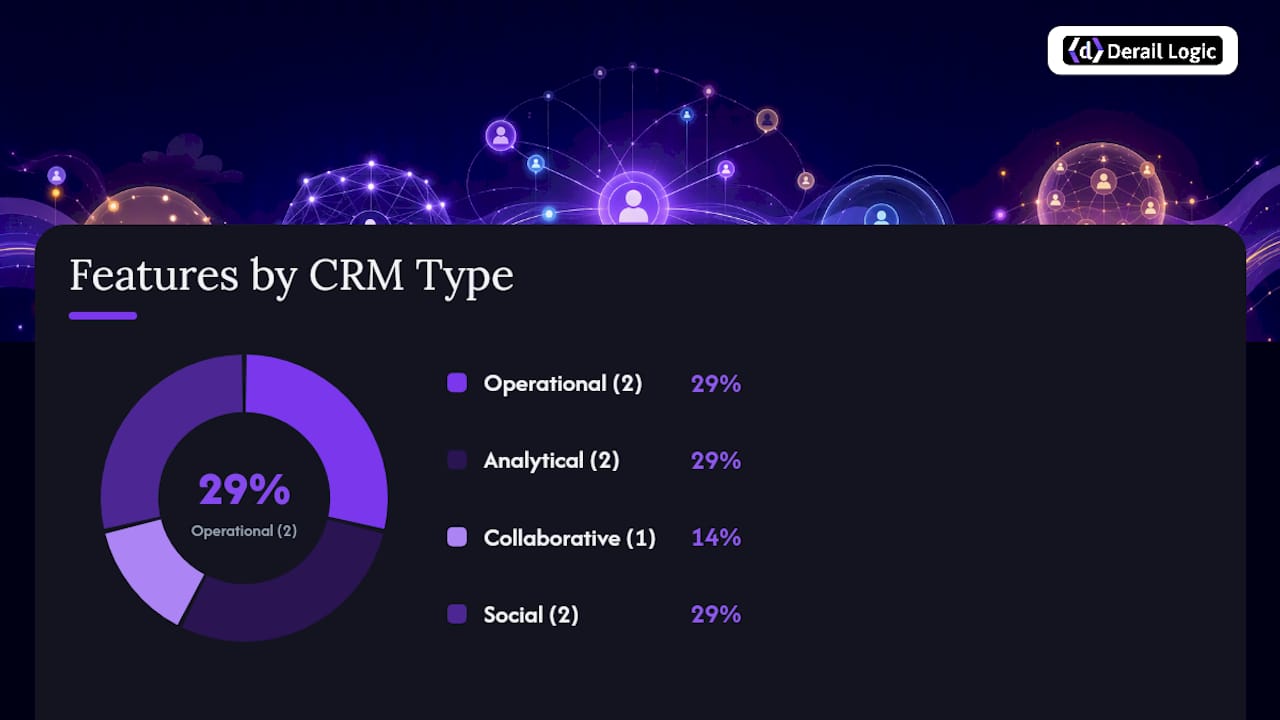
A single customer view, where all four CRM types feed into one unified profile, is the prerequisite for advanced capabilities like predictive churn alerts and AI-driven personalization. Without data unification, each system operates on a partial picture.
What happens at each stage of the customer relationship lifecycle?
The lifecycle gives teams a shared map for assigning activities, owners, and metrics to each phase of the relationship.
| Stage | Main Activity | Primary KPI |
|---|---|---|
| Acquisition | Attract and qualify prospects | Lead-to-customer conversion rate |
| Onboarding | Activate new customers to first value | Time-to-first-value / activation rate |
| Growth | Deepen usage and expand accounts | Expansion MRR / product adoption rate |
| Retention | Renew and prevent churn | Retention rate / churn rate |
| Advocacy | Generate referrals and reviews | NPS / referral rate |
| Win-back | Re-engage lapsed customers | Win-back rate / reactivation revenue |
Recommended actions by stage:
- Acquisition: align marketing and sales messaging so the promise made in an ad matches what the sales team delivers; qualify for fit, not just budget
- Onboarding: define a clear “first value moment” and build every onboarding step toward it; assign a named contact for high-value accounts
- Growth: use product usage data to identify expansion triggers; proactively suggest the next logical feature or tier
- Retention: run health score reviews 90 days before renewal; address friction before the customer raises it
- Advocacy: ask for referrals and reviews at peak satisfaction moments, not at random; build a formal referral program with clear incentives
- Win-back: segment lapsed customers by reason for leaving; tailor re-engagement offers to the specific friction point, not a generic discount
Subscription businesses should treat post-sales as an active relationship-building phase, not a passive holding pattern. The growth and retention stages are where most subscription revenue is won or lost.
How do you build and manage customer relationships effectively?
Prioritizing two or three engagement strategies that map to your north-star metric, then measuring before expanding, is more effective than running seven initiatives at half-effort. Start with data unification, then personalize, then automate conservatively.
-
Unify customer data first. Fragmented data produces fragmented experiences. Before personalizing or automating, connect your CRM, product analytics, and support platform so every team sees the same customer record. This is the foundation everything else depends on.
-
Personalize at scale. Segment by behavior, not just demographics. A customer who has used a feature three times in the last week responds differently than one who has not logged in for 30 days. Behavioral segmentation lets you send the right message at the right moment.
-
Automate routine touches, not relationship-critical ones. Automated onboarding sequences, renewal reminders, and post-purchase check-ins free your team for high-value conversations. But automated messages on high-stakes accounts, such as a renewal at risk, should trigger a human review before sending.
-
Close the feedback loop. Closing the feedback loop quickly is one of the highest-leverage loyalty actions available. When a customer submits a negative survey response, a follow-up within roughly 48 hours converts a detractor into a recoverable relationship far more reliably than a delayed response.
-
Move support from reactive to proactive. Monitor usage signals for early warning signs (declining logins, repeated error events, unanswered onboarding steps) and reach out before the customer contacts you. Proactive support reduces ticket volume and signals that the brand is paying attention.
-
Build community. Peer-to-peer engagement, user groups, and knowledge communities create loyalty that does not depend entirely on the vendor relationship. Customers who help each other stay longer and expand more.
-
Use loyalty mechanics thoughtfully. Points programs and discounts create transactional loyalty, which is fragile. Emotional connection drives advocacy and higher lifetime value, while transactional loyalty is margin-negative and easy to replicate. Layer recognition, exclusive access, and personalized milestones on top of any points program.
Pro Tip: When running relationship experiments, measure both a short-term signal (NPS change at 30 days) and a long-term signal (retention rate at 6 months). Short-term signals tell you whether the tactic landed; long-term signals tell you whether it actually changed behavior. Optimizing only for the short-term metric produces tactics that look good in a sprint review but do not move annual revenue.
Which metrics tell you how healthy your customer relationships are?
Metrics are only useful when read together. A high NPS alongside a rising churn rate is a warning sign, not a success story.
| Metric | Definition | Simple Formula / Example |
|---|---|---|
| Customer Lifetime Value (CLV) | Total net revenue a customer generates over the relationship | Average purchase value × purchase frequency × average customer lifespan |
| Churn Rate | Percentage of customers lost in a period | (Customers lost ÷ customers at start of period) × 100 |
| Retention Rate | Percentage of customers retained in a period | ((Customers at end – new customers) ÷ customers at start) × 100 |
| Net Promoter Score (NPS) | Likelihood to recommend, on a 0–10 scale | % Promoters (9–10) minus % Detractors (0–6) |
| Customer Satisfaction Score (CSAT) | Satisfaction with a specific interaction | Average rating on a 1–5 or 1–10 scale post-interaction |
| Customer Effort Score (CES) | Ease of completing a task or resolving an issue | Average rating on a 1–7 “how easy was it?” scale |
| Activation Rate | Percentage of new customers who reach first value | (Activated customers ÷ total new customers) × 100 |
| Repeat Purchase Rate | Percentage of customers who buy more than once | (Customers with 2+ purchases ÷ total customers) × 100 |
CES as a loyalty predictor: Research from CEB (now Gartner) found that reducing customer effort is a stronger predictor of loyalty than delighting customers. High-effort experiences drive disloyalty more reliably than high-effort experiences drive loyalty in the opposite direction. If your CES is trending up (more effort required), churn will follow.
Use these metrics in clusters. CLV and churn rate together tell you whether the relationship is growing or eroding in revenue terms. NPS and CSAT together tell you whether customers are satisfied in the moment and likely to stay long-term. CES tells you whether your processes are getting in the way.
What are the most common challenges in managing customer relationships?
Even well-resourced teams run into predictable failure modes. Knowing them in advance is half the mitigation.
-
Data silos. When sales, support, and marketing each hold a piece of the customer record, no one has the full picture. The mitigation is a single source of truth: a unified CRM or customer data platform (CDP) that all teams write to and read from. This is a governance decision as much as a technology one.
-
Privacy and regulatory constraints. GDPR, CCPA, and sector-specific regulations limit how customer data can be collected, stored, and used. The practical mitigation is a data governance framework that defines what data is collected, why, how long it is retained, and who can access it. Compliance is not optional, and it is not a one-time project.
-
Over-automation that loses empathy. Automated sequences are efficient, but a customer who receives a cheerful renewal email the day after submitting a critical support ticket feels invisible. The fix is suppression logic: pause automated marketing for any account with an open high-priority support ticket.
-
Inconsistent cross-channel experiences. A customer who gets a personalized email but a generic chat response loses confidence in the brand’s coherence. Consistent experiences require shared data and shared standards, not just shared branding.
-
Measuring the wrong thing. Teams that optimize for CSAT scores without tracking churn can produce high satisfaction numbers while quietly losing customers. Pair every satisfaction metric with a behavioral metric (retention, repeat purchase, expansion) to confirm the relationship is actually healthy.
Pro Tip: Early signs of relational decay often appear in product data before they appear in survey data. Any one of these warrants a proactive outreach; two or more together indicate a retention risk that needs a human conversation, not an automated email.
How is “customer relationship” different from customer service, CX, and CRM software?
These terms are often used interchangeably in casual conversation, but they describe distinct concepts. Precision matters in reporting, team design, and academic work.
| Concept | Core Definition | Scope | Who Owns It |
|---|---|---|---|
| Customer relationship | The ongoing bond between brand and customer across the full lifecycle | Entire lifecycle, all touchpoints | Cross-functional (sales, CS, marketing, product) |
| Customer service | Reactive support provided when a customer has a problem or question | Specific service interactions | Support / service team |
| Customer experience (CX) | The customer’s total perception of every interaction with the brand | All touchpoints, from the customer’s perspective | CX team or cross-functional |
| CRM software | Technology that records, organizes, and automates customer data and workflows | Data and process layer | IT, operations, RevOps |
Key distinctions in plain language:
- Customer service is a subset of the customer relationship. Excellent service matters, but a relationship built only on reactive support is fragile.
- Customer experience is the customer’s perception of the relationship. CX is the view from the outside; the customer relationship is the view from the inside.
- CRM software is the tool, not the strategy. A company can have a sophisticated CRM platform and still manage relationships poorly if the underlying strategy is absent.
When precision matters: use “customer relationship” when discussing strategy, lifecycle design, or organizational accountability. Use “customer service” when discussing support operations. Use “CX” when discussing perception, journey mapping, or Voice of Customer programs. Use “CRM” when discussing the technology stack or data architecture.
Real-world examples of customer relationship practices
B2B SaaS: high-touch onboarding and renewal
A mid-market SaaS company assigns a dedicated customer success manager (CSM) to every account above a defined ARR threshold. The CSM runs a structured 30-60-90 day onboarding plan, tracks product adoption weekly, and schedules a business review 90 days before renewal. The objective is to reach a defined activation milestone before day 30, because accounts that activate early renew at significantly higher rates. The primary tactic is a named human contact with a clear success plan, not an automated sequence.
E-commerce: loyalty and recovery
An e-commerce brand uses purchase history and browsing behavior to segment customers into tiers. High-value customers receive early access to new products and a dedicated support line. When a customer has a poor delivery experience, the brand’s recovery protocol triggers a personal apology, a replacement, and a credit within 24 hours. The objective is to convert a negative experience into a loyalty signal rather than a churn event.
Subscription product: proactive engagement
A consumer subscription app monitors weekly active usage. When a subscriber’s usage drops below a threshold for two consecutive weeks, an automated alert triggers a personal outreach from the support team, not a marketing email. The message acknowledges the drop and offers a short tutorial or a call. This proactive model, informed by customer success platforms that centralize usage signals, reduces involuntary churn and surfaces product friction before it becomes a cancellation.
Nonprofit: donor stewardship
A nonprofit treats major donors as long-term relationship partners, not transaction sources. Each major donor receives a personalized impact report twice a year showing exactly how their contribution was used. The organization follows a CX loyalty cycle of listen, analyze, act, and close the loop: after each campaign, donors who gave feedback receive a direct response explaining what changed as a result.
The compact lesson across all four examples: the organizations that build durable relationships share one habit. They act on signals before the customer has to ask. Whether that signal is a usage drop, a support ticket, a survey response, or a missed activation milestone, the response is proactive and personal. Automation surfaces the signal; a human or a well-designed process acts on it.
How CRM, marketing automation, and AI work together
The practical value of combining CRM, marketing automation, and AI is a unified customer view that triggers the right action at the right moment without requiring a team member to manually monitor every account.
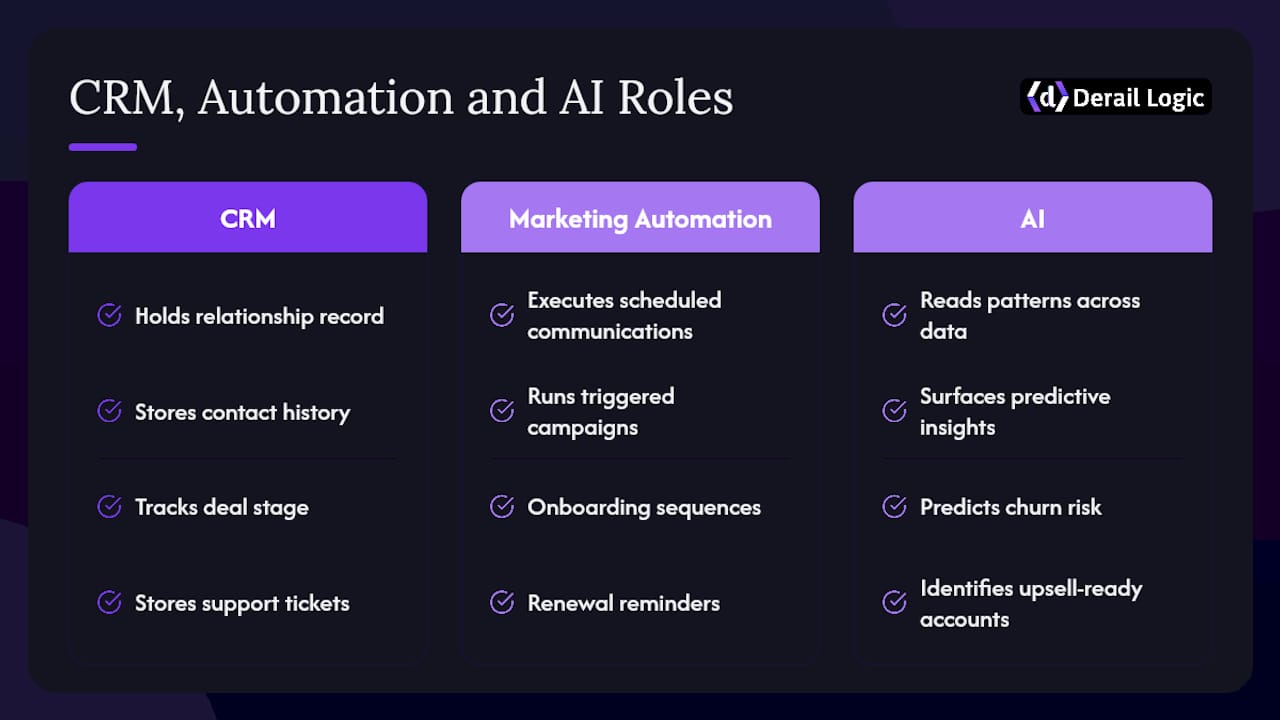
Here is how the integration works in practice. The CRM holds the relationship record: contact history, deal stage, support tickets, and product usage. Marketing automation executes the scheduled and triggered communications: onboarding sequences, renewal reminders, re-engagement campaigns. The AI layer reads patterns across all of that data and surfaces predictions: which accounts are at risk of churning, which are ready for an upsell conversation, which onboarding steps are causing drop-off.
Derail Logic’s MartechAI platform illustrates this integration. Its AI engine pulls from live business data to generate personalized content and predictive insights, while its intelligent CRM and campaign studio connect the data layer to execution. The result is that a marketing team can run personalized lifecycle campaigns without manually segmenting every list or writing every message from scratch. For agencies and e-commerce teams, AI-driven personalization at this level translates directly into measurable engagement and retention improvements.
Prioritizing engagement strategies that unify data first, then personalize, then automate is the sequencing that produces durable results. Automation without unified data produces inconsistent experiences. Personalization without automation does not scale.
Automation impact: Organizations that implement connected CRM and marketing automation report faster customer activation and reduced manual workload for customer-facing teams, freeing capacity for high-value relationship conversations.
Pro Tip: Keep human review in place for any automated action that affects a high-value account. Set a revenue or health-score threshold above which automated emails require a CSM to approve before sending. The role of CRM in automated outreach is to surface the right moment and draft the right message; the human’s role is to confirm the context is right before it goes out.
Ready to connect your CRM, automation, and analytics into one workflow? Derail Logic’s MartechAI gives marketing teams a visual campaign studio, intelligent CRM, and AI-driven insights in a single platform. Explore marketing automation and see how it fits your team’s lifecycle strategy.
What most practitioners get wrong about customer relationships
The dominant mistake is treating the customer relationship as a support function rather than a revenue function. Teams invest heavily in acquisition, then hand the customer to an onboarding sequence and hope for the best. The data tells a different story: most revenue in subscription businesses comes from retention and expansion, not new logos. That means the relationship work that happens after the contract is signed is where the actual business outcome is determined.
There is also a tendency to conflate activity with relationship health. A high email open rate, a good CSAT score, a full event calendar: none of these confirm that the relationship is strong. What confirms it is behavioral evidence. Does the customer log in? Do they expand? Do they refer? Those are the signals that matter, and they require connected data to surface.
The teams that get this right share a common discipline: they pick two or three relationship metrics that connect directly to revenue, they build their processes around moving those metrics, and they review them in the same meeting where they review pipeline. Relationship health is not a soft metric. It is a leading indicator of next quarter’s retention number.
Sources
- Customer relationship management
- Customer engagement guide for 2026: Definition and strategies
- 12 Customer Engagement Strategies for 2026 (+ Examples)
- What is Customer Relationship Management? | Gainsight
- How to Build Customer Loyalty: A Practical Guide for CX Teams
FAQ
What is the meaning of “customer relationship”?
A customer relationship is the ongoing emotional and transactional bond between an organization and its customers, formed across every interaction from first contact through renewal and advocacy.
What is an example of a good customer relationship?
A B2B SaaS company that assigns a dedicated customer success manager, tracks product adoption weekly, and proactively addresses friction before renewal is a practical example of a managed, high-quality customer relationship.
What does “good customer relations” mean in practice?
Good customer relations means consistently delivering on promises, responding to problems quickly, personalizing communication based on customer history, and closing the feedback loop so customers know their input was heard and acted on.
What are the four types of CRM?
The four recognized CRM types are operational (automating sales, marketing, and service workflows), analytical (turning data into insight and predictions), collaborative (sharing customer information across departments), and social (managing relationships through social and messaging channels).