



Consolidating your marketing tech stack cuts total cost of ownership, eliminates martech debt, unifies your data, and compresses campaign cycles. The benefits of consolidating marketing tech stacks are measurable from day one.
- Lower costs: Enterprises report reductions of roughly between one-fifth and one-third in total martech spending after structured consolidation
- Faster execution: Fewer handoffs and integrations mean shorter campaign cycle times
- Cleaner data: A unified data layer closes attribution gaps and improves identity resolution
- Better customer experience: Connected systems deliver consistent messaging across every channel
- Future-proofing: A leaner stack scales without multiplying integration debt
Key Takeaways
Consolidating your marketing tech stack produces compounding financial and operational returns, but only when you start with the data layer and maintain governance after launch.
| Point | Details |
|---|---|
| Audit first, always | Structured audits find 30–40% tool redundancy and data fragmentation in over 70% of stacks. |
| TCO beats invoice math | True cost of ownership runs 2–3x the license fee; model migration and training costs before committing. |
| Data layer comes first | Fix identity resolution and unify your customer record before migrating to any new platform. |
| Governance sustains gains | Without a formal tool intake process, consolidated stacks rebuild within 18 months. |
| Derail Logic centralizes the stack | MartechAI replaces email, CRM, analytics, and campaign tools in one connected workspace. |
Table of Contents
- Why a fragmented martech stack is quietly costing you
- The core benefits of consolidating marketing tech stacks
- How to consolidate your marketing tools: a practical roadmap
- How to choose the right center of gravity platform
- What consolidation costs and how to calculate ROI
- Common consolidation mistakes and how to avoid them
- High-impact quick wins you can execute this month
- The discipline consolidation actually demands
- How Derail Logic helps you consolidate and move faster
- Sources
- FAQ
Why a fragmented martech stack is quietly costing you
Every tool you add to a disconnected stack creates new integration points, new logins, and new failure modes. That is martech debt: the accumulated cost of maintaining connections between systems that were never designed to talk to each other. It shows up as invisible waste, not on a single invoice, but spread across engineering hours, duplicate licenses, and the time your team spends acting as “human glue” between platforms.
Audits consistently find data fragmentation in more than 70% of stacks and tool redundancy in 30–40% of cases, along with broken identity resolution that makes reliable attribution nearly impossible. When your CRM, email platform, analytics tool, and ad accounts each hold a different version of the customer record, every report you produce is a best guess.
The operational consequences compound quickly:
- Broken attribution: No single source of truth means you cannot confidently connect spend to revenue
- Slow campaign cycles: Each tool handoff adds approval steps, data exports, and manual QA
- Training overhead: Every new hire must learn five platforms instead of one
- Shadow IT risk: Teams adopt unsanctioned tools to fill gaps, skewing audit results and adding compliance exposure
- Security and compliance gaps: More vendors means more data-sharing agreements, more breach surfaces, and more GDPR/CCPA touchpoints to manage
Gartner recommends regular technology portfolio audits as a core governance practice for CMOs, precisely because fragmentation tends to grow faster than teams notice. The signs your marketing stack needs consolidation are usually hiding in plain sight: overlapping feature sets, low adoption scores on paid tools, and attribution reports nobody trusts.
The core benefits of consolidating marketing tech stacks
Consolidation is not just a cost-cutting exercise. Done well, it produces operational, financial, and strategic gains that compound over time. Here is how each category breaks down.
Cost and TCO reduction
The license invoice is only part of the story. True Cost of Ownership (TCO) typically runs 2–3x the license fee once integration, training, and maintenance are included. Consolidation attacks all three layers simultaneously. When you retire four point tools and replace them with one connected platform, you eliminate four sets of renewal negotiations, four integration maintenance contracts, and four onboarding cycles for every new team member.
Metric to track: Total annual martech spend (licenses + integration labor + training) before and after consolidation.
Pro Tip: Negotiate multi-year contracts on your new platform only after you have confirmed adoption. A lower per-seat price on a tool nobody uses is still a loss.
Productivity and time saved
When your team stops exporting CSVs between platforms and starts working inside a single workflow, the time savings are immediate. Campaign setup that required coordinating four tools collapses into one. Reporting that took a half-day of data wrangling becomes a live dashboard.
Metric to track: Campaign cycle time from brief to launch, measured in business days.
Improved data and attribution
A unified data layer resolves the identity fragmentation problem at its root. When your CRM, analytics, and campaign tools share the same customer record, attribution models actually reflect reality. You can trace a conversion back through every touchpoint without manually joining tables from three different exports.
Analytics-driven marketing consistently produces stronger ROI precisely because the data feeding those models is clean and complete. Fragmented stacks undermine that foundation before the analysis even begins.
Metric to track: Attribution model confidence (percentage of conversions with a complete touchpoint path).
Better customer experience
Disconnected tools produce disconnected experiences. A customer who clicks an email, visits your site, and then calls your sales team should not have to repeat their context at each step. Connected CRM and workflow systems reduce those handoffs and let every team member see the same customer history. That consistency is what omnichannel unification actually delivers in practice.
Metric to track: Customer retention rate and Net Promoter Score, tracked quarterly.
Scalability and future-proofing
A consolidated stack scales by adding capacity to existing platforms, not by bolting on new ones. When your team grows or you enter a new channel, you configure rather than integrate. That architectural discipline is what separates teams that can move fast from teams that spend their sprints maintaining connectors.
Pro Tip: Before signing any new platform contract, map every tool it would replace. If the answer is “none,” it belongs on a watchlist, not in your stack.
| Benefit category | Typical outcome | Primary KPI |
|---|---|---|
| Cost and TCO | 20–35% reduction in total martech spend | Total annual martech spend |
| Productivity | Shorter campaign cycle time | Days from brief to launch |
| Data and attribution | Closed identity gaps, reliable attribution | % conversions with full touchpoint path |
| Customer experience | Consistent cross-channel messaging | Retention rate, NPS |
| Scalability | New channels added via configuration, not integration | Time to activate new channel |
How to consolidate your marketing tools: a practical roadmap
Consolidation is a program, not a project. It runs in stages, each with a clear owner and a defined exit criterion before the next begins.
Stage 1: Discovery and audit (weeks 1–4)
Owner: Marketing operations lead, with IT and finance support.
Inventory every tool in use, including unsanctioned ones. Pull contract renewal dates, per-seat costs, and actual usage data (logins, API calls, active users). Include shadow IT in the discovery; tools your team adopted without procurement approval are often the most redundant. Martech.org’s guidance on tool sprawl recommends prioritizing tools with zero measurable impact on pipeline for immediate cancellation review.
Checklist:
- [ ] Complete tool inventory with owner, cost, and renewal date
- [ ] Usage data pulled for every active subscription
- [ ] Shadow IT tools identified and documented
- [ ] Renewal calendar built for the next 18 months
Stage 2: Prioritize overlaps and define core needs (weeks 5–8)
Owner: Marketing leader and operations lead.
Map tools against the jobs they perform. Where two or more tools do the same job, flag them for consolidation. Where a tool has low adoption despite high cost, flag it for cancellation. Define the non-negotiable capabilities your stack must retain.
Checklist:
- [ ] Functional overlap map completed
- [ ] Low-adoption tools flagged with usage evidence
- [ ] Core capability requirements documented
- [ ] Stakeholder sign-off on the priority list
Stage 3: Select the center of gravity platform (weeks 9–12)
Owner: Marketing leader, with procurement and IT.
Choose the platform that will serve as your data and workflow hub. This decision is covered in detail in the next section. The key output here is a scored shortlist and a signed contract with exit terms reviewed.
Stage 4: Phased migration and sunsetting (months 4–9)
Owner: Marketing operations, with engineering support.
Migrate one functional area at a time. Start with the highest-overlap tools. Run parallel systems briefly to validate data parity, then sunset the legacy tool. Do not attempt a big-bang migration; phased sunsetting limits risk and gives teams time to adapt.
Checklist:
- [ ] Migration sequence approved by stakeholders
- [ ] Data parity validation plan in place for each tool
- [ ] Sunset dates communicated to affected teams
- [ ] Training completed before each legacy tool goes dark
Stage 5: Governance and intake (ongoing)
Owner: Marketing operations lead.
Establish a formal intake process for any new tool request. Every addition must justify itself against the existing stack. Quarterly stack reviews keep debt from rebuilding. This is the discipline that makes consolidation durable rather than a one-time cleanup.
| Phase | Duration | Key milestone | Primary owner |
|---|---|---|---|
| Discovery and audit | Weeks 1–4 | Full tool inventory with costs | Marketing ops |
| Overlap analysis | Weeks 5–8 | Functional overlap map signed off | Marketing leader |
| Platform selection | Weeks 9–12 | Contract signed, exit terms reviewed | Marketing leader + procurement |
| Phased migration | Months 4–9 | Each legacy tool sunset after validation | Marketing ops + engineering |
| Governance | Ongoing | Quarterly stack review cadence | Marketing ops |
How to choose the right center of gravity platform
The platform you choose as your stack’s hub will shape every integration decision for years. Getting this choice wrong is expensive; getting it right compounds in your favor. Here is a reproducible scoring framework.
Start with the data layer
Before evaluating any platform’s features, establish where your customer data lives. Your center of gravity must be built on, or tightly connected to, your primary data source: a CRM, a customer data platform (CDP), or an e-commerce system. Successful consolidation programs center on data architecture first, because a unified data layer is what enables reliable identity resolution. Without it, you risk recreating silos inside your new platform.
Scoring template
Score each candidate platform on a scale of 1–5 for each criterion, then apply the weights below.
| Criterion | Weight | What to evaluate |
|---|---|---|
| Integration depth | 25% | Native connectors to your existing tools; API quality and documentation |
| Data model and identity resolution | 25% | Ability to unify customer records across channels without custom dev |
| Extensibility | 20% | Webhook support, open API, marketplace of pre-built integrations |
| Total cost of ownership | 15% | License + estimated integration + training + ongoing maintenance |
| Vendor stability | 10% | Funding, customer base size, contract exit terms, data exportability |
| Adoption likelihood | 5% | UI quality, onboarding support, team familiarity |
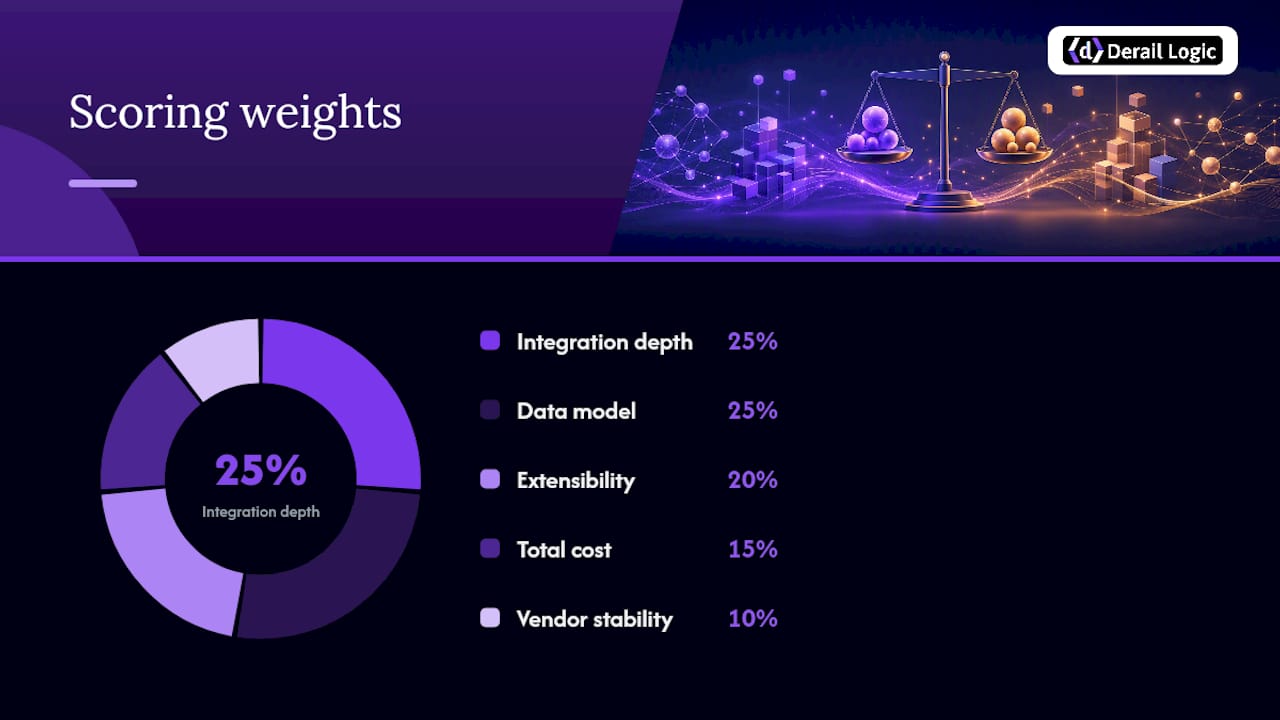
Example calculation: A platform scoring 4 on integration depth (4 × 0.25 = 1.0), 5 on data model (5 × 0.25 = 1.25), 3 on extensibility (3 × 0.20 = 0.60), 4 on TCO (4 × 0.15 = 0.60), 4 on vendor stability (4 × 0.10 = 0.40), and 3 on adoption (3 × 0.05 = 0.15) produces a weighted score of 4.0 out of 5.
Evaluation steps
- Build your shortlist from platforms that cover at least three of your top-five functional requirements natively
- Score each platform using the template above with your team
- Validate integration claims with a proof-of-concept connection to your CRM or data warehouse
- Review contract exit terms before signing: confirm data exportability, portability formats, and termination notice periods
- Check vendor stability: look at customer retention rates, funding history, and whether the vendor has a published API deprecation policy
Pro Tip: Ask every vendor for a data export in a standard format (CSV, JSON, or Parquet) before you sign. A vendor that makes export difficult is a vendor that will make exit expensive.
What consolidation costs and how to calculate ROI
Year 1 of consolidation almost always costs more than it saves. That is expected and should be modeled honestly in your business case. The savings arrive in years 2 and 3, once migration overhead is behind you and the compounding efficiency gains take hold.
Typical cost categories
- License costs: New platform fees, often offset by canceled subscriptions
- Migration costs: Data migration, integration development, and QA
- Training costs: Onboarding sessions, documentation, and productivity dip during transition
- Temporary duplicate spend: Running old and new tools in parallel during validation
- Internal labor: Marketing ops and engineering time allocated to the program
TCO typically runs 2–3x the license fee when integration, training, and maintenance are included. Build your model on TCO, not invoice totals.
Three-year ROI model (conservative assumptions)
| Cost or benefit item | Year 1 | Year 2 | Year 3 |
|---|---|---|---|
| Canceled license savings | $40,000 | $80,000 | $80,000 |
| Migration and integration costs | ($35,000) | ($5,000) | ($2,000) |
| Training and productivity dip | ($15,000) | ($3,000) | ($1,000) |
| Time savings (ops labor reclaimed) | $10,000 | $25,000 | $30,000 |
| Net benefit | $0 | $97,000 | $107,000 |
These figures are illustrative benchmarks based on industry consolidation case studies; your actual numbers will vary by stack size and team structure. Use them as a starting framework, then replace each line with your own baseline data.
KPIs to track after consolidation
- Total annual martech spend (licenses + integration + training)
- Campaign cycle time (days from brief to launch)
- Customer acquisition cost (CAC)
- Pipeline generated per marketing headcount
- Customer retention rate
- Percentage of conversions with a complete attribution path
Procurement timing matters. Aligning your consolidation timeline with contract renewals gives you negotiation leverage. A vendor facing non-renewal will often offer price concessions, extended terms, or migration support that would not otherwise be available.
- Map every renewal date in the next 18 months before you begin
- Start consolidation conversations with vendors 90 days before renewal
- Use competing platform quotes as negotiation anchors
- Never renew a tool you plan to sunset; negotiate a short-term extension instead
Common consolidation mistakes and how to avoid them
Most consolidation programs that fail do so for predictable reasons. Knowing them in advance is most of the defense.
- Consolidating before fixing the data layer. If your CRM holds duplicate records and your analytics tool uses a different customer ID, migrating to a new platform just moves the problem. Fix identity resolution first.
- Ignoring shadow IT. Tools your team adopted without IT approval often duplicate sanctioned tools. Missing them in the audit means you are solving half the problem.
- Removing critical niche features without a replacement. Some point tools exist because the platform you are consolidating onto does not cover that use case. Map every feature before you sunset, not after.
- Poor migration sequencing. Migrating your highest-traffic workflows first maximizes risk. Start with lower-stakes functional areas to build confidence and catch integration issues early.
- Weak governance after launch. Without a formal intake process for new tools, the stack rebuilds itself within 18 months. Governance is not optional; it is what makes the investment durable.
- Underestimating adoption resistance. Change management and training are where consolidation programs most commonly fail. Executive sponsorship and a clear “what’s in it for me” message for each team are not soft considerations; they are hard dependencies.
Pro Tip: Identify two or three early adopters in each affected team before migration begins. Their visible success with the new platform reduces political resistance faster than any top-down mandate.
High-impact quick wins you can execute this month
You do not need to wait for a full consolidation program to start recovering budget and time. These actions produce results within 30 days and build the evidence base for a larger program.
- Cancel subscriptions with zero active users. Pull login data for every paid tool. Any subscription with no logins in the past 60 days is a candidate for immediate cancellation. This alone often recovers thousands of dollars in annual spend.
- Remove obvious duplicate tools. If you have two email platforms, two social scheduling tools, or two project management systems, pick one and cancel the other. The 30–40% tool redundancy that audits typically find means most teams have at least one obvious duplicate hiding in plain sight.
- Centralize analytics queries into a single dashboard. Stop pulling reports from four different tools. Build one shared dashboard that pulls from your primary analytics source. The time saved per week compounds quickly across a team.
- Enforce a temporary freeze on new tool purchases. No new subscriptions until the audit is complete. This prevents the stack from growing while you are trying to shrink it.
- Document every quick win for stakeholder reporting. Record the tool name, annual cost, cancellation date, and reason. This log becomes your ROI evidence when you present the full consolidation case to finance.
For a deeper look at reducing your tool count without losing capability, the 2026 guide to reducing your marketing software stack covers the practical trade-offs in detail.
Documenting quick wins matters. Each canceled subscription is a data point. Aggregate them into a simple table: tool name, annual cost, cancellation date, and the functional replacement (or confirmation that the function was not needed). That table is your opening slide when you present the full consolidation business case.
The discipline consolidation actually demands
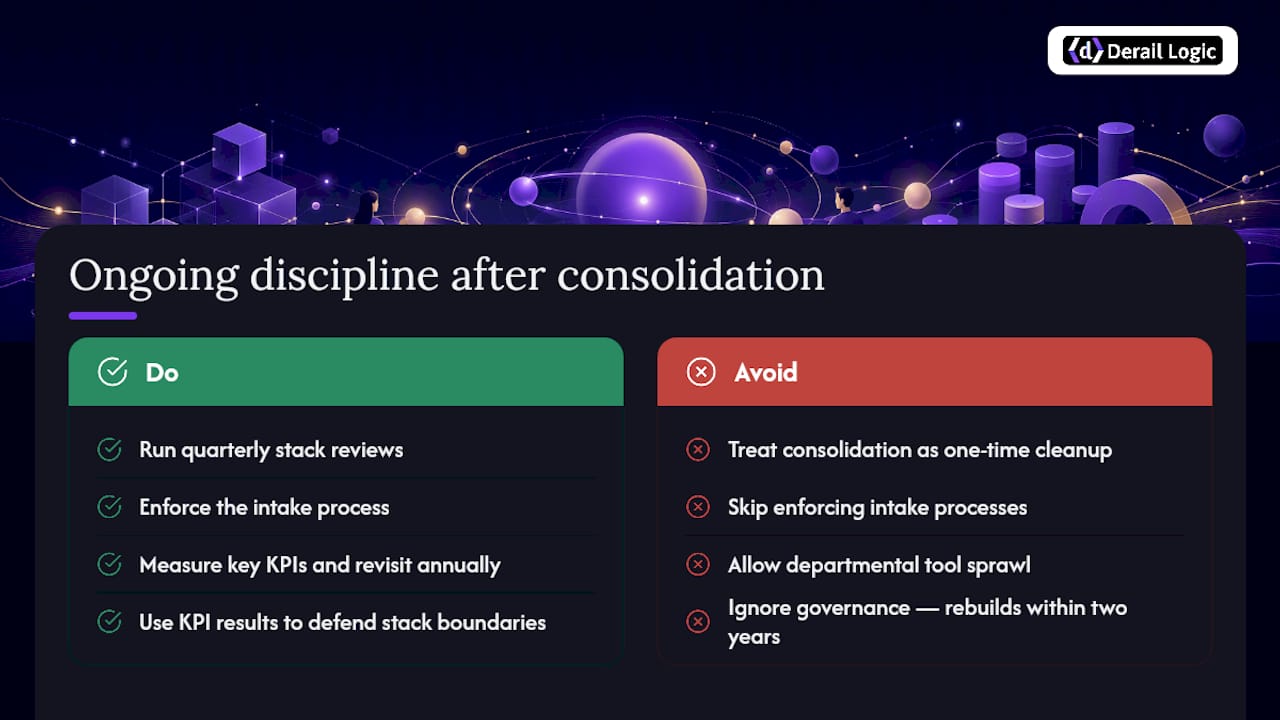
Consolidation is one of those initiatives that looks straightforward on a slide and turns complicated in practice. The technical work, choosing a platform, migrating data, retiring tools, is genuinely manageable. The harder part is the discipline it requires afterward.
Most stacks that get consolidated rebuild themselves within two years. Not because the platform was wrong, but because the governance was absent. Teams found workarounds. New tools crept in through departmental budgets. The intake process was skipped once, then twice, then permanently.
The leaders who get lasting value from consolidation treat it as an ongoing operating discipline, not a one-time cleanup. They run quarterly stack reviews. They enforce the intake process even when it slows things down. They measure the KPIs that matter, campaign cycle time, CAC, attribution coverage, and they use those numbers to defend the stack’s boundaries against the next wave of tool pitches.
There is also a trade-off worth naming directly: consolidation means accepting that your chosen platform will not be best-in-class at every function. That is the price of integration. The question is whether the coordination cost of best-in-class point tools exceeds the capability gap of a unified platform. For most marketing teams, it does. But that calculation is specific to your stack, your team size, and your growth stage. Do the math before you commit, and revisit it annually.
How Derail Logic helps you consolidate and move faster
Fragmented stacks cost real money and real time. Derail Logic’s MartechAI platform was built specifically to replace the cluster of disconnected tools most marketing teams are managing today, giving you one connected workspace instead of five separate subscriptions.
The platform combines a visual campaign studio, intelligent CRM, deep analytics, SEO auditing, keyword tracking, email marketing with AI-driven content generation, social media scheduling, and a project management layer, all connected to the same data layer. That means your attribution is clean, your reporting is live, and your team works from one interface.
- Replace your email + CRM + analytics cluster with a single connected workflow
- Run campaigns from brief to report inside the visual campaign studio without exporting data between tools
- Use the AI engine to surface insights from your actual business data, not generic benchmarks
- Support agencies and e-commerce teams with purpose-built solutions that scale without adding integration complexity
Marketing automation is the core of what Derail Logic delivers. Start a free trial and see how much of your current stack it replaces.
Sources
- What a MarTech Stack Audit Actually Reveals (and What to Do About It) – McGaw
- MarTech Stack Consolidation: How Enterprises Are Reducing Tool Sprawl and Driving Efficiency – TechBullion
- Gartner
FAQ
What is martech stack consolidation?
Martech stack consolidation is the process of reducing the number of marketing tools in use by replacing overlapping point solutions with fewer, more integrated platforms. The goal is to lower total cost of ownership, improve data quality, and reduce the integration overhead that fragments marketing operations.
What are the main benefits of consolidating marketing tech stacks?
The primary benefits include reductions ranging roughly between one-fifth and one-third in total martech spending, shorter campaign cycle times, cleaner attribution data, and a more consistent customer experience across channels. Operational efficiency gains often exceed the direct subscription savings.
What is tech stack consolidation in practice?
In practice, it means auditing every tool your team uses, identifying functional overlaps and low-adoption subscriptions, selecting a central platform that covers the majority of your needs, and retiring the tools it replaces through a phased migration.
What are the advantages of data consolidation in marketing?
Unified data eliminates the identity fragmentation that breaks attribution models. When your CRM, analytics, and campaign tools share a single customer record, you can trace conversions across every touchpoint and make budget decisions based on accurate, complete data rather than best guesses.
How long does a typical martech consolidation take?
Discovery and platform selection typically run 12 weeks. The phased migration and sunsetting of legacy tools usually takes several months, depending on stack complexity. Full governance and steady-state operations are generally in place within 9–12 months of program launch.