



If you market to California residents, honor Global Privacy Control opt-outs immediately, publish specific retention periods by data category, update every data processing agreement, and stop using sensitive personal information for ad targeting unless you have explicit opt-in consent. If your business meets any CCPA/CPRA threshold, the California Privacy Protection Agency treats 2026 enforcement as active, not theoretical, and there is often no cure period to fix a violation after the fact.
TL;DR:
- Marketers must immediately implement Global Privacy Control detection, update vendor DPAs, and ensure sensitive data targeting is turned off unless explicitly consented.
- Compliance violations are often due to integration failures, such as tags firing before consent is confirmed or suppression lists not propagating downstream, which must be corrected within a week.
- All vendor contracts need specific CPPA flow-down clauses, including data retention limits and support for consumer data requests, or vendors should be replaced.
- Retention periods should be published clearly, kept within industry-recommended ranges, and automated deletion schedules implemented across all data systems within 30 days.
- Adapting measurement strategies to favor first-party data, authenticated signals, and aggregated insights is essential as opt-out rates increase and third-party signals decline.
Table of Contents
- CCPA Compliance Marketing: The Requirements That Actually Bite
- Priority Checklist: What To Fix This Week
- What the CCPA, CPRA, and CPPA Actually Require of Marketers
- How Consumer Rights Reshape Your Marketing Workflows
- Building Technical Controls That Actually Honor Consent
- Vendor Contracts: What Your DPAs Must Say Now
- How Long Should You Keep Marketing Data?
- Rethinking Measurement When Opt-Outs Rise
- Your 30-Day Compliance Sprint
- How CCPA Compliance Changes Google Ads and Facebook Campaigns
- Email Marketing Rules Under CCPA
- Privacy-Compliant Analytics and Measurement Tools
- Managing Third-Party Cookies and Alternative Tracking
- Privacy Is Marketing Infrastructure, Not a Legal Tax
- Make CCPA Compliance Part of Your Campaign Workflow, Not a Side Project
- Sources
- FAQ
CCPA Compliance Marketing: The Requirements That Actually Bite
Most marketing teams still think of CCPA compliance marketing as a legal department problem that shows up once a year in a privacy policy update. That assumption is what gets teams fined. The California Privacy Protection Agency’s final regulations put specific, checkable obligations directly on marketing operations: how tags fire, how audiences get built, how long a pixel event sits in your data warehouse, and what your DPA with a demand-side platform actually says.
The practical shift in 2026 is enforcement posture. The CPPA has moved from guidance mode to audit mode, and marketing systems are where violations are easiest to find. A cookie firing before consent state loads, a suppression list that never reaches your ad platform, a vendor contract missing flow-down language. These aren’t edge cases. They’re the default state of most martech stacks built before privacy requirements were retrofitted in.
This is where a platform like Derail Logic’s centralized approach to campaign management becomes relevant, because the compliance failures above are almost always integration failures. Your CMP knows about an opt-out. Your ad platform doesn’t. Nobody built the pipe between them.
The rest of this guide walks through what changes now, in priority order: a checklist you can run this week, the legal scope every marketer needs memorized, the consumer-rights workflows that touch your CRM and ad accounts, the technical controls that make consent real instead of decorative, vendor contract language, data retention rules, measurement trade-offs, and a 30-day plan with owners attached to every task.
Priority Checklist: What To Fix This Week
Before touching a single campaign brief, run this list. It’s ordered by risk, not by ease.
-
Enable GPC detection in your consent management platform, then verify it in an actual browser test using Brave or Firefox with GPC turned on, not just a vendor’s dashboard confirmation.
-
Add a conspicuous “Do Not Sell or Share My Personal Information” link with a working opt-out landing page. Regulators check whether this link is buried in a footer versus clearly visible, per CPPA regulations.
-
Pause sensitive-data targeting immediately. Location history, health inferences, race, religion, and similar categories require explicit opt-in, not a passive privacy policy disclosure. If you can’t prove opt-in, turn the targeting off.
-
Request updated DPAs from your top ten vendors this week. Log every response, every gap, and every date in a single shared tracker, not scattered email threads.
-
Confirm your tag manager actually blocks tags pre-consent. Many setups load the consent banner and the tracking pixel simultaneously, which defeats the entire purpose.
Pro Tip: Test GPC compliance the way a regulator would: open an incognito browser, install a GPC extension like the one built into Brave, land on your site, and watch your network tab. If ad pixels fire before you see a consent decision logged, you have a live violation, not a theoretical one.
None of this requires a six-month project plan. It requires someone with admin access to your CMP and your tag manager spending a focused afternoon, followed by a vendor email blast that doesn’t get ignored. The teams that get burned are the ones who treat this checklist as a Q3 initiative instead of a this-week fix.
What the CCPA, CPRA, and CPPA Actually Require of Marketers
Marketing teams often confuse three acronyms that describe one evolving law. The CCPA was the original 2018 statute. The CPRA amended it in 2020 and created the enforcement agency. The CPPA is that agency, and its final regulations are the operational rulebook marketers now have to follow.
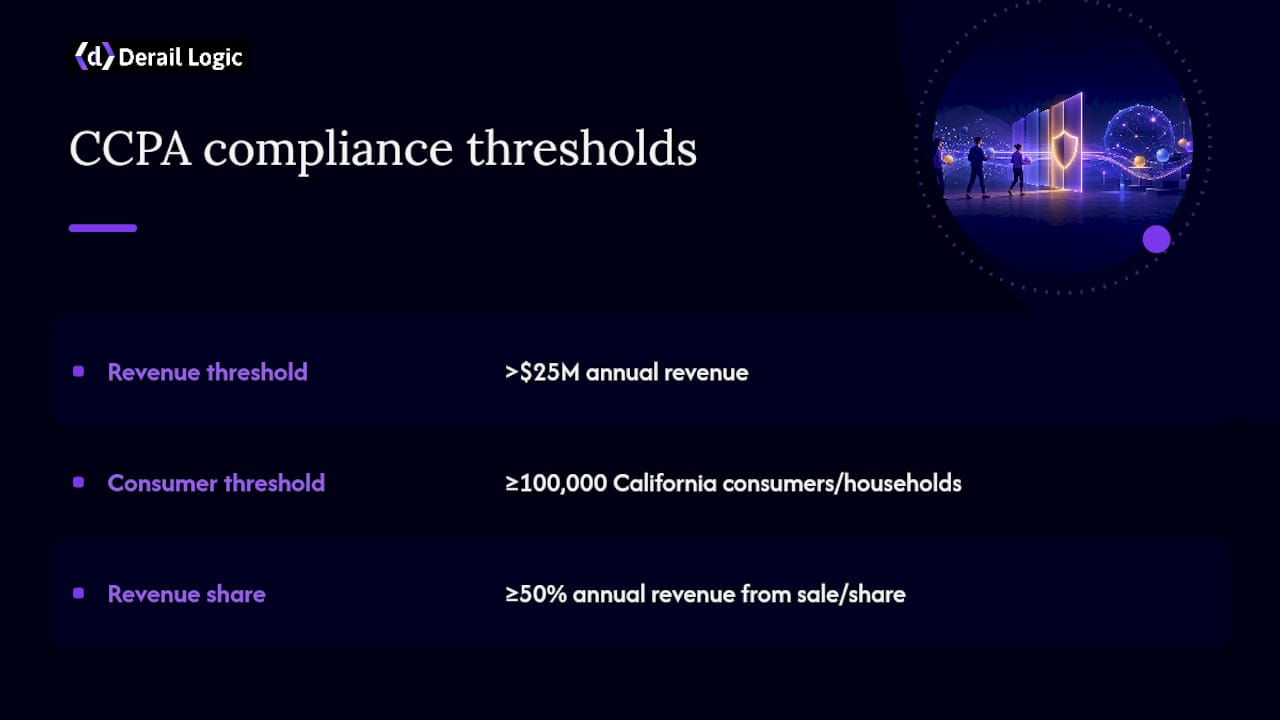
Scope is the first thing to check, because plenty of teams assume they’re exempt and aren’t. A business falls under the law if it meets any one of three thresholds: gross annual revenue over $25 million, buying, selling, or sharing personal information for 100,000 or more California consumers or households annually, or deriving 50% or more of annual revenue from selling or sharing personal information. That second threshold catches far more mid-size e-commerce brands and lead-gen operations than most marketing directors expect, because “100,000 consumers” includes website visitors tracked by a pixel, not just paying customers.
A handful of definitions determine whether your campaigns are compliant or not. “Sale” and “sharing” both cover the exchange of personal information for cross-context behavioral advertising, even when no money changes hands. That means most programmatic ad buys and most Meta or Google remarketing setups count as a sale or sharing under the statute, which is why the opt-out link requirement exists in the first place. “Sensitive personal information” includes precise geolocation, health data, sexual orientation, religious belief, and similar categories, and using it for targeting requires opt-in, not opt-out. “Notice at collection” means the disclosure a consumer sees at the exact point you collect their data, not buried three clicks deep in a privacy policy. The “alternative opt-out link” lets businesses combine the Do Not Sell/Share mechanism with a broader privacy choices tool, provided it’s equally accessible.
Enforcement is where this gets expensive. Violations carry penalties up to $2,500 per violation, rising to $7,500 for intentional violations or those involving minors, and for many violation types there is no cure period before the agency can act. A single mis-tagged campaign touching thousands of consumer records can compound fast when the per-violation math starts multiplying.
How Consumer Rights Reshape Your Marketing Workflows
Every consumer right under CCPA eventually lands on a marketing system, whether that’s your CRM, your email platform, or your ad accounts. The rights themselves are straightforward: access, deletion, correction, and opt-out of sale or sharing. Operationalizing them across a fragmented martech stack is where teams struggle.
Opt-outs have to work through three channels simultaneously: your Do Not Sell/Share link, an alternative opt-out mechanism if you use one, and the Global Privacy Control signal detected automatically in a consumer’s browser. The CPPA treats GPC as a valid opt-out request with the same legal weight as a manual click, which means your CMP needs to detect that header and suppress tracking without the consumer taking any additional action. The common failure mode here isn’t the front-end opt-out button. It’s the suppression list that never propagates downstream to your DSP or identity resolution partner, so a consumer opts out on your site and still gets retargeted three days later through a programmatic partner who never got the memo.
Access and deletion requests run on a clock. Businesses typically have 45 days to respond, with a possible 45-day extension when reasonably necessary. For a marketing team, that means:
- Search every system that holds the consumer’s data — CRM, email platform, ad platform custom audiences, analytics warehouse, and any vendor holding a copy.
- Verify the requester’s identity using a method proportionate to the sensitivity of the data involved.
- Purge or export the data across all systems, not just the primary database, within the response window.
- Log the fulfillment with a timestamp, so you can prove compliance if audited later.
Consent records deserve the same rigor. Every consent decision should carry a timestamp, a version number tied to the specific banner or notice shown, and a link to the marketing identifier it applies to, so when a consumer rights request comes in six months later, you can show exactly what they agreed to and when.
Building Technical Controls That Actually Honor Consent
A consent banner that displays correctly but doesn’t stop tags from firing is worse than having no banner at all, because it creates a paper trail proving you knew about consent requirements and didn’t enforce them.
The mechanics start with GPC detection. GPC arrives as an HTTP header, Sec-GPC: 1, sent automatically by browsers like Brave and Firefox extensions when a consumer has enabled the setting. Your CMP needs to check for that header at script load, before any marketing or analytics tag executes, and treat its presence as an immediate opt-out of sale and sharing. Many CMP vendors shipped GPC detection as a feature in 2025, but it often ships disabled by default, so confirm the setting is active rather than assuming it.

Tag sequencing matters more than most marketers realize. The correct order is: consent state loads, GPC and stored preferences get checked, then tags fire conditionally based on that state. If your tag manager fires Meta Pixel, Google Ads conversion tracking, and your CMP banner all in the same page load without a gating condition, you’re capturing data before consent is established.
Server-side tagging adds a layer many teams overlook. If you’ve moved conversion tracking to Meta’s Conversions API or Google Analytics 4’s server-side container to fight signal loss, the opt-out flag has to travel with that server-side call. A client-side opt-out that doesn’t reach your server-side SDK means you’re still sending suppressed events to ad platforms, just through a different pipe. The same applies to identity resolution vendors stitching your CRM data to ad platform identifiers. If they don’t receive the suppression signal, they keep matching a consumer you’ve already suppressed.
Audience pipeline hygiene closes the loop. Maintain a live suppression list and enforce a no-add rule: once a consumer opts out, no downstream automation should re-add them to a custom audience, a retargeting pool, or a lookalike seed list. Test this quarterly by opting out a test profile and checking whether it resurfaces in any ad platform audience within 30 days.
- Audit your tag firing order in Google Tag Manager or your CMP’s preview mode before assuming consent gating works.
- Confirm server-side endpoints receive opt-out flags, not just your client-side pixel.
- Run a suppression propagation test monthly, tracking a known opted-out profile across every connected ad platform.
Pro Tip: Most suppression failures aren’t caused by bad code. They’re caused by a vendor integration built before your opt-out mechanism existed, and nobody revisited it when the CMP launched. Map every downstream data flow once a quarter, not once a year.
Derail Logic’s approach to multi-channel campaign tracking treats consent state as part of the campaign configuration itself, which cuts down on the gap between what your CMP knows and what your ad platforms actually enforce.
Vendor Contracts: What Your DPAs Must Say Now
Every vendor touching consumer data on your behalf, from your email service provider to your programmatic ad partner to your analytics tool, needs a data processing agreement with CPPA flow-down language. A generic DPA written for GDPR compliance won’t automatically satisfy California’s requirements.
Request three specific clauses from every vendor:
- CPPA flow-down language obligating the vendor to comply with CCPA restrictions on sale, sharing, and use of personal information, and to pass those same restrictions to any subprocessor they use.
- Defined retention limits stating how long the vendor holds your consumer data and confirming deletion timelines that match your own retention schedule.
- Consumer request assistance committing the vendor to help fulfill access, deletion, or opt-out requests within a specified window, typically matching your own 45-day obligation.
Run a practical audit against every active vendor: does a signed DPA exist, does the vendor support GPC signal propagation, and can they delete or restrict processing of specific records within a contractually defined window? If a vendor answers no to any of those three, they’re a liability sitting inside your stack, not a growth partner.
The escalation path matters as much as the audit itself. Vendors who won’t sign updated flow-down language, who can’t confirm GPC support, or who take longer than your compliance window to act on a deletion request should get replaced or have their data access limited immediately. This is also the moment to ask whether you need six separate point solutions handling pieces of your consent, audience, and analytics stack, or whether consolidating your marketing software stack actually reduces the number of vendor contracts you have to police in the first place. Fewer vendors means fewer DPAs to chase and fewer places for a suppression signal to get lost.
How Long Should You Keep Marketing Data?
Retention limits are the single most under-documented piece of CCPA compliance marketing, and the CPPA’s final regulations specifically require businesses to publish retention periods by category in their privacy disclosures, not just promise to delete data “when no longer needed.”
Industry guidance points to practical retention windows that hold up under both compliance and marketing utility:
- Analytics data: 14 to 26 months, matching most standard analytics platform defaults.
- Pixel and behavioral event data: roughly 12 months, since retargeting value drops sharply past that window anyway.
- Email subscriber data: retained until unsubscribe plus 90 days, or per your documented policy.
- Custom audience source data: 6 to 12 months, depending on how frequently you refresh seed lists.
- Form submission and lead data: 24 months unless the lead remains active in a sales pipeline.
These ranges aren’t arbitrary. They reflect what industry practitioners recommend as the balance point between having enough signal to run effective campaigns and not holding data indefinitely just because storage is cheap.
Building the actual inventory takes more discipline than picking numbers. Map every system holding consumer data, the specific tables or fields involved, the identifiers used to link records across systems, and every downstream recipient who receives a copy, whether that’s a data warehouse, an ad platform, or a BI tool.
Once the inventory exists, automate the deletion. Manual retention cleanup fails within two quarters because someone gets busy. Set scheduled jobs that anonymize or purge records once they cross your published retention window, and tie those automation rules directly to the DPA terms you negotiated with each vendor, so your internal deletion schedule and your vendor’s contractual deletion obligation match.
Rethinking Measurement When Opt-Outs Rise
Every opt-out shrinks your addressable audience and adds noise to attribution models built on complete tracking. That’s not a reason to resist compliance. It’s a reason to change what you measure and how.
First-party identity becomes the foundation once third-party signal degrades. A consumer who logs into your site, opens an email, or completes a purchase gives you a durable, consented signal that doesn’t disappear when a browser blocks a cookie. Server-side measurement through tools connected to authenticated data, rather than anonymous pixel firing, holds up better against both browser restrictions and opt-out volume.
Practical tactics worth adopting now include authenticated measurement tied to logged-in sessions, cookieless cohort modeling where your ad platform supports it, and privacy-preserving clean-room matching for advertiser-publisher data collaboration, all operating within the consent boundaries your CMP enforces. None of these fully replace the granularity of pre-2026 tracking, and pretending otherwise sets your team up for disappointing quarterly reviews.
Adjust what leadership expects from a dashboard. Audience sizes will shrink as opt-out rates climb. Attribution windows may need to lengthen since fewer signals arrive in real time. Statistical confidence on smaller segments drops, which means fewer micro-optimizations and more directional decisions based on aggregate trends. Privacy-first measurement rewards teams that build durable first-party relationships over teams chasing maximum audience volume, and that’s a genuinely different way to plan a media calendar.
Your 30-Day Compliance Sprint
Baseline compliance doesn’t require a year-long transformation program. Practitioner estimates suggest focused teams can complete core compliance work in about 30 days when tasks are prioritized correctly and legal review runs in parallel instead of as a bottleneck at the end.
- Week 1: Inventory and quick wins. Marketing ops and legal jointly audit every data source, confirm the opt-out link works, run GPC detection tests, and send priority DPA requests to your top ten vendors.
- Week 2: Technical remediation. Engineering and marketing ops fix tag firing order, confirm server-side flows receive opt-out flags, and run suppression propagation tests across every connected ad platform.
- Week 3: Governance and training. Data ops and legal automate retention schedules, build a consumer request playbook with clear ownership, and train customer-facing and marketing staff on how to handle a rights request that lands in their inbox.
- Week 4: Vendor closeout and reporting. Whoever owns security posture, often a CISO or VP of marketing, follows up on outstanding DPA requests, runs an internal audit against the checklist from week one, and documents the full sprint for leadership with clear next steps for anything unresolved.
Treat week four’s documentation seriously. If the CPPA ever asks, a dated record showing you ran a structured compliance sprint carries real weight, even if a handful of items remain in progress.
How CCPA Compliance Changes Google Ads and Facebook Campaigns
Cross-context behavioral advertising, the mechanism behind most Google Ads remarketing and Facebook Custom Audiences, falls squarely inside the CCPA’s definition of a sale or sharing of personal information. That means every campaign built on retargeting pixels or lookalike audiences needs a working opt-out path feeding directly into those platforms.
Both major platforms have adjusted their own tools in response. Google’s Consent Mode adjusts how conversion tracking behaves based on a visitor’s consent state, modeling conversions when explicit tracking consent is absent rather than firing a full pixel event. Meta’s Limited Data Use setting restricts how Meta itself processes data for California users when a business flags that a user has opted out. Neither tool works automatically. Both require your CMP to correctly signal consent state to the platform’s SDK, and both require you to actually configure the settings rather than assume the platform handles it by default.
The strategic shift is toward smaller, higher-intent audiences. Lookalike and custom audience seeds built from opted-out or suppressed users need to exclude those records entirely, which shrinks seed list size over time as opt-out rates climb. Budget allocation should follow that shift: less spend chasing broad retargeting pools, more spend on contextual targeting and first-party audience segments where you hold clean, consented data. Campaigns that once ran almost entirely on third-party signal now need a first-party foundation to stay effective, which is exactly why measurement strategy and ad platform configuration have to move together, not in separate workstreams.
Email Marketing Rules Under CCPA
Email doesn’t carry the same opt-in requirements as SMS under the TCPA, but CCPA still governs how you collect, use, and retain subscriber data, and most marketing teams miss the parts that aren’t about the unsubscribe link.
Every email capture form needs a notice at collection explaining what data you’re gathering and how it will be used, displayed at the point of signup rather than buried in a linked privacy policy. If you’re enriching email subscribers with third-party data (purchase history from a data co-op, demographic overlays, behavioral scoring), that enrichment counts as processing personal information and needs to appear in your privacy disclosures.
Segmentation built on sensitive personal information deserves particular caution. An email program that segments by inferred health conditions, religious affiliation, or precise location history needs explicit opt-in before that segmentation drives send logic, not just a general marketing consent checkbox.
Suppression list accuracy matters as much on email as it does on ad platforms. A consumer who submits a deletion request or opts out through your Do Not Sell/Share link should stop receiving marketing email tied to that record, and your email platform’s suppression list needs to sync with your CMP’s opt-out record rather than operating as an island. Unsubscribe alone isn’t the same signal as a CCPA opt-out or deletion request, and treating them interchangeably creates gaps: a consumer can opt out of sale/sharing while still wanting your newsletter, or request deletion entirely, which is a stronger action than an unsubscribe click.
Retention discipline applies here too. Keep subscriber data until unsubscribe plus a documented grace period, then purge rather than let inactive records accumulate indefinitely in your email service provider.
Privacy-Compliant Analytics and Measurement Tools
Standard analytics setups built years before privacy law caught up often collect more granular, longer-retained data than CCPA compliance marketing allows without explicit disclosure. The fix isn’t abandoning analytics. It’s choosing configurations and tools that respect consent state by design.
Server-side analytics implementations give you more control than client-side scripts because you decide exactly what data leaves your infrastructure and when, rather than a third-party script capturing everything a browser will allow. Google Analytics 4’s server-side container, deployed through Google Tag Manager’s server container option, lets you filter or anonymize fields before they ever reach Google’s servers, which matters when a visitor has opted out of sale or sharing but you still want aggregate, non-personal usage data.
Consent-aware analytics tools that support IP anonymization, cookieless session tracking, and configurable data retention windows fit better into a CCPA compliance marketing program than tools built around indefinite raw event storage. Whatever tool you choose, confirm it lets you set a retention window matching the schedule you’ve published in your privacy policy, because a tool defaulting to “keep forever” undermines the retention limits you’ve committed to elsewhere.
The deeper shift is philosophical as much as technical: measurement tools should answer “is this campaign working” without requiring you to retain personally identifiable detail longer than the campaign needs it. Aggregate reporting, cohort-based analysis, and modeled conversions increasingly do that job as well as granular user-level tracking used to, particularly as opt-out volume grows.
Managing Third-Party Cookies and Alternative Tracking
Third-party cookies were already declining before CCPA enforcement intensified, and browser-level restrictions from Safari and Firefox did more to kill them than any single privacy law. CCPA adds a legal obligation layer on top of a technical one: even where third-party cookies still function, using them for cross-context behavioral advertising requires the same opt-out mechanism as any other sale or sharing of personal information.
Alternative tracking methods carry their own compliance requirements, not a free pass around them. First-party data collection through authenticated logins or on-site forms still requires notice at collection and still triggers opt-out and deletion rights once you use that data for advertising purposes. Contextual advertising, which targets based on page content rather than user identity, sidesteps most CCPA obligations specifically because it doesn’t rely on personal information at all, making it one of the cleaner paths forward as third-party signal continues to erode.
Server-side tagging and first-party pixel implementations, where you control the data collection point directly on your own domain rather than through a third-party script, give you the technical ability to apply consent logic before any data leaves your infrastructure. That control is the actual compliance advantage, not a marginal tracking improvement. Identity resolution services matching hashed emails or phone numbers across platforms still count as sharing personal information for advertising purposes, so those partnerships need the same DPA scrutiny and opt-out propagation as any programmatic vendor.
The practical takeaway: build tracking architecture around consented, first-party data as the primary signal, and treat every third-party or cross-context method as something requiring the same opt-out and disclosure discipline, regardless of whether it technically uses a cookie.
Privacy Is Marketing Infrastructure, Not a Legal Tax
The framing I keep pushing back on is treating CCPA compliance marketing as a cost center that legal imposes on marketing against its will. That’s backwards. Privacy investment reduces churn, because consumers increasingly distrust brands that mishandle their data, and it improves email deliverability, because a clean, consented list performs better than a bloated one full of unengaged or improperly acquired contacts.
The teams getting this right aren’t the ones treating compliance as a checkbox exercise finished once a year. They’re productizing privacy controls, building consent state, suppression logic, and retention automation directly into how campaigns get configured, the same way they’d build in budget pacing or creative rotation. That mindset shift matters more than any individual regulatory clause. Compliance work done well becomes marketing infrastructure that makes every future campaign faster to launch and easier to trust, not a recurring tax paid to avoid fines.
— Zachary
Make CCPA Compliance Part of Your Campaign Workflow, Not a Side Project
Most of the fixes in this guide, GPC detection, suppression propagation, retention automation, consent-linked campaign controls, fail not because teams don’t understand the law but because those controls live in five disconnected tools that never talk to each other. Derail Logic was built to close exactly that gap: a unified marketing platform where consent state, audience suppression, and campaign configuration sit in one workflow instead of scattered across a CMP, a tag manager, an email platform, and a spreadsheet tracking vendor DPAs.
Inside Derail Logic, campaign controls are linked to consent status directly, so an opted-out audience segment can’t accidentally get re-added to a retargeting pool, and your centralized data inventory gives you one place to document retention schedules instead of hunting across six systems during an audit. During a 30-day compliance sprint, that centralization is the difference between finishing on schedule and still chasing vendor responses in month three. Teams running their marketing automation through a single platform get audit-ready reporting built in, rather than assembling evidence from disconnected exports after the fact.
If your team is heading into a compliance sprint this quarter, start a trial and map your existing campaign stack against Derail Logic’s centralized controls before your next vendor renewal cycle.
Sources
- CPPA – FINAL REGULATIONS TEXT
- CPPA compliance for marketers 2026: what changed Jan 1 | Adfirm
- CCPA Compliance Checklist for Marketers 2026 – BIGDBM
FAQ
What Is CCPA Compliance Marketing?
It refers to how marketing teams collect, use, and share consumer data in ways that meet CCPA and CPRA requirements, covering consent tracking, opt-out mechanisms, retention limits, and vendor contracts across ad platforms, email, and analytics.
Do Small Marketing Teams Need To Worry About CPPA Enforcement?
Yes, if your business meets any threshold: revenue over $25 million, data on 100,000 or more California consumers annually, or 50% or more of revenue from selling or sharing personal information; team size doesn’t exempt you.
How Quickly Must We Respond to a Consumer Deletion Request?
Businesses typically have 45 days to respond, with a possible 45-day extension when reasonably necessary, which means every connected system, from your CRM to your ad platform custom audiences, needs to be searchable within that window.
Does Global Privacy Control Apply to Email Marketing?
GPC governs opt-outs of sale and sharing tied to cross-context behavioral advertising rather than direct email sends, but your suppression logic should still sync CCPA opt-outs and deletion requests with your email platform to avoid contradictory consumer records.
Can a Platform Like Derail Logic Help With CCPA Compliance Marketing?
Derail Logic centralizes campaign configuration, consent status, and audience data in one workflow, which reduces the suppression propagation failures that cause most real-world CCPA violations in marketing operations.