



Confirm the signed SOW and first payment, then assign a named onboarding owner before you touch any deliverable. That single move prevents most onboarding chaos. This guide gives you a runnable 7-step checklist, a 12-field intake template, a 60-minute kickoff agenda, a Day 1 to Day 30 timeline, and the KPIs that predict renewal.
TL;DR:
- Lock in the signed scope of work and first payment before scheduling any onboarding tasks or kickoff meetings to avoid scope disputes and unpaid work.
- Complete all seven onboarding steps in order, ensuring each has an assigned owner and clear deadlines, to prevent gaps in communication and resource alignment.
- Conduct a fixed 60-minute kickoff meeting with a strict agenda and send a same-day recap to solidify decisions and maintain momentum.
- Use templates for intake, expectations, and communication plans, layered for easy customization and scalability across multiple clients.
- Automate reminders, workspace setup, and reporting to streamline onboarding, reduce manual work, and enable onboarding in 3 to 5 days for most clients.
Table of Contents
- What Does Agency Client Onboarding Actually Cover?
- Why Structured Onboarding Matters More Than Most Agencies Think
- The 7-Step Agency Client Onboarding Checklist
- Intake Assets and Templates to Use or Copy
- Tools and Workspace Setup: The Minimal Provisioning Checklist
- Your Day 1 to Day 30 Onboarding Timeline
- How to Measure Onboarding Success
- Common Onboarding Mistakes and How to Fix Them
- Scaling Onboarding Across More Clients
- Why the Kickoff Hour Matters More Than the Kickoff Deck
- How MartechAI Standardizes Agency Client Onboarding
- Sources
- FAQ
What Does Agency Client Onboarding Actually Cover?
Agency client onboarding starts the moment a contract is signed and ends when the client settles into your normal monthly cadence, usually marked by a 30-day review. Everything between those two points is the onboarding window, and it runs on two parallel tracks that need to move together.
The internal half covers resourcing, budget allocation, team assignment, and tool setup. The client-facing half covers goals, stakeholder mapping, access collection, and expectation-setting. Neither track works alone. A structured onboarding process builds trust and reduces miscommunication precisely because it forces both halves to sync before real work begins, and the statement of work becomes the fallback reference whenever scope gets disputed later.
Onboarding is complete when three things are true:
- The client has received their first agreed deliverable and approved it
- Your team has a locked reporting cadence and communication rhythm in place
- A 30-day review has happened and both sides have flagged (or cleared) early friction
Skip any of those three, and you are not onboarded. You are just hoping.
Why Structured Onboarding Matters More Than Most Agencies Think
Retention lives or dies in the first 30 days. A client who feels confused, ignored, or surprised during onboarding rarely sticks around long enough to see your actual work product. A structured onboarding process builds trust, sets expectations, and reduces miscommunication between sales and operations, which matters because sales teams routinely oversell timelines that operations then has to walk back.
Fast alignment prevents scope creep before it starts. When goals, deliverables, and change-order rules are documented in week one, there is no ambiguity for a client to exploit later, intentionally or not. Every “just one more thing” request gets measured against a written scope instead of a vague memory of a sales call.
Quick wins compound. A client who sees a small, visible result in week two starts trusting your process, which makes them more forgiving when something inevitably slips in month three. That early trust is what makes renewal conversations easy instead of adversarial.
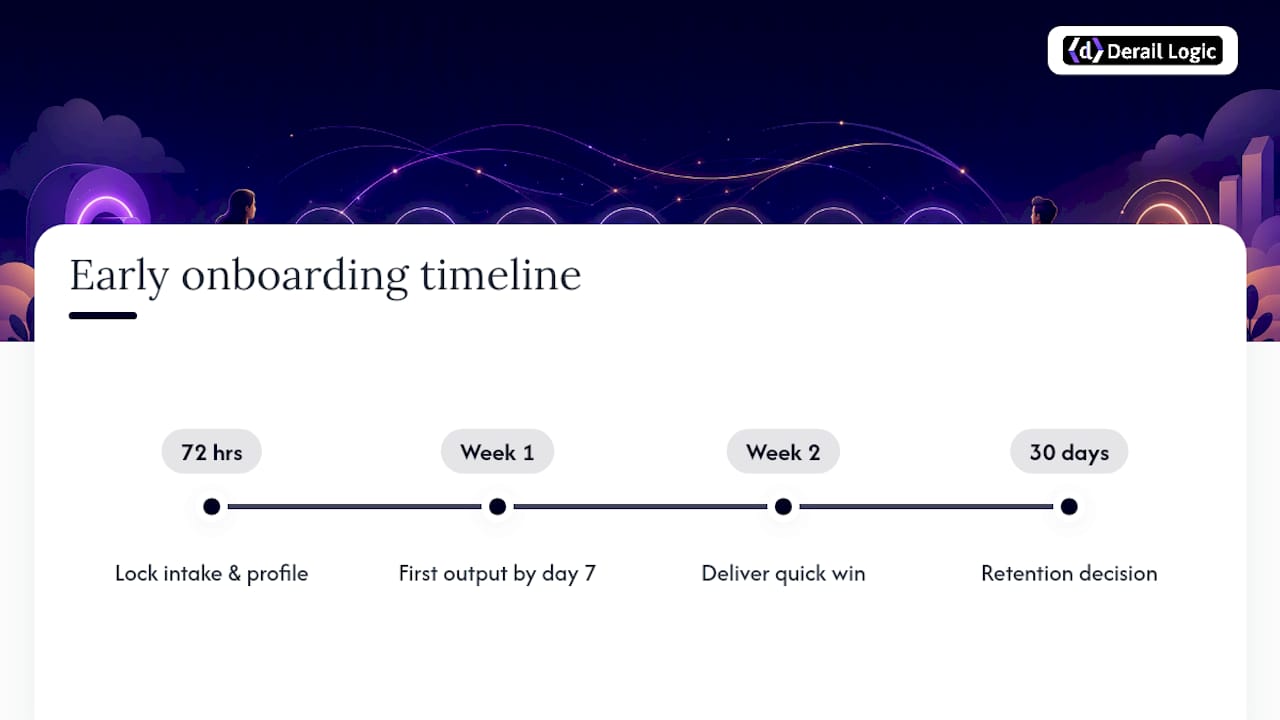
Early data point: agencies that lock intake and profile setup within 72 hours of kickoff can deliver a directional first output within seven days in retained search workflows, a speed that most clients read as competence.
The 7-Step Agency Client Onboarding Checklist
This is the operational core. Run every new client through these seven steps in order, and assign a single owner to each one so nothing falls into the gap between sales and delivery.
1. Confirm contract, payment, and send the welcome packet
Owner: Account lead. SLA: Same day the SOW is countersigned. Deliverable: Signed contract on file, first invoice sent or paid, one-page welcome packet delivered.
Do not schedule a kickoff, request access, or open a project file until payment terms are confirmed. Starting delivery work before the SOW is finalized is one of the fastest ways to end up doing unpaid scope negotiation later.
Red flag: A client who stalls on payment setup but wants “just a quick call to get started” is telling you something about how the relationship will run.
2. Send the intake form and collect key information
Owner: Onboarding owner. SLA: Within 24 hours of step 1. Deliverable: Completed intake form covering goals, brand assets, competitors, and prior campaign history.
3. Request access and logins
Owner: Onboarding owner, with IT/ops support. SLA: 48 hours from intake completion. Deliverable: Verified access to analytics, ad accounts, CMS, and any third-party platforms the engagement requires.
Red flag: Access requests that go unanswered for more than three business days usually mean the client hasn’t identified the right internal contact, which you need to flag and resolve before kickoff, not after.
4. Run the internal debrief and lock resourcing
Owner: Account lead plus department heads. SLA: Before kickoff is scheduled, typically Day 2 to 3. Deliverable: Assigned team roster, budget allocation, and a shared internal brief.
This step is where most agencies rush. A ten-minute internal debrief that aligns strategy, media, and creative before the client ever sees a kickoff invite saves hours of contradictory messaging later.
5. Run the kickoff meeting
Owner: Account lead facilitates; onboarding owner takes notes. SLA: Day 3 to Day 5. Deliverable: A same-day written recap distributed to every stakeholder on both sides.
Pro Tip: A fixed 60-minute kickoff that forces three concrete decisions, and ends with a same-day recap, is the single highest-leverage hour of the entire onboarding process. Anything longer usually means the agenda wasn’t tight enough.
6. Set the timeline, milestones, and reporting cadence
Owner: Project manager. SLA: Within 48 hours of kickoff. Deliverable: A shared project timeline with named milestones and a confirmed reporting schedule (weekly, biweekly, or monthly).
7. Run the 30-day review and calculate a health score
Owner: Account lead. SLA: Day 28 to 32. Deliverable: A documented review covering deliverable acceptance, response times, and a short client survey.
Red flag: If you reach Day 30 and can’t point to at least one approved deliverable, the onboarding has stalled, and you need to diagnose why before the client does.
Pro Tip: Capture the intake conversation in a structured summary the same day it happens. Fast recaps prevent drift because decisions made verbally in a kickoff call get reinterpreted differently by everyone who wasn’t in the room, unless you write it down within hours.
Intake Assets and Templates to Use or Copy
You do not need to build these from scratch. A practical onboarding pack has five documents, and each one has a known ideal length that keeps clients from skimming past it.
- Welcome packet: one page, sent same day as contract signing, covering who’s on the team and what happens next
- Intake form: roughly 12 fields, covering goals, brand assets, target audience, competitors, and past campaign performance
- Expectations document: one page, covering scope boundaries, change-order process, and response-time commitments
- Communication plan: half a page, covering meeting cadence, preferred channels, and escalation contacts
- Kickoff agenda: structured for a 60-minute session that must produce a confirmed scope, a named point of contact, and an agreed timeline
A five-document onboarding pack built this way consistently reduces setup time compared to agencies that improvise each new client relationship from scratch.
| Document | Length | Send timing |
|---|---|---|
| Welcome packet | 1 page | Day 1, same day as signing |
| Intake form | 12 fields | Day 1 to 2 |
| Expectations doc | 1 page | Day 1 to 2, with intake |
| Communication plan | Half page | Before or during kickoff |
| Kickoff agenda | 60 minutes | Day 3 to 5 |
Build templates in three layers: an agency-wide base, a service-line variant (SEO differs from paid media differs from content), and a client-specific customization layer. This three-layer model prevents templates from going stale while still letting you personalize fast instead of rebuilding documents for every new logo.
Tools and Workspace Setup: The Minimal Provisioning Checklist
You do not need a dozen platforms running before day one. You need a handful configured correctly, with clear permissions from the start.
- Project management tool: create the client workspace and assign roles before kickoff, not after
- Client portal or shared drive: set folder structure once, replicate it per client, never improvise per project
- E-signature tool: confirm the SOW template is loaded and ready before sales even opens conversation
- Form builder: host the intake form somewhere trackable, so you know when it’s opened and when it stalls
- Analytics access: request read-only or admin access (specify which) during step 3 of the checklist, not during reporting week one
Use a consistent folder pattern: one top-level client folder, subfolders for contracts, creative assets, reporting, and meeting notes. Permission by role, not by individual, so onboarding a new team member doesn’t mean rebuilding access from scratch.
Automation for reminders, workspace provisioning, and templated recap emails shortens time-to-first-deliverable and cuts the manual follow-up work that eats a project manager’s week. A platform like MartechAI’s marketing automation can handle recurring reminder sequences so no one on your team has to chase a client for the third time about a missing login.
Your Day 1 to Day 30 Onboarding Timeline
Most well-run agency onboardings finish core setup within 3 to 5 working days, with a 30-day review scheduled from the start rather than added as an afterthought once someone notices a problem.
- Day 1: Contract confirmed, welcome packet sent, intake form delivered (account lead)
- Day 2 to 3: Access requested, internal debrief run, resourcing locked (onboarding owner)
- Day 3 to 5: Kickoff meeting held, same-day recap sent (account lead)
- Week 2: Timeline and reporting cadence confirmed, first visible progress shared with client
- Day 28 to 32: 30-day review, client health score calculated, renewal risk flagged if needed
Short engagements (under 90 days) should compress steps 1 through 3 into 48 hours. Long retainers can stretch the internal debrief but should never push the kickoff past Day 5, since delayed kickoffs correlate with delayed everything else.
How to Measure Onboarding Success
A client health score gives you an early warning system instead of a surprise churn notice three months in. Build it from four weighted components.
- Response time (25%): how quickly the client answers requests for access, feedback, or approvals
- Access readiness (25%): whether logins and permissions were provided within the agreed window
- Deliverable approvals (30%): how many first-month deliverables were approved without major revision cycles
- Early outcome metrics (20%): whether the first tracked result (traffic, leads, engagement) moved in the expected direction
Access readiness, approval pace, and first-deliverable acceptance are the early signals that predict renewal, more reliably than how the client “feels” on a status call.
For first-month reporting, keep the fields simple: deliverables completed, deliverables pending client input, current risk flag (green, yellow, red), and one qualitative note. Report weekly during onboarding, then shift to your standard cadence once the 30-day review clears.
A short survey sent at Day 30 surfaces problems early and signals to the client that you’re paying attention to the relationship, not just the invoice.
Common Onboarding Mistakes and How to Fix Them
Most onboarding failures trace back to five repeatable mistakes, and each one has an obvious owner who should have caught it.
- Skipping the intake form: relying on a sales call summary instead of structured intake leads to missing brand assets and unclear goals. Fix: onboarding owner enforces the form before kickoff is scheduled.
- No single onboarding owner: when three people think someone else is handling access requests, nobody handles them. Fix: account lead names one owner in writing on Day 1.
- Starting work before the SOW is signed: creates unpaid scope disputes later. Fix: account lead holds the line, no exceptions for “just a quick start.”
- Poor access management: logins shared over email, never revoked, never tracked. Fix: onboarding owner logs every credential in the client portal, not in a chat thread.
- No written kickoff recap: verbal decisions get remembered differently by different people. Fix: whoever runs kickoff sends the recap same day, no exceptions.
Scaling Onboarding Across More Clients
Template reuse is what makes onboarding scalable instead of exhausting. The three-layer customization model (agency base, service-line variant, client-specific tweak) lets you spin up a new client’s documents in under an hour once the base templates exist, instead of rebuilding from a blank page every time.
Automation handles the repetitive parts: intake reminders, workspace provisioning, and recap emails. This is where a connected platform earns its place. MartechAI’s campaign studio and CRM can trigger a reminder sequence when an intake form stalls, or auto-provision a client workspace once a contract status changes, cutting the manual chasing that eats a project manager’s Monday morning.
Pro Tip: Build your onboarding templates once, in a tool that can trigger reminders automatically. The time you save on the fifth client is bigger than the time you save on the first.
Why the Kickoff Hour Matters More Than the Kickoff Deck
Most agencies over-invest in the kickoff slide deck and under-invest in what happens in the sixty minutes after. I’ve watched account teams spend three days polishing a presentation, then leave the meeting without a written recap, and wonder two weeks later why the client “remembers it differently.”
The rule I’d push every agency to adopt: a tight, fixed kickoff agenda that forces three real decisions, followed by a same-day recap sent to every stakeholder, beats a longer, more polished meeting almost every time. Speed matters more than thoroughness in that specific hour, because thoroughness without a written record just becomes a future argument.
Use the intake template and kickoff agenda structure earlier in this guide as your starting point. Adjust the fields, not the discipline behind sending them fast.
— Zachary
How MartechAI Standardizes Agency Client Onboarding
Derail Logic is the alternative to piecing together five disconnected tools for onboarding. Instead of a form builder, a separate CRM, a project tracker, and a reporting dashboard that never talk to each other, some platforms connect campaign planning, CRM, and analytics into one workspace built for managing more clients without multiplying the admin work.
For agency teams, that means the intake data you collect feeds directly into client workspaces, kickoff decisions map straight into project timelines, and reporting cadences run off the same dashboard your account leads already use. Templates built once inside MartechAI’s agency solution scale across every new client instead of living in a folder someone forgets to update.
If you’re running the 7-step checklist above manually across spreadsheets and email threads, start by looking at MartechAI’s pricing plans, including the Agency plan built for teams managing multiple client accounts at once. See what a connected onboarding workflow looks like before your next kickoff call.
Sources
- Bringing Value Onboard — HBR/ North Highland
- Client Onboarding Template: 5 Free Agency Templates – Gatilab
- Agency-client onboarding: the 7-step intake workflow – Metaview
- Agency Client Onboarding Guide — Productive
FAQ
What Is the First Step in Agency Client Onboarding?
Confirm the signed SOW and first payment, then assign a single named onboarding owner before any other step begins.
How Long Should Agency Client Onboarding Take?
Core setup typically finishes within 3 to 5 working days, with a full 30-day review scheduled from the start to catch early misalignment.
What Should Be in a Client Intake Form?
A practical intake form runs around 12 fields covering goals, brand assets, target audience, competitors, and past campaign history.
How Do You Measure Onboarding Success?
Track a client health score built from response time, access readiness, deliverable approvals, and early outcome metrics, since these signals predict renewal.
Can Onboarding Be Automated?
Yes. Reminder sequences, workspace provisioning, and recap emails can run automatically, and platforms like MartechAI connect that automation to your CRM and reporting so nothing gets tracked twice.