



A content style guide is a reference document that defines how a brand writes: its voice, its grammar rules, and its do’s and don’ts across channels. It gives every writer, editor, and AI tool the same rulebook, which means faster drafts, fewer rounds of edits, and content that sounds like one brand instead of five different people. Most teams put an editor or communications lead in charge of keeping it current.
TL;DR:
- A content style guide should focus on 3 to 5 clear voice traits, supported by do and don’t examples, to ensure consistent brand tone.
- Building a one-page voice chart and a brief template is the fastest way to create an effective guide that teams actually use daily.
- Embedding style rules into content tools and establishing ownership with regular reviews helps enforce adherence and keeps the guide current.
- Channel-specific rules—such as email subject line length and support reply structure—must be tailored to each platform’s format and purpose.
- Using publicly available guides like Mailchimp’s or Microsoft’s can provide a practical starting point for structuring your own brand style documentation.
Table of Contents
- What Does a Content Style Guide Cover, and When Do You Need One?
- What Belongs in a Useful Content Style Guide?
- How Do You Build a Style Guide from Scratch?
- How Do You Get a Team to Actually Follow the Guide?
- What Public Style Guides Are Worth Studying?
- How Do You Keep the Guide from Going Stale?
- What Do Channel-Specific Rules Look Like in Practice?
- Why Short Operational Guides Beat Long Brand Bibles
- Where to Find More Style Guide Templates
- Sources
- FAQ
What Does a Content Style Guide Cover, and When Do You Need One?
Three related documents get lumped together under “style guide,” and mixing them up is the fastest way to build something nobody uses.
House style covers mechanics: Oxford comma or not, how you write numbers, whether it’s “email” or “e-mail.” Brand voice guidelines describe personality: are you playful or formal, terse or expansive? An editorial guide sets process rules: who approves what, how sources get cited, what claims need a fact check. A complete content style guide usually blends pieces of all three, scaled to what the team actually needs.
You know you need one when:
- More than two or three people are writing customer-facing content and their output doesn’t sound related.
- You’re onboarding new writers, freelancers, or an agency and re-explaining voice every time.
- Support, marketing, and product teams each have their own vocabulary for the same feature.
- You’ve started using AI to draft content and the results feel generic because there’s no house voice to feed it.
The audience for the guide is broader than the writing team. Product managers writing in-app copy, support agents drafting canned responses, and agencies producing campaign assets all need the same reference, or the brand fragments across every touchpoint it owns.
What Belongs in a Useful Content Style Guide?
A guide earns its place in someone’s bookmarks bar when it answers real questions fast, not when it reads like a manifesto. The most functional guides share a short list of core components.
- 3 to 5 voice traits, each with a one-line definition and a matching do/don’t example. Vague traits like “friendly” are useless without a contrast; “friendly, not familiar” paired with sample sentences does the job.
- A tone map by channel, since voice stays consistent but tone shifts. A support reply after a billing error needs more warmth than a product launch tweet.
- Word lists: preferred terms, banned jargon, and product-name capitalization rules, all in one scannable table.
- A grammar and mechanics baseline, usually AP or Chicago style, with your house exceptions flagged separately so nobody has to guess which rule wins.
- Before/after microcopy examples for buttons, error messages, and email subject lines. Abstract rules rarely change behavior; a rewritten sentence does.
- Accessibility and SEO metadata rules, including alt text conventions and meta description length.
- Publishing permissions and asset links, so a writer knows who approves what and where the logo files live.
A guide built from three ingredients tends to outperform longer ones: a small set of defined voice traits, side-by-side do/don’t examples, and a clear grammar baseline. Everything else is useful scaffolding around that core.
Pro Tip: If you can only build one artifact this month, make it the do/don’t voice chart. It’s the single page people actually reopen before writing.
How Do You Build a Style Guide from Scratch?
Building a working guide is a five-step process, and most teams can get a usable first draft done in a week if they resist the urge to write a brand bible.
- Audit existing content. Pull ten to fifteen recent pieces across channels and mark every inconsistency: capitalization, tone shifts, contradictory word choices. This audit becomes your evidence for what actually needs fixing, not a guess.
- Pick a baseline style manual. Don’t invent grammar rules from zero. Adopt AP style, Chicago Manual of Style, or a similar standard, then document only the exceptions your brand needs. This alone saves weeks of debate over serial commas.
- Define 3 to 5 voice traits on tonal scales. Plot each trait on a spectrum, say, “formal to casual,” and mark where your brand sits. Write a do/don’t example for each trait so the definition isn’t abstract.
- Build a one-page voice chart and a brief template. Condense the voice traits, tone map, and top word-list items onto a single page. Pair it with a short content-brief template that forces writers to reference the chart before drafting.
- Pilot, revise, publish, and assign ownership. Test the guide with one team or one campaign before rolling it out company-wide. Fix what breaks, then publish it into your CMS and brief templates. Name an owner and set a review cadence, quarterly works for most teams, so the guide doesn’t quietly go stale.
The order matters. Skipping the audit means you’re guessing at problems instead of documenting real ones, and skipping the baseline manual means every grammar question turns into a Slack debate that never fully resolves.
How Do You Get a Team to Actually Follow the Guide?
A style guide that lives in a shared drive and nowhere else is a guide nobody follows. Governance is what turns a document into a habit.
Start by assigning a clear owner, usually an editor or communications lead, backed by a small governance group that includes someone from product and support. That group sets decision rules for edge cases: what happens when a new feature name doesn’t fit existing conventions, or when a regional team wants a tone exception. Without a documented process, every exception becomes a one-off negotiation.
The guide needs to live inside the tools people already use, not sit beside them. That means:
- Embedding voice traits and word-list reminders directly into content brief templates.
- Adding style fields to CMS content types, so a writer sees the rule at the point of drafting, not after.
- Building style checks into your editorial review checklist alongside fact-checking and SEO review.
Training works best as a short playbook rather than a one-time onboarding session: a 15 minute walkthrough for new hires, a quarterly review session to cover recurring mistakes, and quick “lightning refresh” reminders when the guide changes. Automation helps enforce the mechanical layer. Style checkers and linters catch banned terms and grammar drift before a human editor has to. A tool like Derail Logic’s Content Studio can hold that editorial context so AI-generated drafts start closer to on-brand instead of needing a full rewrite.
Adoption is measurable. Track edit cycles per piece before and after rollout, and spot-check published content quarterly against the word list and voice chart. Fewer rounds of revision is the clearest signal the guide is doing its job.
What Public Style Guides Are Worth Studying?
You don’t need to build from a blank page. Several organizations publish their guides, and studying the structure, not copying the content, gives you a faster start.
- Mailchimp keeps a public, searchable content style guide organized by content type, with concrete rules for product copy and UX writing. It’s one of the most cited examples because it’s genuinely usable, not just decorative.
- Microsoft’s Style Guide documents brand voice principles built around three traits: warm and relaxed, crisp and clear, and ready to lend a hand. It pushes writers to get to the point fast using short, conversational language, a useful model for any team writing product or support copy.
- The AMA Sample Style Guide Template offers a downloadable, editable toolkit with persona tables and asset placeholders, a practical starting shell rather than a finished example.
- HubSpot’s house style guide functions as a reference template for common editorial decisions and new-hire onboarding, useful for structure even when the specific rules don’t apply to your brand.
- City and county guides, like the City and County of Denver’s, show what governance looks like at scale, with dedicated sections for web and SEO metadata, accessibility, and social media rules.
Borrow the skeleton from each, voice traits, word lists, metadata rules, then fill it with your own brand’s answers. Copying language wholesale from a public guide under a restrictive license, such as Mailchimp’s Creative Commons BY-NC 4.0 terms, means checking attribution and noncommercial restrictions before reuse.
How Do You Keep the Guide from Going Stale?
A style guide that never changes is a style guide people stop trusting. Treat it as a living document with a version number, a changelog, and a named approver for edits, the same governance owner from earlier works well here.
Split the guide into two layers. Keep a one-page operational voice chart for daily use, and a longer reference document for edge cases, legal language, and channel-specific detail. Most writers only ever need the one-pager; the longer version exists for when someone has a genuinely unusual question.
The newer wrinkle is AI. Voice traits and do/don’t examples work best when they’re packaged as persistent context that an AI tool references on every draft, rather than re-explained in each prompt. Platforms like Derail Logic’s AI engine can hold that brand context across generations so output doesn’t drift back toward generic phrasing after a few sessions.
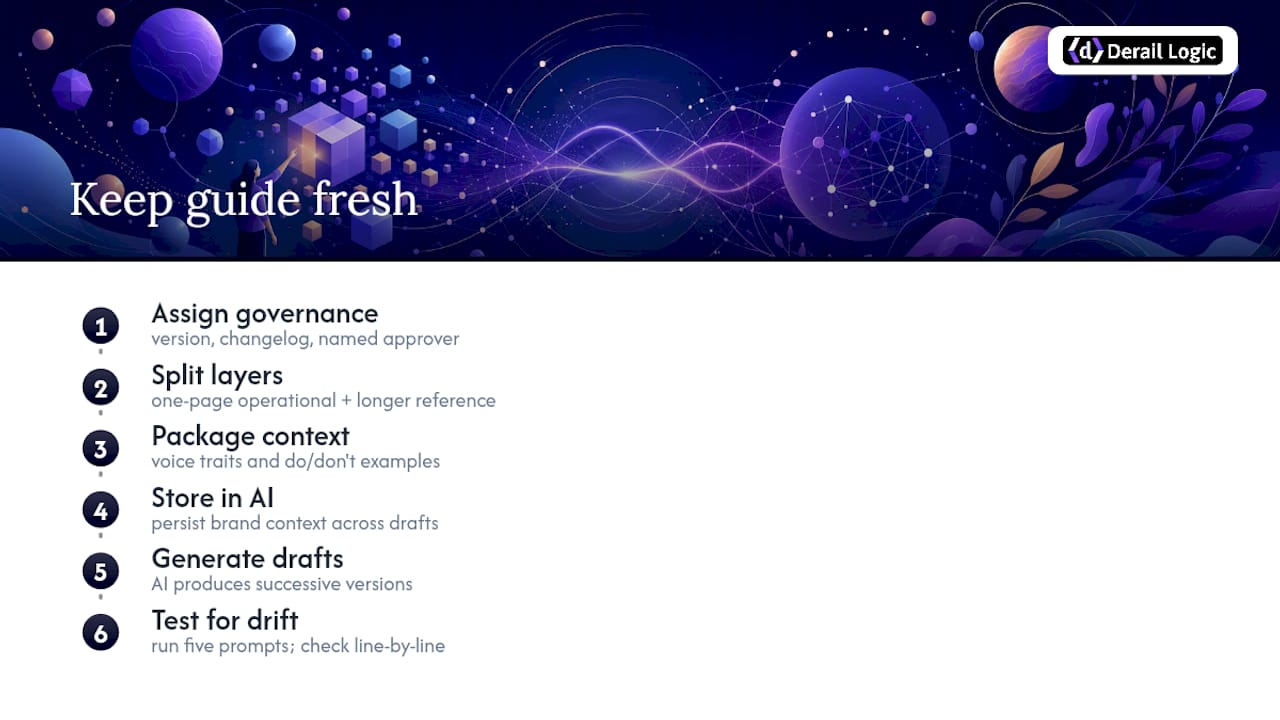
Pro Tip: Test AI output against your guide the same way you’d test a new writer: run five prompts through it, then check each result against your voice chart line by line. Drift shows up fast once you’re looking for it.
What Do Channel-Specific Rules Look Like in Practice?
Voice stays constant, but the rules that apply it need to flex by channel. A web headline and a support reply are solving different problems even when they come from the same brand.
- Web headings and CTAs: lead with the verb, keep buttons concise (e.g., “Start Your Trial” rather than a longer phrase).
- Meta descriptions: stay under roughly 155 characters and include the primary keyword once, naturally.
- Email subject lines: keep them under 50 characters; preheaders should extend the subject, not repeat it.
- Support replies: open with acknowledgment, then the fix, then next steps, in that order every time.
- Social and SMS: respect character limits and always write alt text for images, since accessibility rules apply everywhere, not just on the website.
Choosing the right format for each channel matters as much as the wording. A guide to content format types is worth a look if you’re still deciding what belongs in long-form versus quick social copy. Before anything publishes, run it against a short checklist: voice traits matched, banned terms cleared, metadata filled, alt text written.
Why Short Operational Guides Beat Long Brand Bibles
The guides that actually get used are short. A fifty-page brand bible looks impressive in a pitch deck and gets opened twice a year. A one-page voice chart with do/don’t examples gets opened before every brief, because it answers a real question in under thirty seconds.
I’d go further than most style guide advice does: build the one-pager first, and don’t let the long reference document exist until the short one is already in daily use. Teams that reverse this order end up with a beautiful document nobody reads and the same inconsistency problems they started with.
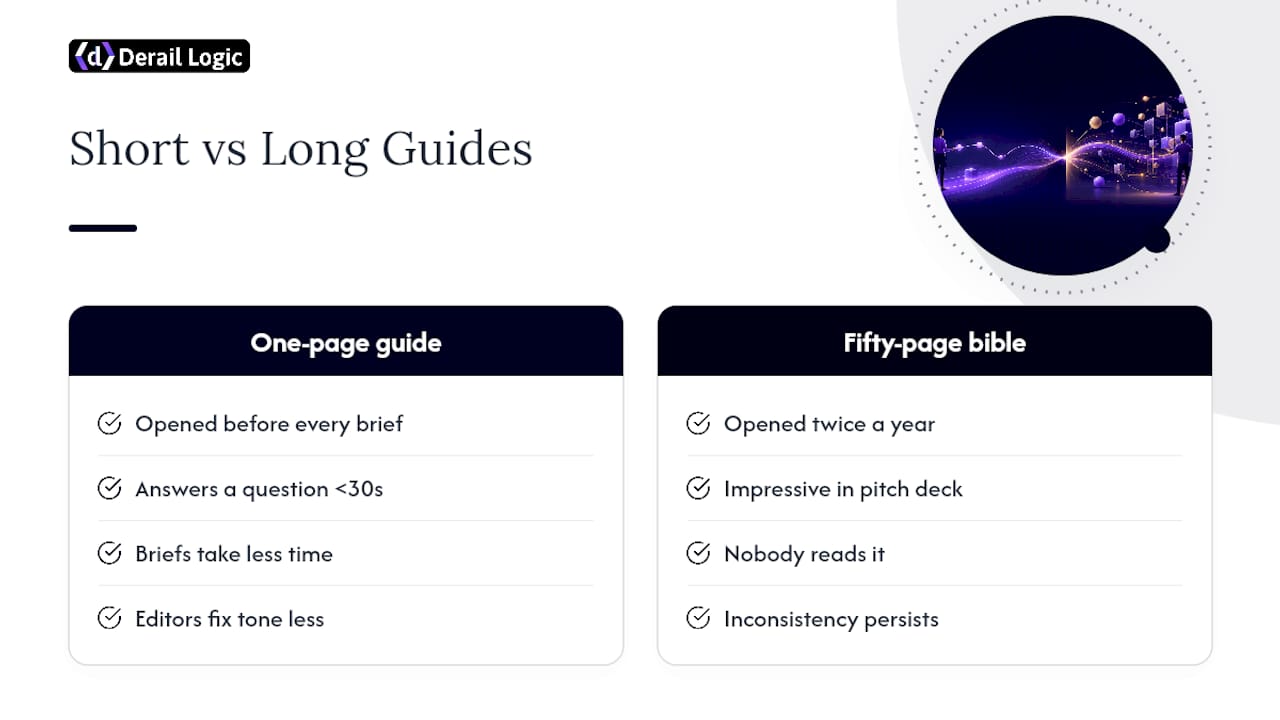
The payoff shows up in three places: briefs take less time to write because the voice traits are already defined, editors spend fewer cycles fixing tone instead of substance, and AI drafts stop sounding generic once real do/don’t examples are feeding the prompt. None of that requires a redesign or a committee. It requires one afternoon and a willingness to ship something imperfect.
Start small this week. Draft a one-page voice chart with three traits and one example each. Pilot it on your next five pieces of content before you touch anything else.
— Zachary
Where to Find More Style Guide Templates
- Microsoft Style Guide for brand voice principles.
- AMA Sample Style Guide Template for an editable starting toolkit.
- Plainlanguage for plain-word, readability guidance.
Sources
- Microsoft’s brand voice; above all, simple and human – Microsoft Style Guide
- Plain Language — Use simple words or phrases
- AMA Sample Style Guide Template
FAQ
Who Should Own a Content Style Guide?
An editor or communications lead usually owns it, backed by a small governance group with representatives from product and support to handle edge cases.
How Long Should a Content Style Guide Be?
Keep the working version to one page covering voice traits and do/don’t examples, with a longer reference document reserved for edge cases and legal language.
Should We Use AP Style or Chicago Style as a Baseline?
Either works as a foundation; pick one, document only your brand’s exceptions, and avoid inventing grammar rules from scratch.
Can AI Tools Follow a Content Style Guide?
Yes, when voice traits and examples are fed to the tool as persistent context rather than re-explained in every prompt, output stays closer to on-brand across sessions.
How Often Should We Update the Style Guide?
Review it quarterly at minimum, with a named approver for changes and a version log so writers know which rules are current.