



AI content personalization increases relevance, engagement, and conversion by matching messaging to individual behavior at a scale manual segmentation can’t match. It works best for teams with clean CRM data, a testing discipline, and patience for a pilot phase. McKinsey research on generative AI’s role in customer personalization confirms the scale gains are real. The roadmap below shows how to get there without breaking customer trust.
TL;DR:
- Effective AI personalization depends on clean, unified customer data; fragmented data significantly reduces the accuracy of predictions and content relevance.
- Pilot projects should focus on a single channel with clear success metrics and run in shadow mode for validation before fully launching live personalization.
- Common implementation mistakes include neglecting fallback content, skipping data cleaning, and not establishing rollback and measurement protocols, risking project failure.
- Privacy concerns can be mitigated through explicit customer consent, data minimization, bias audits, and transparent communication about personalization practices.
- Successful teams prioritize data hygiene over model complexity and deploy gradual rollouts, ensuring continuous monitoring and robust governance to avoid costly errors.
Table of Contents
- What Is AI Content Personalization?
- Does AI Personalization Actually Improve Business Results?
- How Does AI Personalization Actually Work?
- What Are Real Examples of AI Content Personalization?
- How Do You Roll Out AI Personalization Without Breaking Things?
- How Do You Measure Whether Personalization Is Working?
- What Are the Risks of AI Personalization?
- How Derail Logic Supports This Roadmap
- What I’ve Learned Watching Personalization Projects Succeed and Fail
- Ready to Unify Your Personalization Stack?
- Sources
- FAQ
What Is AI Content Personalization?
AI content personalization uses machine learning models to adjust messaging, offers, and layout for each customer based on their data, rather than showing everyone the same content. That’s distinct from basic segmentation, which groups customers into broad buckets like “new subscribers” or “high spenders” and serves each bucket one static version. Hyper-personalization goes further still. It combines real-time behavioral signals with predictive modeling to generate a unique experience for each individual, adjusting as their behavior changes.
Three technology categories make this possible:
- Machine learning (ML) models that predict what a specific customer wants based on patterns in historical data
- Natural language processing (NLP) that reads and interprets customer intent from text, chat, or search queries
- Generative AI that produces the actual variants, subject lines, product descriptions, or images at scale
- Recommendation systems that rank content or products by predicted relevance to an individual
The data feeding these systems falls into three buckets: behavioral (clicks, browsing, purchase history), transactional (order value, frequency, product category), and contextual (device, location, time of day, weather). According to IBM’s overview of AI personalization, this combination is what lets marketers move from generic email blasts to tailored emails, product descriptions, and video content that respond to a customer’s actual situation.
Does AI Personalization Actually Improve Business Results?
Yes, and the gap between companies that execute it well and those that don’t is widening every year. McKinsey’s research on the value of getting personalization right found that organizations executing personalization effectively grow revenue meaningfully faster than slower-moving competitors, and the businesses that lag are falling further behind rather than closing the gap.
The takeaway: personalization is no longer a nice differentiator. It’s becoming a growth lever with a widening reward for teams that get it right and a widening penalty for those that don’t.
The gains split into two timeframes:
- Immediate wins: dynamic email content that swaps subject lines and product blocks by segment, template-based landing pages, basic recommendation widgets
- Longer-term gains: omnichannel personalization that follows a customer from email to website to ads with consistent context, predictive churn prevention, and lifetime-value optimization
Generative AI is what makes the immediate wins realistic for smaller teams. Instead of writing 12 versions of an email by hand, generative AI can produce dozens of tailored variants in the time it used to take to draft one.
How Does AI Personalization Actually Work?
Three layers do the work, and understanding them helps you evaluate any platform or vendor pitch you’ll encounter.
The data layer. This is your CRM, customer data platform (CDP), and event streams from your website and app. If this layer is fragmented, meaning customer records live in five disconnected tools, no model downstream will produce accurate personalization. Garbage in, generic content out.
The model layer. This includes recommendation models that rank what to show, predictive models that forecast what a customer will do next (churn, purchase, upgrade), and generative models that write or design the actual content. These models don’t operate independently. A predictive model might flag a customer as likely to churn, and a generative model writes a retention email tailored to that specific risk.
The decisioning and orchestration layer. This decides which content variant reaches which customer, through which channel, and when. It’s the traffic controller.
Before any of this touches real customers, responsible teams run new models in apprentice or shadow mode. The model makes predictions in parallel with your existing system without acting on them, so you can compare its recommendations against what actually happened. Microsoft’s Azure AI Personalizer uses exactly this pattern to validate new personalization logic before it ever reaches a live customer, which meaningfully reduces rollout risk.
The content production pipeline itself needs structure too: base templates, generative variants layered on top, and deterministic fallbacks for when personalization data is missing or a model has low confidence.
Pro Tip: Never let a generative model write directly into a live email or page without a fallback path. If a customer’s data field is empty or a model returns nothing, your template should default to a safe, generic version rather than sending a broken or blank personalized block.
What Are Real Examples of AI Content Personalization?
These five use cases account for most of the practical value teams see in year one.
-
Dynamic email content. Subject lines, hero images, and product blocks shift based on purchase history or browsing behavior. The catch: you must test the actual rendered email a customer receives, not just the template logic, since conditional content and data-driven fields break in ways static templates never do.
-
Personalized website content and landing pages. Conditional sections show different headlines, offers, or case studies depending on visitor source, industry, or past behavior. A visitor arriving from a paid ad about inventory management sees different proof points than one arriving from an organic search about pricing.
-
Recommendation engines. Product or content suggestions ranked by predicted relevance, the same mechanism Amazon and Netflix popularized, now available to mid-size teams through commerce and CDP integrations. AWS’s personalization use cases show how these systems increasingly connect directly to CMS and commerce platforms for real-time updates.
-
Chatbots and conversational personalization. A returning customer gets a chatbot that references their order history instead of starting from zero every time. This tends to shorten resolution time and reduce the number of support tickets that escalate to a human.
-
Next-best-action in ads and retargeting. Instead of one retargeting ad shown to everyone who abandoned a cart, the system picks the message, discount level, and creative most likely to convert that specific visitor.
How Do You Roll Out AI Personalization Without Breaking Things?
Move in this order. Skipping steps is the most common reason personalization projects stall or get shut down after a bad launch.
-
Pick one high-impact pilot with one clear metric. Don’t try to personalize everything at once. Choose a single channel, like cart-abandonment emails, and define success as one number: conversion lift, revenue per email, or click-through rate.
-
Run it in apprentice or shadow mode first. Let the model generate predictions alongside your current process without acting on them, then compare accuracy before you let it touch real customers.
-
Unify your identifiers and clean your data. A customer who exists as three separate records across your CRM, email tool, and ad platform will get contradictory, broken personalization. Fix this before scaling anything.
-
Set experiment rules and governance up front. Define your holdout group size, your A/B test structure, and a QA checklist specifically for dynamic content: check links, check personalized totals, check rendering across email clients and devices.
-
Train your team and write a deployment runbook. Someone needs to own what happens when a model returns bad data or a fallback triggers. Document it before launch, not after an incident.
-
Roll out templates and automation at scale. Once the pilot clears its metric threshold, expand the same architecture to adjacent channels rather than starting over each time.
Pro Tip: Keep your first pilot’s candidate set small. A recommender trying to rank 20 to 50 message variants for a single cohort is a tractable problem you can validate quickly. A recommender trying to rank thousands of variants across every segment on day one is a research project, not a pilot.
How Do You Measure Whether Personalization Is Working?
Four KPIs matter most: engagement rate, conversion lift versus a control group, revenue per user, and retention or repeat-purchase rate. Track all four, because a lift in one without the others often signals a false positive rather than real impact.
Validation requires more than a simple before-and-after comparison:
- Holdout groups that never receive personalized content, so you have a clean baseline to measure against
- A/B tests structured around the specific variant, not the entire campaign, so you know what actually drove the lift
- Apprentice-to-production comparisons that confirm the model’s shadow-mode predictions matched real outcomes before you trust it fully
Set rollback criteria before launch, not after a problem appears. If negative signals like unsubscribe rate or complaint volume spike past a defined threshold, the system should revert to the non-personalized baseline automatically rather than waiting for someone to notice.
What Are the Risks of AI Personalization?
Privacy sits at the top of the list. Personalization that feels helpful to one customer feels invasive to another, and the difference often comes down to transparency. Research on consumer perceptions of AI-driven personalization found that effectiveness depends heavily on whether customers understand why they’re seeing specific content and whether they perceive it as genuinely useful. Skip that transparency and personalization reads as surveillance instead of service.
Practical mitigations:
- Get explicit consent for behavioral tracking and offer a visible, easy opt-out
- Practice data minimization: collect only what a specific personalization use case actually requires
- Audit models regularly for bias, since a recommendation engine trained on historical data can quietly reinforce old patterns that exclude entire customer segments
- Build deterministic fallbacks for every dynamic content block so a data gap never produces a broken link or a blank personalized field
- Monitor negative signals continuously rather than only reviewing performance monthly
Independent perspectives on AI-driven marketing’s practical tradeoffs echo the same point: the technology’s ceiling is high, but the failure modes are unglamorous. Bad data hygiene and missing fallbacks cause more damage than any model’s accuracy limits.
How Derail Logic Supports This Roadmap
Every stage above requires connected data, and that’s the core failure point for most teams attempting this alone. Derail Logic’s platform solutions unify CRM, campaign, and analytics data into one workflow instead of five disconnected tools.
- The AI Engine pulls from live business data sources to power personalization decisions grounded in your actual customer history
- Autopilot surfaces opportunities and triggers proactively, supporting the decisioning layer described above
- Content Studio handles the generative variant production for emails, landing pages, and ad copy
- Unified data reduces the identifier fragmentation that breaks personalization before it starts
What I’ve Learned Watching Personalization Projects Succeed and Fail
The teams that succeed treat data hygiene as the actual project, not a prerequisite to skip. The teams that fail treat the AI model as the hard part and the data as an afterthought. It’s backwards every time.
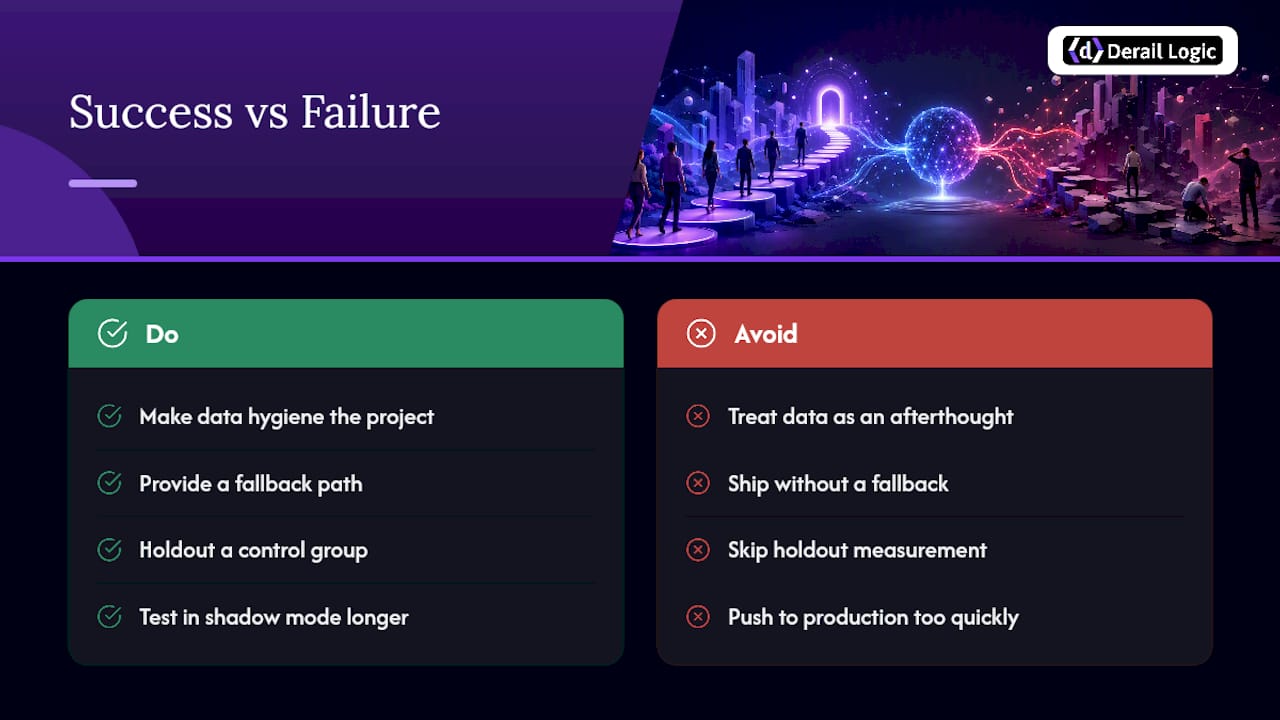
Three red flags worth pausing for: no fallback path when personalization data is missing, no holdout group to measure real lift against, and a launch plan with no rollback trigger if complaints spike. If any of those three are missing from your rollout plan, fix them before you ship.
Test in shadow mode longer than feels necessary. The instinct to rush a promising model into production is exactly what turns a good pilot into a bad launch.
— Zachary
Ready to Unify Your Personalization Stack?
Derail Logic replaces the fragmented tool stack that makes personalization risky in the first place. Instead of stitching together a CDP, a separate email tool, a recommendation engine, and a spreadsheet tracking which segment gets which variant, you get one workflow: unified customer data feeding a visual campaign studio, an AI Engine trained on your business context, and Content Studio generating the variants your pilot needs.
That consolidation matters most during the pilot phase outlined above, where fragmented data is the single biggest reason personalization projects stall before they ever reach scale. Derail Logic’s marketing automation tools let you set up your first dynamic email or landing page pilot without hand-coding conditional logic across five systems, and Autopilot flags opportunities as your data accumulates, so you’re not manually hunting for the next segment to test.
If you’re planning a pilot in the next quarter, start with a trial and map one campaign, your cart-abandonment flow or your welcome series, onto the platform before committing further.
Sources
- How gen-AI can take customer personalization to the next level — McKinsey
- AI-driven personalization: Unraveling consumer perceptions in social media engagement — ScienceDirect
- AI personalization — IBM
- Dynamic email guide for templates, personalization, and testing — MailSlurp
FAQ
How Does AI Personalize Content?
AI analyzes behavioral, transactional, and contextual data through machine learning and generative models, then produces or selects content variants (subject lines, product recommendations, page sections) matched to each customer’s predicted preferences.
What Is the 10-20-70 Rule for AI?
It’s a framework for prioritizing implementation effort, not a personalization-specific standard.
What Are the 4 D’s of Personalization?
This isn’t a standardized industry framework with one fixed definition, so treat any “4 D’s” list you encounter as one author’s shorthand rather than an established standard.
Is AI Content Personalization Worth the Investment for Smaller Marketing Teams?
Yes, particularly for immediate wins like dynamic email and templated landing pages, which require less infrastructure than full omnichannel personalization. Starting with one pilot channel, as outlined in the roadmap above, keeps the investment proportional to the team’s size.